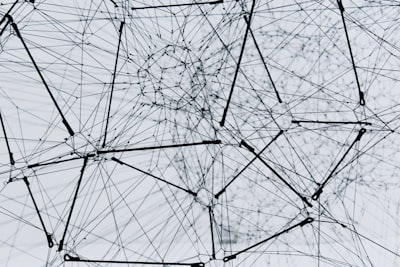
In the age of big data, the ability to align and compare complex structures has become a fundamental pillar for technological innovation. Graph matching is a technique that allows you to find correspondences between the nodes of two graphs that represent similar systems, such as social networks, biological databases or IT infrastructures. A recent advance in this field has shown that it is possible to achieve an almost exact recovery of these correspondences in an almost quadratic time, opening up new possibilities for applications on an industrial scale.
The traditional challenge of graph matching lies in its computational complexity. When two graphs are large and contain noise, finding the best alignment can require exponential resources. However, under certain statistical conditions—such as the correlation between the graphs and a controlled connection density—it is possible to design algorithms that offer guarantees of recovery at much lower costs. The new approach, based on local tree correlation tests and a range-based algorithm, achieves a runtime of approximately n^{2+o(1)} for n nodes, which is a qualitative leap compared to previous methods.
This result is not just a theoretical curiosity. In the business world, data networks often present duplicates, versions, or variations that need to be reconciled. Think of a multinational that merges its customer bases after an acquisition: the tickets may have different identifiers but represent the same person. Graph pairing solves this problem by modeling relationships between entities and looking for the optimal match. With the new algorithm, processing time is drastically reduced, allowing even datasets with millions of nodes to be aligned in hours instead of days.
The key to the new method lies in the use of subgraph correlations in the form of a tree. Instead of examining the entire structure, local patterns are analyzed that, when repeated, provide reliable clues about the identity of the nodes. The algorithm assigns ranks to candidates based on these correlations, eliminating the need for difficult-to-calculate thresholds. This robust approach is especially valuable in environments where noise and uncertainty are unavoidable, such as in social media or IoT sensors.
From a practical perspective, the implications are enormous. In cybersecurity, for example, graph pairing makes it possible to detect attack patterns in corporate networks. A legitimate communications graph can be compared to a suspicious one to identify deviations. Artificial intelligence for companies enhances this analysis, and at Q2BSTUDIO we integrate these techniques into advanced cybersecurity solutions. We combine graph matching algorithms with machine learning to provide early warnings and prevent security breaches.
Also in the area of business intelligence, graph matching makes it easier to integrate disparate data sources. A Power BI dashboard can reveal hidden relationships between customers, products, and transactions thanks to precise graph alignment. Our business intelligence services, which include the use of Power BI and visualization tools, benefit from these advancements to deliver deeper insights. For example, by pairing shopping and loyalty graphs, companies identify customer segments with similar behaviors and design personalized campaigns.
The scalability offered by the new algorithm is critical in the cloud. Many enterprises migrate their workloads to AWS and Azure cloud services, where distributed processing can take advantage of near-quadratic complexity. At Q2BSTUDIO we develop custom applications that run these algorithms on cloud infrastructures, optimizing costs and response times. The ability to match massive graphs in real-time opens the door to large-scale social media analytics, fraud detection, and recommendation systems.
In addition, the range-based technique is ideal for the creation of autonomous AI agents. An agent who must navigate multiple knowledge bases represented as graphs can use matching to correlate information and make decisions. At Q2BSTUDIO we develop AI agent frameworks that integrate this capability, allowing companies to automate complex processes such as catalog reconciliation, master data synchronization, or platform integration after mergers.
From a custom software development perspective, implementing an efficient graph matching algorithm requires a thorough understanding of the nature of the data and correlation patterns. It's not a trivial task, but the benefits in terms of accuracy and speed are worth the investment. Our team at Q2BSTUDIO is experienced in designing these solutions from scratch, adapting them to the specific needs of each client. We use open source and proprietary technologies, and we always seek the balance between performance and maintainability.
Of course, graph pairing also has applications in fields such as bioinformatics, where protein-protein interaction networks are aligned to discover new functions, or in logistics, where transport routes are compared to optimize fleets. In all these cases, the ability to achieve an almost exact recovery in almost quadratic time marks a before and after. Researchers continue to refine these algorithms, but there are already practical implementations that companies can adopt.
In short, the new approach to graph matching represents a milestone in data science. Its efficiency makes it possible to address problems that were previously unfeasible, from aligning giant social networks to integrating complex business data. At Q2BSTUDIO, we combine these advances with our expertise in custom software, artificial intelligence, cybersecurity, AWS and Azure cloud services, and business intelligence to deliver end-to-end solutions. If your business handles complex relational data and needs to align graphs accurately, contact us. We are prepared to transform that challenge into a competitive advantage.