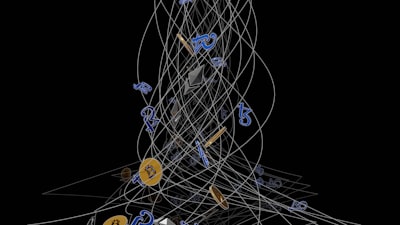
In the fast-paced world of artificial intelligence, the optimization of probabilistic models has become a fundamental pillar to achieve more accurate and robust systems. One of the most recent and fascinating advances in this field is the application of Wasserstein geometry to the learning of variational inferences. In particular, the development of the Bures-Wasserstein importance-weighted evidentiary lower bound represents a convergence of mathematical theory and practical applications that is transforming the way companies approach complex data analytics and machine learning problems.
To understand its relevance, we must first remember that variational inference is a technique that allows complex probability distributions to be approximated by means of more manageable distributions, such as Gaussian distributions. Traditionally, the optimization of these approximations was carried out in Euclidean space, which presented significant limitations: the gradients lost strength as the number of important samples increased, causing a drop in the signal-to-noise ratio. This resulted in slow training processes and a tendency to get caught up in unrepresentative local modes.
The key innovation lies in reformulating the problem in the Bures-Wasserstein space, a geometric manifold that endows the set of Gaussian distributions with a metric from optimal transport. In doing so, the gradients acquire remarkably stable properties: the signal-to-noise ratio scales favorably with the number of samples, ensuring efficient optimization even when many points of importance are used. This discovery, backed by rigorous theoretical analyses, not only improves the performance of generative models such as importance-weighted variational autoencoders, but opens the door to high-impact enterprise applications.
At Q2BSTUDIO, we understand that cutting-edge technology must be translated into concrete solutions for our customers. That's why we're incorporating these advanced principles into our enterprise AI offerings. The ability to train more stable and accurate models allows, for example, to improve recommendation systems, detect anomalies in real time or enhance data-driven decision-making. In addition, the robustness of gradients in curved spaces is especially relevant when working with high-dimensional data, a common scenario in corporate environments where information is abundant but the quality of the modeling is critical.
From a practical perspective, imagine a company that needs to segment customers with complex behavior patterns. A variational model trained with the Bures-Wasserstein bound can better capture uncertainties and nonlinear relationships, offering sharper and more actionable clusters. This becomes even more powerful when combined with applications as they integrate these algorithms into existing workflows. At Q2BSTUDIO we develop custom software that incorporates state-of-the-art artificial intelligence, adapting to the specific needs of each business, whether in the financial, logistics or healthcare sectors.
Another fundamental aspect is optimization in cloud environments. Stable gradients allow compute to be distributed efficiently, taking full advantage of the AWS and Azure cloud service infrastructure. At Q2BSTUDIO we integrate these cloud services to scale variational inference models without compromising speed or accuracy. In addition, data security is a priority; That's why our solutions include robust cybersecurity measures that protect both models and the sensitive information they handle.
Artificial intelligence does not operate in a vacuum: it needs processed data and visualizations that allow business teams to interpret the results. This is where business intelligence comes into play. With tools such as power BI, we can connect the outputs of variational models to interactive dashboards, making it easier for managers and analysts to make informed decisions. At Q2BSTUDIO we offer business intelligence services that close the loop from advanced modeling to business action.
We cannot ignore the growing trend towards intelligent automation. The AI agents we develop at Q2BSTUDIO directly benefit from these improvements in inference. For example, a conversational agent can better calibrate its responses if its probabilistic core has been optimized with high-stability methods such as the one discussed here. The combination of AI for businesses and freelance agents is redefining operational efficiency in industries such as e-commerce and customer service.
Looking to the future, Wasserstein's space research and its variational applications promises even more developments. The ability to handle multimodal distributions with reliable gradients is crucial for areas such as reinforcement learning, simulation of physical systems, or generation of synthetic content. At Q2BSTUDIO we closely monitor these trends to incorporate them into our custom application projects, ensuring that our customers are always at the forefront of technology.
In short, Bures-Wasserstein's importance-weighted evidentiary lower bound is not just an academic breakthrough: it is a practical tool that can improve the quality of AI models and, therefore, the value that companies derive from their data. At Q2BSTUDIO, we turn these complex concepts into real solutions, from custom software development to integration into cloud infrastructures. If your organization is looking to make the leap towards more robust and efficient models, we invite you to explore how we can collaborate.