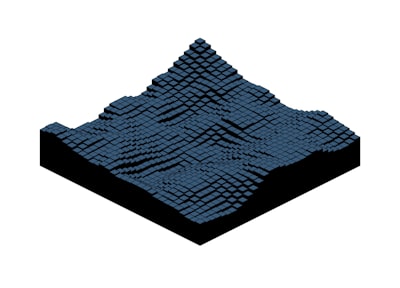
Geological exploration using electromagnetic (EM) methods has revolutionized the ability to detect underground resources without the need for invasive drilling. However, the processing of the data obtained is still a task that consumes enormous human and computational resources. In this context, artificial intelligence emerges as a transformative tool, capable of accelerating analysis and improving the accuracy of interpretations. But the success of deep learning models depends critically on the quality and diversity of the training datasets. Until now, most of the available datasets were based on simplified models in one or two dimensions, far removed from the real complexity of the subsurface. OpenEM comes to fill that gap: a massive three-dimensional dataset that groups nine categories of geoelectrical models, from anomalous bodies in semispace to folded layers, curved faults and their variants. Not only does this resource provide a unified basis for research, but it also includes a controllable 3D model generator, allowing the dataset to be expanded flexibly and extensibly. The public release of OpenEM on Zenodo marks a milestone for the scientific and technical community, as it removes one of the main barriers to the application of artificial intelligence techniques for companies in the field of geophysics.
From a business and technology development perspective, creating datasets like OpenEM not only boosts academic research, but opens the door to high-value business applications. Companies engaged in hydrocarbon, mineral or groundwater exploration can now train deep learning models with realistic data, reducing interpretation times from weeks to hours. This translates into a significant competitive advantage. However, to realize the full potential of this data, a robust technology infrastructure is required. This is where companies like Q2BSTUDIO offer bespoke applications that integrate AI models with existing workflows. For example, a custom software system could consume the OpenEM dataset, apply AI agents for automatic detection of geological structures, and visualize the results in interactive Power BI dashboards. In addition, the implementation of these systems in the cloud, using AWS and Azure cloud services, guarantees scalability and accessibility from anywhere in the world. Cybersecurity also plays a crucial role, especially when the browsing data is sensitive. A comprehensive approach that combines business intelligence with cloud solutions ensures that companies can fully exploit the value of data without compromising its security.
The differential value of OpenEM lies not only in its scale, but also in its generalization-oriented design. Previous models were often random or too simple, causing algorithms to learn artificial patterns not found in nature. OpenEM incorporates geologically plausible structures, such as flat, folded layers, curved faults, and intrusive bodies. This allows artificial intelligence systems trained on this dataset to have a much more realistic prediction capacity. For a company looking to implement these capabilities, having a technology partner that understands both geoscience and software engineering is critical. Q2BSTUDIO offers precisely that combination: from designing data pipelines to deploying machine learning models in production environments. For example, a project might start with generating additional synthetic models using OpenEM's 3D generator, then train convolutional neural networks to segment EM images, and finally deploy the model as a cloud service with AI agents that automate continuous analysis. All this is supported by business intelligence services that provide dashboards in Power BI for the monitoring of key metrics.
OpenEM's publication is a clear example of how collaboration between academia and industry can generate tools that accelerate the adoption of advanced technologies. However, the path from a public dataset to a fully operational enterprise solution requires overcoming several challenges: integration with legacy systems, managing big data, quality assurance of input data, and interpreting results in real time. Companies wishing to take this step need a structured approach that includes everything from initial consulting to ongoing support. Q2BSTUDIO is positioned as an ally in this transformation, offering services ranging from custom software development to process automation with artificial intelligence. For example, a mineral exploration company could commission a system that uses the OpenEM dataset to generate early warnings of potential deposits, integrating real-time sensor data and visualizing the predictions in Power BI dashboards. Cybersecurity is guaranteed through pentesting protocols and secure architectures on AWS or Azure. In the end, the goal is for the technology to be not only innovative, but really useful and applicable in the day-to-day operations.
In an increasingly competitive market, the ability to extract knowledge from geophysical data quickly and accurately can make the difference between a profitable project and one that is not. OpenEM provides a fundamental pillar for the development of more robust deep learning algorithms, but it is only the first step. Effective implementation requires an entire technology ecosystem: from data acquisition and cleansing to modeling, deployment, and monitoring. Artificial intelligence solutions for enterprises, combined with cloud services and business intelligence tools, allow you to build platforms that learn and improve with each new piece of data. Q2BSTUDIO, with his expertise in custom application development and systems integration, is poised to help organizations navigate this complexity. Whether it's optimizing the interpretation of EM data using AI agents or building advanced dashboards in Power BI, the goal is the same: to turn scientific innovation into tangible value. OpenEM is an open resource, but its true potential is unlocked when combined with the right software engineering and a sound business strategy. We invite industry professionals to explore these possibilities and contact us to discuss how we can collaborate on their next project.