
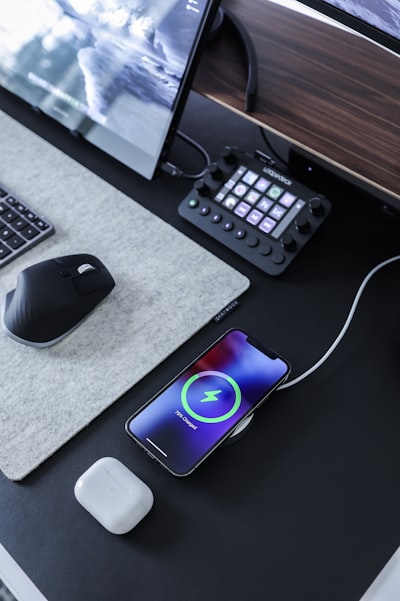
A few months ago, in the middle of a move and with the desk full of cables, I had to improvise. My monitor, work mini PC, and laptop charger all shared the same plug, and when I plugged in the third device, the differential tripped. Among the drawers I found a 65W USB-C charger, the same one I used for my phone. For testing, I connected it to the mini PC that supports Power Delivery. To my surprise, it not only turned on, but ran Node.js builds and a local database without stuttering. That day I understood that the industry is migrating towards a standard that promises to simplify our lives: leaving behind bulky barrel transformers and opting for a single cable that powers everything from mobile phones to desktops.
USB Power Delivery (USB-PD) technology isn't new, but its adoption in desktops has been slow. Manufacturers like GEEKOM are leading the charge by integrating USB-C charging ports into their mini PCs, but the concept goes much further. Powering a desktop computer with a mobile charger is no longer a rarity when we understand that the maximum power of USB-PD reaches 240 W in its latest specification (USB-PD 3.1). This covers the needs of most office equipment, lightweight servers, and energy-efficient workstations. The key is in the intelligent negotiation of voltage and current: the device and the charger agree on the most efficient profile, avoiding overheating and losses.
Why should we care about this in a business or software development environment? Because standardization reduces logistics costs, simplifies team management and opens the door to more modular architectures. At Q2BSTUDIO, as a software and technology development company, we've seen many of our customers look to optimize their infrastructures with bespoke applications running on compact, efficient hardware. A USB-C-powered mini PC can act as an edge server to process data from IoT sensors or as a node for a network of AI agents that make decisions in real time. Portability and low energy footprint allow solutions to be deployed in remote environments without relying on specialized power supplies.
From a technical perspective, the transition to USB-C charging forces us to rethink the design of internal power supplies. Today's motherboards integrate charge controllers that dynamically manage power. For example, a computer that previously consumed 90W with a barrel charger can now operate with a 65W USB-C adapter as long as simultaneous peak charging is not required. This efficiency translates into less heat, lower fan noise, and longer component life. In addition, by eliminating proprietary connectors, it is easier to replace lost chargers: any USB-C charger of sufficient power will do, even the latest generation with support for fast smartphone charging.
But the real qualitative leap comes when we combine this universal power supply with the cloud ecosystem. Imagine a workstation that, instead of a tower PC, uses a USB-C-powered mini PC that syncs with AWS and Azure cloud services. The user can disconnect their computer, take it to a meeting, plug it into a USB-C monitor with an integrated hub, and continue working without losing connection to centralized databases. For companies developing custom software, this flexibility streamlines development and testing cycles, as environments can be replicated on any desktop without complex configurations.
Cybersecurity also benefits from this standardization. USB-C ports with Power Delivery include authentication and data encryption mechanisms that reduce the risk of charger tampering attacks (such as the famous 'juice jacking'). At Q2BSTUDIO we offer cybersecurity services that audit not only applications, but also physical infrastructure. By recommending equipment with USB-C PD ports, we reduce the attack surface by eliminating legacy connectors and ensuring that power meets international standards. This is especially relevant when deploying AI agents in industrial environments, where a power failure could compromise data integrity.
Another area of impact is business intelligence. USB-C powered computers can function as distributed computing nodes to process large volumes of data in real time. With Power BI increasingly present in organizations, having hardware capable of updating dashboards without relying on oversized stations is a competitive advantage. At Q2BSTUDIO we design architectures that integrate business intelligence services with efficient energy sources, achieving a balance between performance and operational cost. In addition, the portability of these systems allows consulting teams to bring their own analytics environment to the customer's premises without the need to install temporary servers.
However, not everything is perfect. The mass adoption of USB-C as a universal power standard faces resistance: peripheral manufacturers, incompatibilities with older versions of USB-PD, and the need for certified cables for high power. However, the trend is clear. The European Union has already legislated for all portable electronic devices to use USB-C starting in 2025, and desktops will be no exception. Companies that anticipate this change will be able to renew their technology park with more versatile and sustainable equipment.
In our experience in Q2BSTUDIO, we have helped startups and corporations migrate their infrastructures to more efficient models, either through AWS and Azure cloud services or by developing custom applications running on modern hardware. USB-C power is just one piece of the puzzle, but it represents a cultural shift: letting go of the idea that a desktop needs a dedicated power supply. Today, a mobile charger can bring an entire workstation to life. And the best part is that, in doing so, we reduce reliance on proprietary connectors and embrace an ecosystem where energy flows clean, efficient, and universal.
So the next time you travel with your laptop and USB-C charger, remember that that same block can power a desktop PC, a monitor, a console, or even a development server. The energy revolution in computing is not in larger batteries, but in the standardization of power delivery. And at Q2BSTUDIO, where we combine artificial intelligence with AI for companies to create customized solutions, we see this convergence as an opportunity to design smarter, more sustainable and future-proof systems.
In short, powering your desktop PC with a mobile charger is no longer a camping anecdote – it's a strategic decision that can transform the way we work, develop and consume technology. And if you want to take that step with guarantees, having a technological ally that understands both hardware and custom software is the best investment. At Q2BSTUDIO we are ready to accompany you on that journey.
