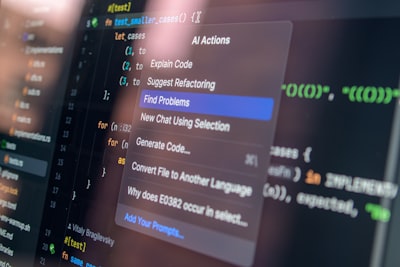
Artificial intelligence applied to code review has gone from being a technical curiosity to becoming an increasingly present tool in development workflows. However, most current implementations focus on a narrow approach: analyzing only the diff of the pull request. This method, while useful for detecting syntactic or stylistic errors, leaves out the most important element: the intent behind the change. At Q2BSTUDIO, as a company specializing in artificial intelligence for enterprises, we know that the true potential of AI agents is not in the model itself, but in the quality of the context provided to it. Language models are fast becoming a commodity: cheaper and more capable versions appear every few months, and the difference between the best and the next is narrowing. What really differentiates one team from another is their ability to feed those models with relevant information: the task ticket, the associated epic, the technical documentation and, above all, the 'why' of each change.
Code review fatigue is a silent but costly problem. On many computers, a large portion of pull requests receive an almost automatic go-ahead: trivial changes, configuration adjustments, minor versions. That superficial review, while leaving a green mark, consumes attention and energy that is then missing when critical migration or sensitive change arrives. The solution is not to ask developers to read everything with the same level of depth, but to intelligently classify risk. A well-designed AI agent can determine if a change is safe to pass through an automated lane or if it requires human intervention. This segmentation has no middle ground: either it is safe or it is not. In Q2BSTUDIO, when we develop custom applications, we apply the same principle: separate the critical from the routine to optimize resources.
The differential value, however, is in the agent's ability to read the full context before parsing the code. An agent that only examines the diff can tell you if the code works, but not if it solves the correct problem. The real test of a good reviewer is not to find syntactic bugs, but to detect deviations of intent: clean, well-written code that passes all the tests but implements something that the ticket never asked for. That's what no linter or any traditional tool can catch. To achieve this, the agent must integrate information from Jira, epics, design documents, and even previous comments into the PR itself. Only then can it issue a review that not only points out problems, but also knows how to shut up when there is nothing relevant to add, avoiding the noise that often leads developers to ignore automatic suggestions.
Practical experience shows that this approach produces tangible results. In real-world tests, context-trained agents have detected errors that would have gone unnoticed until weeks later, such as holes in tools designed precisely to prevent dangerous changes. In addition, they learn to collaborate with other bots instead of repeating their findings, reading the environment and avoiding redundancies. While detecting deviations of intent is still the holy grail and early results don't always show that kind of success, the simple fact that the team makes fewer such mistakes already indicates that the process is working. At Q2BSTUDIO, we integrate these principles into our AWS and Azure cloud service developments, where intelligent automation reduces operational burden without sacrificing security.
Looking ahead, the key will not be in the AI model, but in the data that feeds it. Each team has its own context, its own business logic, its own conventions. Whoever invests in capturing, structuring and connecting that information will be the one who obtains the competitive advantage. At Q2BSTUDIO, we offer business intelligence services with Power BI and AI agents designed to understand each customer's business, because we know that the real value is in customizing the technology, not in using the same recipe for everyone. Cybersecurity, for example, benefits greatly from this approach: an agent that understands context can detect not only vulnerabilities in the code, but also deviations in authorization logic or in the handling of sensitive data, something that a static analysis would not achieve. In the end, artificial intelligence for companies is not a product that is bought, but a process that is built, and in that construction, context is king.