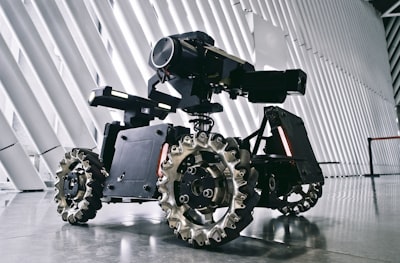
In the fast-paced world of robotics and artificial intelligence, each new advancement redefines what we consider possible. Recently, Mistral AI has unveiled a model that promises to be a game-changer in autonomous navigation: Robostral Navigate. Designed specifically for physical robot navigation, this system accomplishes something that until recently seemed reserved for multi-sensor setups: navigating complex environments using only a standard RGB camera, without the need for lidar, depth sensors, or stereoscopic cameras. This milestone opens doors to more accessible, economical and scalable applications for industry and services.
To understand the real impact of Robostral Navigate, it is worth first analyzing the technical context. Traditional robotic navigation systems (known as Vision-Language Navigation or VLN) often rely on expensive sensors to calculate distances and avoid obstacles. Robostral Navigate, on the other hand, employs a technique called 'pointing': the model predicts the pixel coordinates in the current image where the robot should move, along with the desired orientation when it arrives. If the lens is out of the field of view, it uses local shifts in relative coordinates. This approach not only reduces the hardware required, but is robust against changes in camera scaling and calibration. With a size of 8 billion parameters, the model has been trained from scratch – not on the basis of open source VLM models – and has achieved a 76.6% success rate in the R2R-CE benchmark (validation in unseen environments) using only an RGB camera, outperforming even systems that use multiple sensors.
Behind this achievement are very interesting design decisions. For training, Mistral AI generated approximately 400,000 simulated trajectories in 6,000 different scenes. But the most innovative is its computational efficiency strategy: using a prefix-caching algorithm and a tree-based attention mask, an entire browsing episode is compressed into a single sequence. This allows all temporary steps to be processed in a single forward pass, reducing training tokens by a factor of 22. What used to take months is now completed in days. In addition, after supervised training, they applied an online reinforcement algorithm called CISPO, which allows the model to learn from its own mistakes and improve the success rate by an additional 3.2%. This combination of techniques positions Robostral Navigate as a solid step toward unified robotic agents.
The practical implications are enormous. Let's imagine a logistics warehouse where a robot on wheels must transport packages between stations following natural language instructions such as 'go to aisle 3, turn right and leave the box at station 5'. Or a robot guide in a hospital that accompanies a patient from reception to the consultation. Robostral Navigate can execute entire tasks with a single command, moving through living spaces with people and obstacles you've never seen before. In addition, the model is compatible with robots of different types: with wheels, legs or even flyers, and adapts to different camera calibrations without the need for retraining. This makes it a versatile solution for heterogeneous fleets.
From a business perspective, this breakthrough underscores a key trend: the convergence between large-scale language models (LLMs) and robotics. Increasingly, artificial intelligence is moving from being a digital assistant to becoming a physical actor in the real world. For companies looking to integrate these capabilities into their operations, having a technology partner that understands both the algorithmic side and the practical implementation is critical. At Q2BSTUDIO, as a software and technology development company, we offer services ranging from AI for businesses to the creation of custom AI agents that interact with robotic or digital systems. Our expertise in custom applications allows solutions such as Robostral Navigate to be adapted to specific environments, whether in logistics, manufacturing or customer service.
However, the adoption of these technologies is not without its challenges. Cybersecurity becomes critical when robots operate in spaces shared with humans; A cyberattack that diverts a robot's navigation could have serious consequences. That's why at Q2BSTUDIO we integrate cybersecurity practices into our projects, including pentesting audits for robotic systems and control platforms. We also offer AWS and Azure cloud services to deploy and scale AI models securely and efficiently, as well as business intelligence services with Power BI to monitor the performance of robotic fleets and optimize routes in real time. The combination of intelligent navigation with data analytics allows companies to make decisions based on concrete information, reducing costs and improving productivity.
One aspect that deserves special attention is Robostral Navigate's approach to training. As it is a model built 'from the ground up', it does not depend on previous architectures that could have biases or limitations. This makes it particularly attractive for bespoke applications where very specific behaviour is required. For example, a manufacturing company might want a robot to move between machines following non-standardized routes, with instructions in their own technical language. At Q2BSTUDIO we develop custom software that integrates navigation models like this with ERP, MES or inventory control systems, creating automated workflows that really add value. Our team of engineers works closely with customers to define use cases, select the most appropriate cloud infrastructure, and ensure the solution is scalable and maintainable.
In addition, the training efficiency of Robostral Navigate (22x reduction in tokens) has a direct implication on costs. For SMBs and mid-sized enterprises, the computational cost of training AI models can be prohibitive. However, prefix-caching and hierarchical attention techniques demonstrate that it is possible to optimize the use of resources without sacrificing performance. At Q2BSTUDIO we help organizations implement these optimizations in their AI pipelines, either using managed cloud services or deploying on-premises clusters. We also offer consulting services to evaluate the feasibility of AI-assisted robotics projects, analyzing the return on investment and designing proofs of concept.
Beyond the technique, the appearance of Robostral Navigate marks a turning point in the democratization of autonomous robotics. By eliminating reliance on expensive sensors, the barrier to entry is lowered for companies that until now could not afford robotic fleets. Mistral AI's model is open source and available for the community to adapt. This encourages collaborative innovation: startups, universities, and R+D departments can experiment and build on it. At Q2BSTUDIO we are excited about this trend, as it aligns with our philosophy of offering accessible and efficient technological solutions. We collaborate with our customers to integrate models such as Robostral Navigate into modular software architectures, enabling upgrades without disrupting operations.
Finally, it is worth reflecting on the future of human-machine interaction. For a robot to understand a natural language instruction and execute it from start to finish without additional human intervention is the dream of intelligent automation. But to get there, you need not only a good navigation model, but also robust communication, security, and data analysis systems. At Q2BSTUDIO we combine all these disciplines: artificial intelligence, custom application development, AWS and Azure cloud services, cybersecurity and business intelligence with power BI. Our goal is for every company to be able to harness the potential of robotics and AI without having to reinvent the wheel. If you are considering how to apply these advances in your organization, we invite you to explore our solutions and contact us to discuss your project. The path to autonomous navigation is clearer than ever, and with the right partners, any business can navigate it successfully.