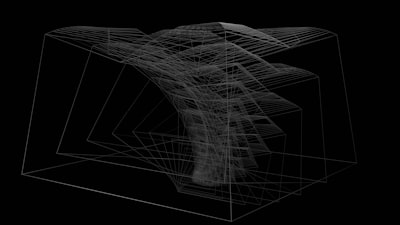
The search for forms in tensegritic structures represents one of the most fascinating challenges of modern structural mechanics. These configurations, based on the balance between compression and traction, demand robust numerical methods that reconcile geometry, forces, and stability constraints. Traditionally, engineers relied on iterative algorithms and total potential energy formulations, but the nonlinear coupling between shape and load made processes slow and sensitive to noise. However, the integration of machine learning techniques is transforming this landscape, making it possible not only to find equilibrium configurations, but also to predict physical properties such as internal forces and force densities. This approach, which we could call 'energy-based form-finding', incorporates the minimization of potential energy and constitutive relationships directly into model training, ensuring physical consistency, robustness against outliers and remarkable data efficiency. In this article, we'll explore how this methodology can be applied to clustered tensegristic systems, from prisms to landers, and how technology companies can leverage it to develop high-value simulation tools.
Tensegrity, a term coined by Buckminster Fuller, describes self-stable structures composed of rigid compression elements (bars) and pull cables. Its appeal lies in its lightness, the ability to deploy and structural efficiency. However, finding the equilibrium geometry, i.e. the 'shape' that satisfies the boundary conditions and internal preloads, is an inverse problem with multiple local solutions. Classic methods such as dynamic relaxation or the force density method require manual adjustments and converge slowly when structures are grouped or scaled. This is where artificial intelligence offers an alternative: by training neural networks with energy-based physical losses, the nodal configuration and forces on each member can be simultaneously predicted, drastically reducing computation time and improving accuracy.
The framework proposed in recent work, which we can call 'energy-based learning for form-finding', rests on two pillars: first, the loss function includes the total potential energy of the system, so that the model learns to minimize it directly. Second, constitutive relationships (e.g., Hooke's law for cables) are imposed as soft constraints on training. This generates a model that not only reproduces known configurations, but generalizes to new topologies and load conditions. For clustered structures, such as prismatic systems or landers, the ability to scale is crucial: a single trained model can predict shapes for different numbers of bars and wires, as long as the clustering logic is maintained. This opens doors to real-time optimization of architectural designs or spatial deployment systems.
From a business perspective, implementing these types of solutions requires a robust technology ecosystem. Companies that offer custom applications can integrate energy-based form-finding models into parametric design platforms, allowing engineers and architects to explore optimal configurations without relying on expensive physical prototypes. For example, custom software could incorporate a tensegritic shape prediction module that, fed with sensor data or project specifications, returns balance geometry and internal forces. This not only speeds up the design, but also reduces the risk of structural failures.
In addition, artificial intelligence plays a central role in this process. Physically-lossy deep learning models are a clear example of AI for companies looking to solve complex simulation problems. At Q2BSTUDIO, we develop custom AI agents that can learn the laws of physics from limited data, and integrate them into engineering workflows. These agents can be trained with previous numerical simulations or experimental data, and then deployed in production environments to assist in decision-making. The key is in architecture: networks that respect principles such as energy conservation or geometric symmetry, ensuring that predictions are physically plausible even outside the training domain.
The infrastructure required to run these models also deserves attention. Intensive training requires scalable computing power, and this is where AWS and Azure cloud services come in. Companies like Q2BSTUDIO offer AWS and Azure cloud services to orchestrate GPU clusters, manage data pipelines, and deploy models as APIs. For example, a form-finding model can be trained in AWS SageMaker using P4 instances, and then serve real-time inferences from Azure Functions, ensuring low latency for interactive design applications. The combination of hybrid clouds also makes it possible to meet cybersecurity requirements by encrypting sensitive project data.
Another critical aspect is integration with business intelligence service systems. Once the tensegritic configurations are obtained, force and displacement data can be visualized using power bi for engineering teams to make informed decisions. For example, a dashboard in Power BI could show the sensitivity of the shape to variations in cable preloads, helping to identify robust configurations. Q2BSTUDIO designs business intelligence services solutions that directly connect simulation results with executive dashboards, facilitating communication between technicians and managers.
The potential of this technology goes beyond civil or aerospace engineering. In soft robotics, tensegritic structures are used to create flexible and resilient actuators. An energy-based model could predict deformation under external loads, enabling closed-loop control of tensegritic robots. In architecture, tensegrity-based deployable pavilions require finding forms that balance aesthetics and stability. And in the entertainment industry, structures for stages or art installations can be quickly optimized with these tools. In all these cases, having a technology partner that offers tailor-made applications and AI for companies makes the difference between a conceptual project and a viable product.
Importantly, the energy-based learning approach also addresses robustness issues. Experimental data often contains noise due to measurement errors or manufacturing tolerances. By including potential energy as loss, the model learns to filter out inconsistencies, as any deviation from the equilibrium setting would increase energy. This makes the method especially useful for structural health monitoring: sensors can be installed in an existing tensile structure and fed the model with noisy readings, obtaining a reliable estimate of the actual forces and detecting potential damage.
From a computational point of view, the implementation of these models requires a modern technological stack. Python with libraries such as TensorFlow or PyTorch is the standard, but integration with structural calculation environments such as ANSYS or COMSOL can be achieved through custom APIs. Q2BSTUDIO specializes in building bridges between academic research and industry, developing custom software that encapsulates complex algorithms in user-friendly interfaces. For example, a plugin for Rhino or Grasshopper that, when selecting a network of nodes and cables, runs a power-based form-finding model and returns the optimized geometry. This democratizes access to advanced techniques without requiring the user to be an expert in machine learning.
Scalability is another differentiating factor. Traditional form-finding methods, such as dynamic relaxation, have an O(n^2) complexity or higher, making them prohibitive for structures with thousands of nodes. In contrast, neural network-based models, once trained, can evaluate configurations in milliseconds, regardless of size, as long as the architecture is appropriate (e.g., using convolutional networks on graphs to capture topology). This allows thousands of design variants to be explored in a single time that previously took a single analysis. On engineering projects with tight deadlines, this speed is a key enabler.
Finally, we cannot ignore the regulatory and quality aspect. In sectors such as construction or aeronautics, any simulation tool must comply with validation and verification regulations. Energy-based AI models offer an advantage: because they are guided by physical laws, their predictions are interpretable and auditable. Q2BSTUDIO collaborates with certification teams to document the training process and model accuracy, using cybersecurity to protect intellectual property, and AWS and Azure cloud services to ensure data traceability. The combination of scientific rigor and technological flexibility is what makes these solutions adoptable in industrial environments.
In conclusion, the search for tensegritic shapes grouped with energy represents a significant advance at the intersection between structural mechanics and artificial intelligence. By integrating potential energy minimization and constitutive relationships into model training, a robust, scalable, and physically consistent tool is achieved. Companies like Q2BSTUDIO are prepared to accompany organizations in the adoption of these technologies, whether through the development of custom applications, the implementation of AI agents or the orchestration of cloud infrastructure. The future of structural design is smart, data-driven, and respectful of the laws of physics. And tensegrity, with its mathematical elegance, is the perfect field to demonstrate this.