
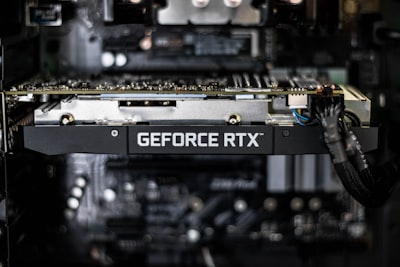
The semiconductor industry is not stopping, and the race to offer greater bandwidth is advancing at a dizzying pace. Development of PCIe Gen7 is already underway, promising to double the speed of its predecessor, while Nvidia Storage Next gains prominence as a strategic solution for handling growing volumes of data in AI and high-performance computing environments. This article discusses the technical and business implications of these innovations, and how companies can prepare to take advantage of them with the support of tailored software solutions.
The evolution of PCI Express has been constant. From the first generation to the sixth generation, each step has multiplied the transfer rate, allowing graphics cards, SSDs, and network devices to communicate data more efficiently. With PCIe Gen7, speeds of up to 128 GT/s (gigatransfers per second) per lane are expected, which translates to a bidirectional bandwidth of more than 500 GB/s in an x16 configuration. This is critical for applications that demand ultra-low latencies and sustained performance, such as deep learning model training or scientific simulation.
At the same time, Nvidia has reinforced its commitment to storage with Storage Next, an architecture that decouples computing from storage through high-speed networks, using standards such as NVMe-oF (NVMe over Fabrics). This solution allows multiple GPUs to access massive data sets without bottlenecks, streamlining AI workflows. The combination of PCIe Gen7 and Storage Next is a quantum leap for data centers that process petabytes of information.
From a business perspective, this technology convergence opens up opportunities to develop more robust AWS and Azure cloud services , capable of delivering high-performance storage on demand. Organizations looking to scale their AI operations need flexible infrastructures, and this is where an enterprise approach to AI can make a difference. Integrating AI agents that manage the allocation of storage and compute resources in real time is a growing trend, requiring tailored software platforms that are tailored to specific workloads.
Cybersecurity also plays a critical role. With higher transfer speeds, the risks of data interception increase; That's why modern storage solutions must incorporate end-to-end encryption and granular access controls. Companies deploying PCIe Gen7 and Storage Next-based systems should consider pentesting and auditing services to ensure the integrity of their sensitive data. At Q2BSTUDIO, we offer security assessments that complement any infrastructure deployment.
Another relevant aspect is business intelligence. Massive data streams generated by AI applications require powerful analytical tools to extract value. Power BI, integrated with high-performance data warehouses, allows you to visualize operational metrics in real time. To do this, companies can turn to customized business intelligence services, designed to connect heterogeneous sources and offer actionable dashboards.
The transition to PCIe Gen7 will not be immediate; The first products are expected to arrive around 2025 or 2026. However, organizations that start planning their technology roadmap now will be better positioned. Adopting applications as they take advantage of these new storage and compute capabilities can provide a significant competitive advantage. From optimizing machine learning processes to automating tasks with AI agents, the software ecosystem must evolve at the same pace as hardware.
In conclusion, the combination of PCIe Gen7 and Nvidia Storage Next marks a milestone in the evolution of data centers. Companies that invest in custom software, cloud services, and AI solutions will be better prepared to meet the challenges of the next decade. At Q2BSTUDIO we accompany this process, offering custom software development, integration into public clouds such as AWS and Azure, and cybersecurity and business intelligence consulting. Preparation begins today.
