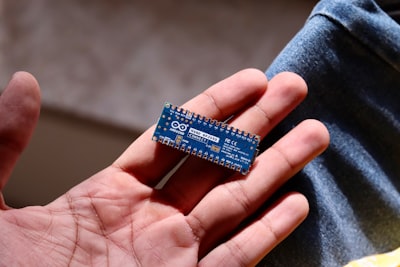
In the world of electronics and prototype development, miniaturization has been a constant driving innovation. It is increasingly common to find components that reduce their size without sacrificing functionality, opening the door to previously unthinkable applications. In this context, a landmark device has emerged: the smallest Arduino-compatible board ever created, with dimensions so small that it literally fits on a fingertip. This advance is not only a technical curiosity, but represents a paradigm shift for the development of embedded solutions, the Internet of Things (IoT) and process automation.
From its inception, Arduino democratized electronics, allowing hobbyists and professionals to create interactive systems with ease. However, standard boards, such as the Uno or Nano, took up considerable space, limiting their integration into wearable devices. The arrival of this ultra-tiny plate is a game-changer. Comparable in size to a small coin, it integrates a high-performance microcontroller, input/output pins, and serial communication capability, all in a form factor that weighs just a few grams. This makes it the ideal candidate for projects where space is the most valuable resource.
The technical implications are profound. To achieve such a reduction, engineers have had to optimize the PCB design, use ultra-small surface mount components, and redesign the connector layout. The result is a board that maintains compatibility with the Arduino ecosystem, but requires careful handling. Developers can now include it in wearable sensors, smart tags, implantable medical devices, or miniature drones. Each of these applications requires custom software that manages control logic, data collection, and communication with other systems.
This is precisely where software development becomes strategically relevant. It's not enough to have the smallest hardware; You need an ecosystem of tailored applications that take full advantage of their capabilities. Q2BSTUDIO, as a software and technology development company, understands this challenge. Our experience allows us to design optimized firmware for these devices, as well as backend platforms that process the information generated. For example, we can build solutions that integrate custom applications to remotely control sensors, visualize real-time data, and activate actuators from anywhere.
Connectivity is another crucial aspect. Such a small board often lacks built-in wireless modules to save space, so it is necessary to add external peripherals such as Bluetooth Low Energy, Wi-Fi or LoRa. This is where AWS and Azure cloud services come into play, allowing you to scale the reception of data from thousands of devices. Q2BSTUDIO offers AWS and Azure cloud services to configure secure and efficient infrastructures, capable of handling massive flows of information from these boards. In addition, cybersecurity becomes critical: any connected device is a potential entry point. We implement robust cybersecurity measures, such as end-to-end encryption and multi-factor authentication, to protect both device data and the corporate network.
But miniaturization doesn't just impact hardware; It also changes the way we conceive of intelligence at the edge. With increasingly powerful processors in a small footprint, it's possible to run lightweight AI models directly on the board. This opens the door to on-premises AI agents that make decisions without relying on the cloud, reducing latency and bandwidth consumption. Q2BSTUDIO develops AI agents for enterprises, customized to work in these constrained environments, from image classification to sensor anomaly detection. The combination of tiny hardware and artificial intelligence makes it possible to create autonomous and adaptive systems.
Of course, the information generated by these devices needs to be visualized and analyzed. Business intelligence services, such as Power BI, become essential tools for transforming raw data into business decisions. Q2BSTUDIO integrates Power BI dashboards that display real-time metrics from thousands of distributed boards, allowing managers to spot trends, optimize processes, and reduce costs. The AI for business we implement not only processes historical data, but also makes automatic predictions and recommendations.
From a business perspective, this ultra-small board represents an opportunity to rapidly prototype commercial products. Its low cost and ease of programming allow startups to launch MVPs (minimum viable products) in weeks. Once the concept is validated, production can be scaled with custom designs. Q2BSTUDIO accompanies this process with process automation services, helping companies to integrate these boards into assembly lines or industrial monitoring systems. Flexibility is key: from a temperature sensor in a warehouse to a smart pet collar, the possibilities are endless.
However, working with such a small device presents challenges. Manual welding is almost impossible, so specialized equipment or adapter plates are required. Power management is critical: these boards are often powered by tiny batteries, so the firmware needs to be optimized to draw microamps in sleep mode. Q2BSTUDIO custom design software that implements low-power techniques, such as deep sleep and interrupt activation, maximizing the life of the device. In addition, we collaborate with manufacturers to ensure that hardware and software design are perfectly aligned.
In conclusion, the world's smallest Arduino board isn't just an engineering achievement; It is a catalyst for the next wave of technological innovation. Its minuscule size challenges our conceptions of what's possible, and its compatibility with the Arduino ecosystem makes it accessible to a global community. However, to turn this potential into real solutions, you need a technology partner that understands both hardware and software. At Q2BSTUDIO we offer that bridge: from the development of custom applications to the implementation of artificial intelligence, including cybersecurity and data analytics. We're ready to help companies leverage this technology and create products that fit in the palm of your hand, but make a giant impact.