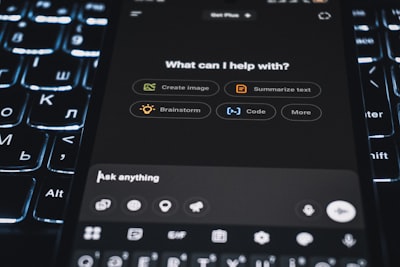
The world of software development never ceases to amaze itself with moves that are as bold as they are unexpected. OpenAI, the company that has redefined the artificial intelligence landscape with tools such as ChatGPT and its language models, has just unveiled a physical keyboard priced at $230 designed specifically for Codex, its AI-based coding assistant. This launch comes in the midst of a legal battle with Apple over alleged hardware misappropriations, which adds an extra layer of complexity and interest to a strategy that mixes hardware, software and development ecosystems.
The new keyboard is no ordinary peripheral. It is intended for developers who use Codex to generate, review, and complete code automatically. It features customizable RGB backlighting, low-profile mechanical keys, and a direct integration with OpenAI's AI agent platform. Most strikingly, it incorporates a dedicated key to invoke Codex, allowing programmers to ask for suggestions, fix bugs, or even write entire blocks of code with the push of a button. This move shows that OpenAI not only wants to dominate the realm of language models, but also that of specialized hardware for developers.
From a business perspective, the decision to launch a $230 keyboard in the midst of litigation with Apple may seem risky, but it follows a clear logic: to create a closed ecosystem where software and hardware work in perfect sync. OpenAI seeks to differentiate itself by offering an AI-augmented programming experience, where the keyboard acts as a physical bridge between the developer and intelligent agents. This is reminiscent of similar strategies from companies such as Google with its Chromebooks or Microsoft with Surface, but focused on a very specific niche: programmers who already use coding assistants.
For companies developing custom applications, this release opens up interesting questions. To what extent can AI be integrated into the daily workflow without sacrificing control or security? At Q2BSTUDIO, as a company specializing in custom software and technological solutions, we see that the trend towards AI-assisted development tools is unstoppable. However, we also warn that reliance on external platforms can lead to cybersecurity risks if not managed correctly. That's why, when working with clients who adopt artificial intelligence in their processes, we always recommend implementing robust cybersecurity layers and evaluating the provenance of the data that feeds those models.
OpenAI's keyboard also raises a debate about the future of integrated development environments (IDEs). If a physical device can invoke AI agents, what role will VS Code extensions or JetBrains plugins play? The answer lies in convergence: we'll see more and more hybrid appliances that mix hardware, aws and azure cloud services, and language models. In fact, many of the applications we develop at Q2BSTUDIO already incorporate connectivity to the cloud to enable real-time AI capabilities, using both AWS and Azure depending on the needs of the project. This allows our customers to scale their solutions without relying on a single vendor.
Another relevant aspect is how this type of hardware can influence the productivity of development teams. With the integration of AI agents directly on the keyboard, context switching times are reduced: the programmer does not need to open a chat or an additional window, but presses a key and receives contextual suggestions. This is especially useful for repetitive tasks such as writing unit tests, documenting functions, or refactoring code. However, it also requires adequate training so that developers know how to interpret and validate the suggestions generated, something that we Q2BSTUDIO include as part of our technology consulting services.
We cannot ignore the legal context of the launch. The battle with Apple over the theft of hardware-related trade secrets adds uncertainty. If OpenAI loses its mind, it might have to redesign its keyboard or even pull it from the market. This would affect not only developers who have already purchased it, but also trust in the company as a hardware vendor. For this reason, many companies prefer to opt for more standardized and open solutions, such as those we offer at Q2BSTUDIO, where custom software is integrated with common peripherals and operating systems, without depending on closed ecosystems.
From a business intelligence perspective, this release is also eye-opening. OpenAI is betting on a physical product that generates usage data: every keystroke, every invocation of Codex, every writing pattern can be analyzed to improve the models. This is reminiscent of how tools like Power BI allow businesses to visualize productivity data. At Q2BSTUDIO, we help our clients design dashboards that monitor the performance of their development teams, integrating metrics from AI tools and cloud workflows. Thus, the decision to adopt a smart keyboard is no longer just a matter of convenience but a data-driven business decision.
The $230 price tag may seem steep for a keyboard, but consider that it's aimed at a professional market where the extra productivity can justify the investment. A developer who saves 30 minutes a day thanks to AI assistance recovers the cost within a few weeks. However, for large teams, the total outlay can be significant. That's why at Q2BSTUDIO we propose an alternative approach: instead of buying specialized hardware, we integrate AI for business directly into the tools they already use, using custom APIs and intelligent agents that work in the background. This is usually more scalable and cost-effective in the long run.
Another interesting point is OpenAI's commitment to hardware as a vector for adoption. By launching a keyboard, the company is not only selling a peripheral, but securing market share for Codex. Developers who invest $230 in the keyboard are likely to become loyal users of the platform. It is a strategy similar to that of video game consoles, where the hardware builds user loyalty. However, this dependency can be a double-edged sword if the product does not meet expectations or if the competition (such as GitHub Copilot, Amazon CodeWhisperer or Google Gemini) offers equally powerful alternatives without the need for dedicated hardware.
In the realm of process automation, this keyboard could also have applications beyond programming. Imagine an AI assistant that, at the touch of a key, generates reports, executes scripts or controls IoT devices. The modularity of OpenAI's agents allows the keyboard to be configured for different tasks. However, cybersecurity remains a critical point: if the keyboard is connected to the internet and sends keystrokes to the cloud, any vulnerability could expose sensitive code. That's why, at Q2BSTUDIO, we always recommend that enterprise AI solutions are deployed with robust security protocols, including end-to-end encryption and regular audits.
Finally, OpenAI's move reinforces a trend that we have been observing for years: the convergence of hardware, software, and artificial intelligence. Companies that want to stay competitive will need to consider how to integrate these technologies into their processes without losing control of their data or exposing themselves to legal risks. At Q2BSTUDIO, we offer artificial intelligence services ranging from initial consulting to implementation and maintenance, always with a practical approach and adapted to each business. Whether you need custom applications, AWS and Azure cloud services, or dashboards with Power BI, our team is ready to help you navigate this new technology paradigm without losing sight of security and scalability.