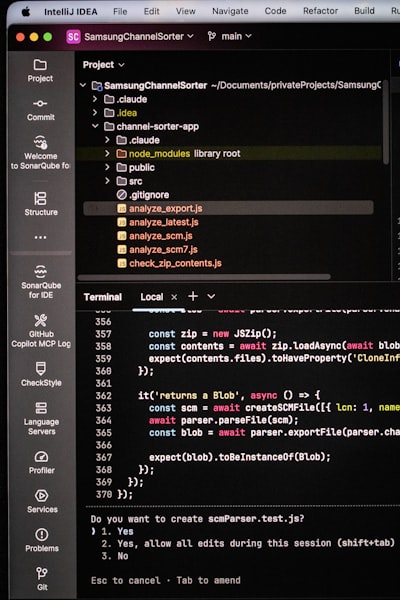
The software development ecosystem is advancing at a dizzying pace, and programming environments must evolve at the same pace to offer technical teams the necessary tools to face increasingly complex projects. The arrival of IntelliJ IDEA 2026.2 represents a significant milestone in this direction, as it incorporates a set of features that go beyond simple compatibility updates. This new version, available from the end of 2026, not only expands support for the latest technologies in the Java and Kotlin ecosystem, but also introduces substantial improvements in productivity, integration with artificial intelligence and reinforcement in critical areas such as cybersecurity and deployment in cloud environments. At Q2BSTUDIO, as a company specialising in the development of custom applications, we closely follow these developments because they have a direct impact on the quality and efficiency of the projects we undertake for our clients.
One of the most notable new features of IntelliJ IDEA 2026.2 is day-one support for Java 27. This version of the language, which is still in the definition phase by the Java Community Process, introduces improvements in memory management, new concurrency patterns and optimizations in the compiler that allow code to be executed faster and with less resource consumption. For teams developing custom software, this early compatibility is a competitive advantage, allowing you to start testing and adopting new capabilities without having to wait for development environments to catch up. In addition, full support has been added for the stable features of Kotlin 2.4, a language that continues to gain traction in backend and mobile development, offering a more concise syntax and full interoperability with Java. In enterprise projects that require high scalability, having these up-to-date tools is critical to keeping technical debt under control.
Artificial intelligence has become an indispensable pillar in modern software engineering, and this version of the IDE reflects this with a native integration of GitHub Copilot, which now acts as a contextual assistant capable of suggesting code snippets, completing complex functions, and even generating unit tests from project analysis. Beyond classic support, AI agents are introduced, intelligent entities that can execute automated tasks within the environment, such as chain refactorings, correction of common security vulnerabilities or generation of technical documentation. For a company like Q2BSTUDIO, which offers AI services for enterprises, this ability to delegate repetitive tasks to specialized agents frees up valuable time for developers, allowing them to focus on business logic and solution architecture. Support for third-party AI vendors has also been expanded, so teams can choose the model that best suits their needs without being tied to a single platform.
Day-to-day productivity also gets a considerable boost. Logpoints, a feature that allows you to log debug messages without modifying the source code, have been enhanced with conditional filters and the ability to export logs to external monitoring systems. This feature is especially useful in production environments where execution cannot be stopped, and it fits perfectly with cybersecurity practices by avoiding the manual injection of debugging code that could expose sensitive information. In addition, the conflict resolution flow in Git has been redesigned to be more intuitive, showing three-dimensional views of changes and suggesting smart merges based on branch history. Support for Docker Compose has also been updated, with a new interface that allows containers, networks and volumes to be managed directly from the IDE, facilitating integration with AWS and Azure cloud services in local development environments.
In the realm of integration and continuous delivery, IntelliJ IDEA 2026.2 offers early support for Gradle 10, the next version of the build system that promises improvements in build speed and better dependency management. The IDE includes a migration wizard that analyzes existing projects and suggests changes needed to accommodate the new APIs, reducing the risk of breakages during the upgrade. This functionality is especially relevant for teams developing custom applications with long lifecycles, where updating build tools can become a bottleneck. On the other hand, the testing framework for Terraform has been natively incorporated, allowing infrastructure to be validated as code directly from the environment, a crucial step in ensuring the reliability of cloud deployments.
Security continues to be a growing priority in software development, and this release incorporates significant improvements in vulnerability scanning through Spring Security Insights. The IDE is now capable of detecting insecure configurations in Spring applications, recommending more restrictive access policies, and flagging potential information leaks on endpoints. For companies that offer cybersecurity services, as part of the comprehensive solutions we provide at Q2BSTUDIO, this early prevention capability is invaluable, as it reduces the attack surface before the code reaches production. In addition, a dependency analyzer has been integrated that alerts on libraries with known vulnerabilities, aligning with DevSecOps best practices.
We cannot overlook the impact on business intelligence. While IntelliJ IDEA is not a BI tool, its ability to connect to databases, generate complex SQL queries, and visualize data directly in the editor makes it easier for teams developing dashboards and reports. New smart dependency completion functionality helps keep connector libraries, such as drivers for analytical databases, up to date, and integration with Power BI through extensions allows you to preview data models without leaving the IDE. For projects that combine backend with data visualization, having a unified environment reduces friction between developers and business analysts.
All in all, IntelliJ IDEA 2026.2 presents itself as a robust and strategic upgrade for any modern development team. The combination of early support for new versions of Java and Kotlin, the incorporation of AI agents, improvements in productivity and reinforcement in security and cloud make it an almost indispensable tool. In Q2BSTUDIO, where we develop custom applications for customers in various industries, we are already exploring these capabilities to optimize our workflows and offer more robust solutions. We recommend all software professionals to upgrade to this version and take advantage of its new features to stay ahead of the curve in an increasingly demanding market.