
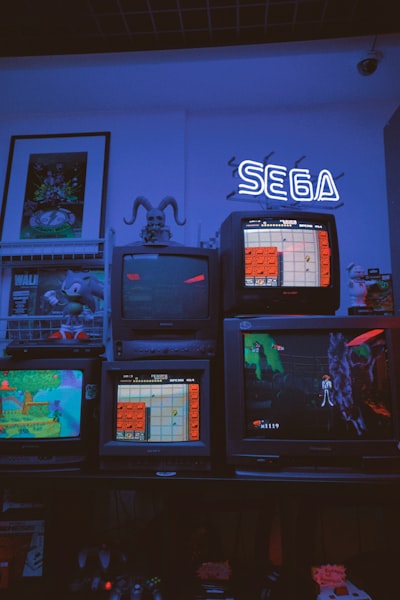
Retro system emulation has reached surprising levels of realism in recent years, but few projects have generated as much buzz as the CRT emulator developed by a former Sega engineer. This software seeks to replicate not only the image, but the entire experience of playing on a cathode ray tube monitor, with its flares, curvature, blurred pixels and that characteristic 'glow' that many gamers yearn for. The creator, who worked for years at the Japanese company designing graphics hardware, has combined his knowledge of analog electronics with modern rendering techniques to achieve a simulation that goes far beyond the simple scanline filters available in other emulators.
The heart of the emulator is a reverse ray tracing engine that models the physical behavior of the electron beam on the phosphor on the screen. Instead of applying a generic filter, the software calculates how each individual phosphor would illuminate depending on the input signal, the persistence of brightness, the interference between adjacent lines, and even the geometry of the glass bulb itself. The result is an image that subtly changes with the angle of view and reproduces artifacts such as moiré, blooming or chromatic dispersion. For purists, this fidelity represents a qualitative leap that brings emulation closer to the original experience.
Behind this achievement is an in-depth research work on the deflection circuits and high-voltage transformers of classic CRT monitors. The former Sega engineer spent months analyzing schematics of Sony Trinitron TVs and arcade monitors from the 1990s, documenting how the phosphor response varied with temperature and aging. He even acquired several old monitors to measure their gamma curves and temporal response using high-speed optical sensors. All this information has been dumped into a mathematical model that runs in real time on modern GPUs, taking advantage of the parallel computing capacity to simulate millions of luminescent particles.
Beyond nostalgia, this type of development opens the door to professional applications in areas such as the preservation of digital heritage, the restoration of classic video games and the verification of visual behaviors that depended on the original hardware. Museums and historical archives are beginning to take an interest in these simulations to preserve the exact appearance of the titles as they were seen at launch. There is also interest in the retro interface design sector for industrial environments, where readability under certain lighting conditions mimicked CRT displays.
In this context, companies such as Q2BSTUDIO offer tailor-made software solutions that allow emulation and simulation projects to be brought to production environments. Whether it's developing specialized rendering engines or integrating complex physical models, having an expert cross-platform application development team is key to transforming a niche idea into a robust and scalable product. CRT emulation is just one example of how the intersection of old hardware and modern software can generate tools of great technical and cultural value.
In addition, the growing demand for extreme realism in simulations has driven the adoption of artificial intelligence techniques to predict behaviors that would be too expensive to model analytically. Using AI for companies, it is possible to train neural networks that learn to generate CRT artifacts from real samples, reducing computational consumption without sacrificing quality. You can even create AI agents that dynamically adjust the parameters of the simulation according to the scene, something that the former Sega engineer himself has begun to explore in his emulator.
From a business perspective, monitoring and analyzing these complex systems requires efficient data management. This is where business intelligence services based on Power BI come in, which allow you to visualize performance metrics, resource usage and simulation quality in real time. Combining an emulation platform with a cloud dashboard facilitates continuous optimization and early detection of deviations in fidelity. Q2BSTUDIO also offers AWS and Azure cloud services to deploy these environments in a scalable way, ensuring that any emulator or simulator can be run from remote servers with low latency.
We cannot forget the importance of cybersecurity in this type of development. When working with software that is often distributed as open source or through collaborative repositories, it is critical to protect both source code and user data. Security audits and penetration testing are essential to avoid vulnerabilities that could compromise systems running these emulators in industrial or museum environments. Q2BSTUDIO integrates pentesting services into its development processes to ensure that each custom application meets the highest standards of protection.
In short, the CRT emulator of the former Sega engineer is not just an exercise in technical nostalgia, but a reminder that precision in simulation has real applications beyond entertainment. The combination of analog knowledge, modern computing, and good software engineering practices can result in tools that preserve our digital heritage while opening up new lines of business. Companies such as Q2BSTUDIO are prepared to accompany this type of initiative, providing experience in custom applications, artificial intelligence, cloud services and business intelligence, always with a focus on quality and responsible innovation.

