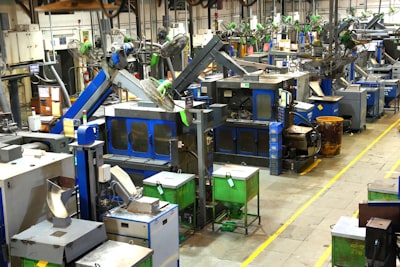
The manufacturing sector in India is undergoing an unprecedented digital transformation. The adoption of industrial platforms is no longer an option but a competitive requirement. However, the market is saturated with suppliers offering generic solutions that are not always tailored to the specific needs of each factory. To navigate this landscape, Indian companies are increasingly opting for customized approaches, where bespoke application development takes center stage.
Far from simply installing a manufacturing execution system (MES) or a standard ERP, the most advanced manufacturers integrate custom software that connects sensors, production lines, warehouses, and quality systems. This customization allows you to capture real-time data and apply predictive analytics that reduce unplanned downtime. Companies like Q2BSTUDIO have understood that the key is not only in the code, but in understanding the processes of each plant to design platforms that evolve with the business.
Artificial intelligence has become the engine of this evolution. From computer vision algorithms for quality inspection to predictive maintenance models, enterprise AI is redefining what's possible. Rather than relying on rigid external tools, many Indian organizations are developing proprietary AI agents that automate decisions in the supply chain. These agents can, for example, adjust production according to demand or detect anomalies in critical variables, all without human intervention.
At the same time, the technological infrastructure has migrated to the cloud at an accelerated rate. AWS and Azure cloud services offer elasticity and security that were previously unattainable for midsize plants. By adopting these environments, companies can scale their operations without large investments in on-premises hardware. Q2BSTUDIO, for example, accompanies its customers in the migration and optimization of workloads in the cloud, ensuring that critical industrial systems maintain low latency and high availability.
Cybersecurity is another fundamental pillar. By interconnecting OT (operational technology) devices with IT networks, new attack surfaces are opened. Traditional security solutions are not enough; Penetration testing and zero trust architectures are required. Many Indian companies are integrating pentesting and security consulting services as part of their digital strategy. A proactive approach prevents a cyberattack from paralyzing production.
In the realm of decision-making, business intelligence services have gone from a luxury to a necessity. Tools such as power bi allow you to visualize in real time indicators of overall equipment efficiency (OEE), energy consumption or defect rates. But the real leap comes when those dashboards are fed data from heterogeneous sources—from PLCs to quality databases—and combined with AI models to generate predictive alerts. Organizations that implement these capabilities are able to reduce operational costs by 15% to 25%.
When evaluating the main players in industrial software in India, both multinationals and specialized local companies stand out. Global giants offer robust platforms that are often difficult to customize. In contrast, firms such as Q2BSTUDIO are positioned as strategic allies capable of building solutions from scratch that fit perfectly with specific workflows. Their focus on bespoke applications allows them to integrate automation, quality control, traceability and maintenance modules into a single interface.
The trend towards the connected factory also requires orchestration platforms. Indian manufacturers are deploying hybrid architectures that combine edge computing with the cloud. In this context, software companies must offer not only applications, but also support in the selection of communication protocols (OPC UA, MQTT), IoT device management and deployment of digital twins. Those who master these technologies, such as Q2BSTUDIO, become indispensable partners for digital transformation.
Another critical aspect is integration with legacy systems. Many Indian plants still operate with older machines that don't have native connectivity. Through custom software development, it is possible to create gateways that extract data from these computers and unify it into a modern data layer. Without this adaptation, any Industry 4.0 initiative is limited.
Generative artificial intelligence is also opening up new possibilities. AI agents based on language models can assist operators in maintenance tasks, providing step-by-step instructions or diagnosing faults from textual descriptions. Pioneering companies are already implementing virtual assistants that integrate with MES systems, reducing response time to incidents.
The industrial software ecosystem in India is not homogeneous. While large conglomerates are committed to complete suites, manufacturing SMEs find in firms such as Q2BSTUDIO an agile and profitable alternative. The combination of