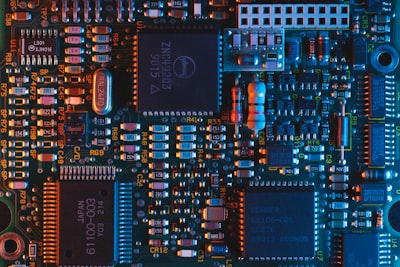
Artificial intelligence is at an energy crossroads. The exponential growth of language models and computer vision systems has sent data center power consumption soaring to unsustainable levels. In this context, an old idea is making a strong comeback: analogue computing. In contrast to classic digital processing based on bits and logic gates, analog chips promise drastic energy savings by operating directly with physical quantities such as voltages or currents. However, the historical enemy of this approach – noise – once again raises doubts about its viability. Will analog AI be able to overcome its own imperfections and become the next hardware revolution?
To understand the challenge, it is worth remembering that a digital chip represents information with zeros and discrete ones, while an analog chip works with continuous signals. This allows it to perform operations such as addition and multiplication inherently parallel and with much lower power consumption, ideal for the deep neural networks that dominate today's AI. But that same continuity makes it vulnerable to electrical, thermal, and manufacturing noise, which can distort calculations and lead to errors. For decades, this problem held back its commercial adoption. Now, the need for efficiency has led researchers to design architectures that coexist with noise, and even incorporate it as part of the learning process.
One of the most promising strategies is to simulate that noise during training, so that the model learns to be robust against the physical imperfections of real hardware. Just as augmented data training improves the generalizability of a network, exposing it to simulated disturbances prepares it to operate on an analog chip without significant loss of accuracy. This approach has reignited the interest of tech giants and startups, which are vying to make neuromorphic chips and resistive memories capable of running AI inference with a fraction of the power consumed by current GPUs.
From a business perspective, the transition to analog hardware is not only a technical issue, but a strategic one. Companies that adopt this technology early could dramatically reduce their operational costs in cloud and model deployment. This is where the need for technology partners capable of integrating AI solutions with hybrid infrastructures comes into play. At Q2BSTUDIO, as a software and technology development company, we offer services ranging from the creation of custom applications to the implementation of AI systems for companies, including deployment in public clouds such as AWS and Azure cloud services. Our team knows that hardware innovation must be accompanied by software that takes full advantage of its advantages.
But not everything is optimism. Noise in these systems continues to be an obstacle for critical applications where accuracy is non-negotiable, such as in cybersecurity or medical diagnostics. As a result, many companies combine analog chips with digital correction circuitry, creating hybrids that balance efficiency and accuracy. At Q2BSTUDIO, we understand the importance of cybersecurity and data integrity, which is why we design solutions that ensure reliability even when the underlying hardware is imperfect. Our business intelligence and Power BI services help organizations monitor the performance of these systems and make decisions based on quality data.
Another key aspect is process automation. AI agents running on analog hardware can perform repetitive tasks with minimal power consumption, freeing up resources for more complex analysis. At Q2BSTUDIO we develop process automation and software as you integrate these new capabilities. In addition, our expertise in AWS and Azure cloud services allows us to advise customers on the best deployment strategy, whether in hybrid or fully analog environments in the future.
In short, the return of analogue AI represents a fascinating opportunity to rethink computing from its physical foundations. While noise remains a challenge, simulations and tolerant architectures are paving the way. Companies that bet on this technology will need a robust and flexible software ecosystem, exactly the kind of solutions we offer at Q2BSTUDIO. Because the artificial intelligence of tomorrow will not only be more efficient, but it will also learn to live with its own imperfections.