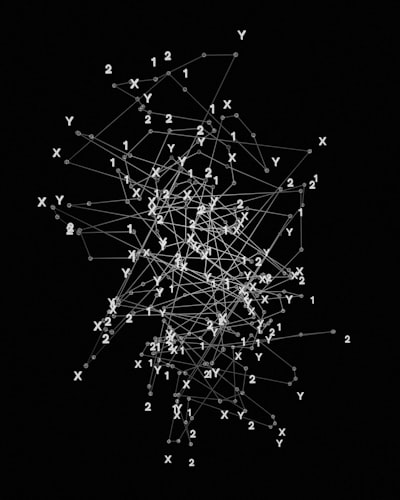
In today's data analytics landscape, the need to model complex structures with high dimensionality is becoming more and more pressing. Modern datasets, especially those that come from images, sensors, or financial systems, exhibit nonlinear patterns, asymmetries, and dependencies that traditional models fail to capture. In this context, bilinear factorization techniques have emerged as a powerful solution, but they often suffer from overparameterization that makes their practical application difficult. An innovative approach to address this challenge is the family of parsimonious mixtures of biased bilinear factor analyzers, based on the asymmetric Student t-distribution. This article explores the fundamentals, benefits, and applications of these models, and how they can be integrated into modern business solutions.
What are biased bilinear factor analyzers? A bilinear factor analyzer is a dimensionality reduction technique that breaks down a data matrix into two sets of latent factors, one for rows and one for columns. When these factors are modeled with biased distributions, such as the asymmetric Student's t-test, both the asymmetry and the presence of outliers in the data are captured. The proposal of a family of 256 parsimonious models implies that constraints can be imposed on parameters across clusters, striking a balance between flexibility and computational efficiency. This is particularly useful in domains such as facial recognition or medical image analysis, where variability is high but computing resources are limited.
Advantages over traditional methods Classical models of Gaussian mixtures or linear factors often require an excessive number of parameters when faced with large matrix data. By introducing a bilinear structure and parsimony constraints, complexity is drastically reduced without sacrificing accuracy. In addition, the use of skewed t-distribution allows for handling heavy tails and asymmetries, which is common in financial or sensor data. The AECM (Alternating Expectation Conditional Maximization) algorithm facilitates the estimation of parameters in an iterative way, ensuring convergence in practical scenarios. Experiments with the MNIST and Olivetti Faces datasets show that these models outperform alternatives such as PCA or Gaussian mixtures in clustering and classification tasks.
Practical applications in the enterprise The ability to model biased and high-dimensional data has a direct impact on multiple industries. For example, in the enterprise AI industry, these models can be used to improve the detection of anomalies in financial transactions or customer segmentation based on complex behavioral patterns. A company that wants to implement advanced analytics solutions can benefit from bespoke applications that incorporate these algorithms, optimizing performance in cloud environments. In fact, AWS and Azure cloud services provide the infrastructure needed to train these models on a large scale, while tools such as Power BI can visualize the results of the clusters obtained. At Q2BSTUDIO, we develop custom software that integrates advanced statistical techniques with modern platforms, facilitating the adoption of methodologies such as parsimonious mixtures.
Computational challenges and solutions Despite their advantages, the implementation of these models requires special care in parameter initialization and memory management. The family of 256 models involves a search over different constraint configurations, which can be costly. However, through parallelization and optimization techniques in the cloud, it is feasible to use it in production. At Q2BSTUDIO we offer artificial intelligence services that include the creation of AI agents capable of automatically selecting the most parsimonious model based on the data, saving time and resources. In addition, cybersecurity is a critical aspect when handling sensitive data; Our team implements robust security protocols at every stage of processing.
Success stories in research and business The academic literature shows applications in image classification, handwriting recognition and genomic sequence analysis. In the corporate world, a logistics company can use these models to group delivery routes based on time and distance matrices, identifying patterns skewed by weather or traffic factors. Integration with business intelligence service systems allows decision-makers to access real-time insights. At Q2BSTUDIO, we help organizations build data pipelines that connect from collection to visualization with Power BI, through advanced statistical modeling.
Conclusion Parsimonious mixtures of biased bilinear factor analyzers represent a significant advance in complex data modeling. Their ability to reduce dimensionality while maintaining structural richness makes them a valuable tool for both researchers and companies looking to extract value from their data. In an environment where artificial intelligence and custom software are key, adopting these techniques allows you to be at the forefront. At Q2BSTUDIO, we are committed to delivering technology solutions that integrate these concepts effectively, whether through cloud platforms, process automation, or advanced analytics. The future of data analytics is parsimonious, flexible, and above all, practical.