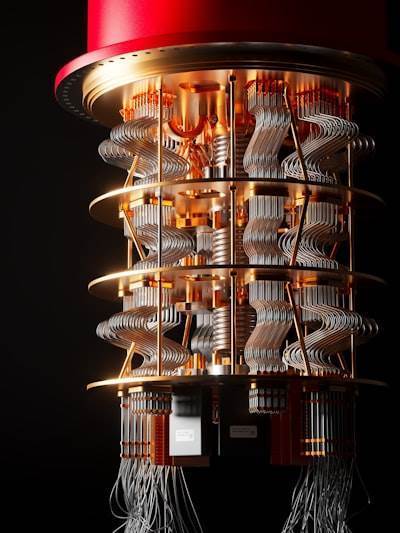
Quantum computing promises to revolutionize entire industries, from cryptography to drug discovery, but its practical maturity faces a lingering hurdle: the fragility of qubits in the face of ambient noise. Among the most elusive sources of noise are charge jumps induced by ionizing radiation, which can corrupt quantum states and generate correlated errors. Detecting them in real time has become a priority for error mitigation and particle detection applications. An innovative approach based on dilated causal convolutional neural networks (DCCNN) is changing the game, achieving microsecond latency on FPGA hardware, allowing detection to be integrated within the qubit control loop. This breakthrough not only benefits fundamental physics labs, but opens a door to artificial intelligence solutions applied to critical systems in real time, a field where companies like Q2BSTUDIO offer expertise in AI for companies and custom software development.
Traditionally, load jump detection was done offline, analyzing Ramsey tomography data after acquisition, which introduced latency incompatible with live correction. The classic chi-square method required per-qubit hyperparameter tuning, limiting its scalability. Trained on synthetic data generated from real templates measured in underground environments such as NEXUS, DCCNN achieves comparable efficiency (0.843 vs. 0.866) without the need for manual calibration. Implemented using hls4ml with ap_fixed quantization on a Zynq UltraScale+ RFSoC, it achieves a latency of 6.19 microseconds per inference, enough time to trigger adaptive protocols before the error propagates. This paradigm shift—from post-hoc diagnostics to primitive loop control—represents a milestone in the architecture of fault-tolerant quantum systems.
From a technical perspective, the dilated causal network captures long-term temporal dependencies without increasing the number of parameters excessively, making it ideal for implementation in programmable logic. The ability to detect load jumps in real time also enables new applications of quantum sensing, where qubits act as detectors for high-energy particles. In this context, the synergy between low-latency hardware and deep learning models is critical. Companies looking to integrate artificial intelligence into real-time environments can benefit from similar approaches, adapting convolutional architectures to FPGAs or ASICs to achieve inferences in microseconds. Q2BSTUDIO accompanies this type of digital transformation with custom application services, AWS and Azure cloud services, and AI agents that optimize industrial and scientific processes.
The practical implementation of this detector in the Quantum Instrumentation Control Kit (QICK) demonstrates that the democratization of quantum computing involves open and customizable control tools. By eliminating the need for manual adjustment, DCCNN paves the way to more autonomous quantum systems. For businesses, this means that artificial intelligence is not only applied to desktop data, but can be embedded in hardware-level control loops. For example, in cybersecurity systems that require anomaly detection in nanoseconds, or in manufacturing processes where predictive analytics need immediate responses. The same long causal network technology can be repurposed to detect patterns in financial time series or critical infrastructure monitoring.
Using tools such as hls4ml to translate TensorFlow models to FPGA firmware bridges the gap between data scientists and hardware engineers. This aligns with Q2BSTUDIO's philosophy, which offers bespoke software to integrate machine learning algorithms into embedded devices. In addition, mixed-precision quantization (ap_fixed) demonstrates that it is possible to maintain sufficient accuracy with limited resources, a key principle in the design of business intelligence services that require real-time dashboards with data from multiple sources. The scalability of this approach allows detection to be extended to hundreds of qubits, something that would be unfeasible with traditional methods.
In a business scenario, the ability to detect anomalous events in microseconds has direct implications for cybersecurity (network intrusion detection), industrial automation (emergency shutdown in the event of failures), and energy management (load balancing in smart grids). Q2BSTUDIO combines these capabilities with Power BI and Business Intelligence Services to deliver a holistic view of operational data. The same long causal network architecture can be used to predict demand spikes or detect transaction fraud, as long as the input is tailored to relevant time series.
From a research point of view, this work also underlines the importance of realistic test environments. The synthetic data generated from NEXUS templates made it possible to train the network without the need for lengthy measurement campaigns, a strategy that can be replicated in other domains where labeled data is scarce. Q2BSTUDIO applies similar methodologies in AI agent projects to simulate complex scenarios, reducing costs and accelerating time-to-market. The combination of simulation and deep learning is an unstoppable trend in Industry 4.0.
Finally, the original article demonstrates that the boundary between quantum and classical computing is blurred when artificial intelligence techniques are integrated into the control of quantum hardware. For companies looking to position themselves in this ecosystem, understanding these synergies is vital. Q2BSTUDIO offers consulting and development of custom applications that leverage both the cloud (AWS, Azure) and edge computing, adapting to the latency and security requirements of each client. Real-time detection of load jumps isn't just an academic achievement; It's a use case that will inspire new solutions in industries where every microsecond counts.