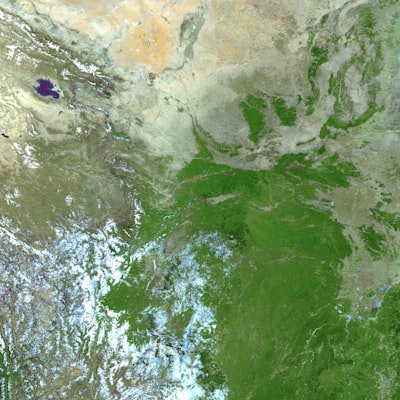
The early detection of forest fires is one of the most pressing challenges for the conservation of the environment and the protection of communities. With the advancement of satellite observation, especially thanks to the Sentinel-2 satellites of the Copernicus programme, a window of opportunity has opened up to identify fires almost in real time. However, analysing these images is not an easy task: atmospheric variability, class imbalance (burned areas versus non-burnt areas) and the high spectral dimensionality of satellite bands complicate traditional semantic segmentation algorithms. It is here that the combination of classical deep learning architectures with quantum computing principles begins to show a promising path. In this article we explore QFireNet, a hybrid model that fuses the renowned U-Net architecture with variational quantum circuits to improve accuracy in fire segmentation from Sentinel-2 images, and discuss how these advances can be integrated into enterprise AI solutions.
To understand why a quantum approach can make a difference, you first need to remember how a classical U-Net works. It is a convolutional network designed for image segmentation, with an encoder-decoder structure that extracts high-level features at a central bottleneck. In problems such as fire detection, this bottleneck processes vectors with very complex spectral characteristics, with information from up to 13 bands of the visible and infrared spectrum. Classical models often face representation limitations when the relationships between bands are nonlinear and higher-order. Quantum computing, on the other hand, can explore high-dimensional Hilbert spaces with an efficiency that escapes classical bits. QFireNet injects a quantum variational circuit into the U-Net bottleneck, allowing the model to capture spectral correlations that are difficult to model with traditional convolutional networks. This type of hybrid architecture is gaining traction in research, and its practical application for companies that need enterprise AI is becoming increasingly viable.
QFireNet's design is not limited to replacing a layer with a quantum circuit. To make the model trainable on current hardware, low-qubit ansatz is used and classical parameters are optimized by conventional backpropagation. Experiments conducted on fire datasets (such as those collected by Sentinel-2 missions) show that these hybrid networks can outperform classical baselines in metrics such as the F1 index. An equally relevant finding, however, is the importance of preprocessing and data blending. Satellite imagery often exhibits domain shift between geographic regions: a model trained on images of Europa may fail when applied in California due to differences in vegetation, lighting, and atmospheric conditions. Techniques for uniform data mixing and sample augmentation help mitigate this bias, and the results show that with good data treatment even a classic model such as the Feature Pyramid Network (FPN) can significantly increase its performance. This underscores that effective AI depends not only on novel architectures, but also on a robust data strategy, something Q2BSTUDIO advises its customers on as part of its AWS and Azure cloud services.
From a business perspective, implementing solutions like QFireNet requires a robust technology ecosystem. The Sentinel-2 satellites generate petabytes of information; Processing and storing that data requires scalable and secure cloud infrastructure. This is where public cloud services such as AWS and Azure come into play, which allow you to deploy inference pipelines and continuous retraining. In addition, quantum hybrid models need access to simulators or real quantum hardware, available through platforms such as Amazon Braket or Azure Quantum. Integrating these components into an end-to-end solution is an engineering challenge that goes beyond academic research. Q2BSTUDIO offers tailored applications to connect satellite data sources, AI models, and dashboards, making it easier for organizations to make operational decisions based on accurate fire segmentations in real-time.
Data security is also crucial, especially when handling critical infrastructure or government information. Fire detection systems based on satellite imagery can be exposed to cyberattacks that compromise the integrity of predictions or access sensitive databases. Therefore, a responsible implementation must include cybersecurity measures by design. At Q2BSTUDIO we integrate data protection protocols and conduct security audits to ensure that AI solutions meet the highest standards, aligned with current regulations.
Beyond fire detection, quantum architectures such as QFireNet open the door to applications in medical diagnostics, crop classification, and any field where hyperspectral image segmentation is relevant. The quantum leap won't happen overnight, but current results indicate that, with the right optimizations and a mature cloud ecosystem, these solutions can begin to be deployed in productive environments. Companies investing in enterprise AI today are positioning themselves to take advantage of the next wave of computational innovation.
Another aspect that should not be overlooked is the ability to interpret and visualize the results of segmentation. End users (fire brigades, natural park managers, insurers) do not require a technical output, but clear maps and actionable alerts. This is where business intelligence services and tools like Power BI can integrate to create interactive dashboards. Combining the power of quantum segmentation with real-time updated dashboards allows organizations to monitor the evolution of fires, allocate resources, and optimize extinguishing strategies. At Q2BSTUDIO we develop solutions that connect deep learning models with BI platforms, generating automatic reports and personalized alerts.
Process automation also plays a key role. Imagine a system that, when detecting a possible fire source using QFireNet, automatically activates a notification protocol, schedules reconnaissance drones and sends reports to the competent authorities. This is made possible by combining AI models with AI agents that run workflows. At Q2BSTUDIO we design and implement custom process automation , integrating orchestrators such as Apache Airflow or serverless functions into AWS Lambda. The result is an autonomous ecosystem that reduces response times to natural disasters.
In conclusion, QFireNet represents a step forward at the intersection of quantum computing and satellite imagery processing for fire detection. Although quantum technology is still in the maturation phase, experimental results show that hybrid models can outperform purely classical ones in problems with high spectral complexity. For companies looking to incorporate these capabilities, it is essential to have a technology partner that understands both cloud infrastructure and custom software development, cybersecurity, and business intelligence. At Q2BSTUDIO we offer just that: a multidisciplinary team that transforms cutting-edge research into practical, secure and scalable solutions.
If your organization is interested in exploring the potential of quantum artificial intelligence applied to fire detection or other segmentation problems, do not hesitate to contact us. We work with technologies such as AWS, Azure, Power BI, and classical and quantum machine learning frameworks to create custom software that fits your operational and business needs. Together we can build more accurate and efficient early warning systems, protecting the environment and the communities that depend on it.