
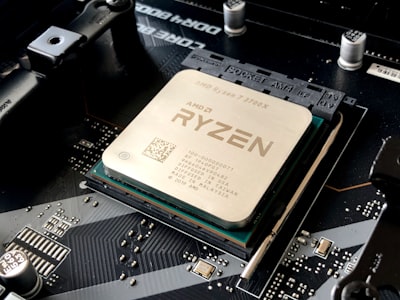
The consumer processor market is experiencing one of the most aggressive movements in recent years. The AMD Ryzen 7 7700X3D, a chip that has only been on the virtual shelves for a few days, has already seen its price fall to $279. This unusually early downgrade not only reflects an aggressive business strategy on AMD's part, but opens up a debate about the true value of performance in gaming and professional environments. To understand what this move means, it is useful to analyze the technical context, the implications for the consumer, and how this technology can be integrated into modern enterprise architectures.
The Ryzen 7000X3D series is characterized by incorporating 3D V-Cache, a technology that stacks additional cache memory on top of the processor chiplets. In the case of the 7700X3D, this design allows graphically demanding titles and scientific simulations to benefit from extremely low latencies. However, the arrival of higher models like the 7800X3D and 7950X3D has left the 7700X3D in a middle position: it's too powerful for an entry-level home PC, but it falls short of the top-of-the-line performance that certain data centers demand. That gap partly explains the rapid price drop, which now makes it an exceptional option for those looking to balance cost and performance without sacrificing energy efficiency.
From a technical perspective, the Ryzen 7 7700X3D offers 8 cores and 16 threads with a maximum boost frequency of 5.0 GHz, and its 120W TDP makes it compatible with mid-range cooling systems. But what really sets it apart is the 104 MB L3 cache, which in rendering, data compression or relational database tasks can be a jump of up to 20% compared to its non-X3D predecessor. This feature makes it an ideal candidate for virtualized machines or containers where data access latency is critical.
For a development company like Q2BSTUDIO, this downgrade is not just consumer news, but an opportunity to rethink the processing infrastructure. Many companies that offer AWS and Azure cloud services often recommend standardized configurations, but when deploying on-premise or hybrid environments, choosing a processor with high cache density can reduce software licensing costs per core. For example, in applications running artificial intelligence for image classification or conversational AI agents, reducing latency in memory access allows you to process more concurrent requests without scaling out.
In the cybersecurity space, a processor like the 7700X3D can run asymmetric encryption algorithms and real-time traffic analysis more efficiently. At Q2BSTUDIO we develop custom applications for security audits, and we have observed that systems with this additional cache improve the performance of pentesting tools that rely on repetitive calculations, such as rainbow table generation or hash analysis. This synergy between specialized hardware and custom software is the key to the solutions we offer our customers.
Another relevant aspect is the integration with business intelligence platforms. When processing massive volumes of data to generate dashboards in Power BI, the bottleneck is often in the data query rather than in the graphics engine. A server with a Ryzen 7 7700X3D can accelerate ETL transformations and in-memory aggregations, allowing visualizations to be updated in real time without the need for expensive distributed architectures. Since Q2BSTUDIO we have implemented business intelligence services on AMD hardware, and the value for money of this chip makes it a recurring recommendation for SMEs that want to make the leap to predictive analytics.
We must not forget the role of AI for companies. Machine learning models running on-premises, such as those we train for supply chain optimization or fraud detection, benefit greatly from the low latency of 3D V-Cache. Even for inference tasks, where millisecond responses are needed, a processor like this can handle multiple instances of lightweight models without the need for dedicated GPUs. At Q2BSTUDIO we help our customers select the right hardware for their workloads, combining the power of the Ryzen 7700X3D with bespoke applications that maximize performance without inflating the budget.
The drop to $279 also has implications for the corporate IT upgrade strategy. Companies that still use 10th Gen Ryzen 3000 series or Intel processors may consider this piece as an intermediate step before migrating to more expensive server platforms. The AM5 socket offers support for DDR5 and PCIe 5.0, which ensures some room for the future. In addition, combined with B650 motherboards, you get a balanced system that supports AWS and Azure cloud services in hybrid environments, as virtual machines can be allocated with predictable performance.
From a business standpoint, the opportunity isn't just in the purchase of hardware, but in how the software is designed as you will take advantage of it. Modern applications need to be optimized for memory hierarchy, and this is where Q2BSTUDIO brings differential value. Our development teams perform performance profiles before deploying solutions, identifying whether the application benefits from the 7700X3D's additional cache or needs more cores. This customization avoids cost overruns and ensures that every dollar invested in hardware translates into real productivity.
In conclusion, the new AMD Ryzen 7 7700X3D at $279 represents much more than a discount: it is an invitation to rethink the processing architecture in companies. Whether for artificial intelligence, cybersecurity, business analysis or custom application development, this chip is positioned as a strategic ally. At Q2BSTUDIO we are prepared to guide organizations in the adoption of these technologies, integrating efficient hardware with AWS and Azure cloud services and business intelligence platforms such as Power BI. The era of efficiency has only just begun.

