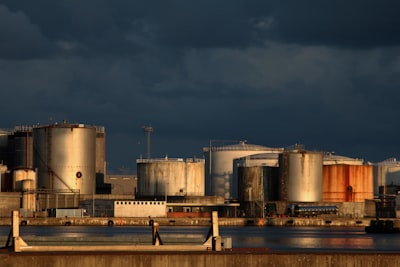
The sustained contraction of inventories at the Cushing logistical hub has reignited alarms over the stability of global crude oil markets. This strategic corridor, structured around interconnected pipelines and high-capacity storage terminals, functions as a barometer of domestic U.S. supply. When commercial reserves fall below historical operational thresholds, the domino effect spreads throughout the entire energy value chain, altering price differentials between international benchmarks and local indices. What appears to be a physical stock problem is, in reality, a complex challenge of enterprise risk management, logistical planning, and technological adaptation.
Understanding the technical dimension of these storage facilities is essential to gauge the real impact. Storage complexes do not operate as passive containers; they are sophisticated industrial installations governed by pressure, temperature, and chemical composition parameters. Each tank maintains a minimum operating volume, below which pumping and filtration systems lose efficiency or, worse, risk compromising the integrity of the remaining product. This lower band, invisible in aggregated market reports, generates an operational scarcity paradox: barrels physically exist but are technically inaccessible for immediate commercialization. The distortion between gross inventory and real available supply becomes a breeding ground for price volatility, especially when market operators adjust their positions upward amid perceived supply tension.
The repercussions of this dynamic extend far beyond trading rooms and commodity brokers. Ground and maritime transport companies, whose operating margins correlate directly with fuel costs, see their budget projections become obsolete within weeks. Manufacturers of plastics, fertilizers, and intermediate chemical products, all dependent on petroleum derivatives as raw materials, face unpredictable cost inflation that complicates the closing of long-term contracts with end customers. Even seemingly distant sectors, such as precision agriculture or last-mile logistics, experience ripple effects through rising freight rates and energy inputs. In this scenario, adaptive capacity no longer resides solely in negotiating financial hedges, but in the agility with which an organization can reconfigure its internal processes in response to changing market signals.
This is where digital transformation ceases to be a strategic option and becomes an operational necessity. At Q2BSTUDIO, we observe that companies best withstand high-volatility cycles are those that have integrated cutting-edge technology into their decision-making core. It is not simply about digitizing files or automating invoices, but about building a corporate nervous system capable of perceiving, analyzing, and reacting to external disruptions in real time. The convergence between industrial operations and advanced digital capabilities defines the new frontier of business resilience.
The first pillar of this resilient architecture is comprehensive data visibility. Implementing BI and Power BI solutions allows organizations to aggregate information from multiple heterogeneous sources —fleet sensors, ERP systems, market price feeds, and proprietary inventory data— into unified control panels. An operations director can, within seconds, correlate a spike in light crude price differentials with the cost per kilometer of their distribution network, or identify which production lines become unviable at a certain petrochemical quotation level. This synthesis capability transforms energy risk management from a reactive exercise based on intuition into a quantitative, auditable, and predictive process.
However, advanced analytics requires underlying infrastructure that scales as data volumes and model complexity grow. Adopting cloud AWS and Azure environments provides the computational elasticity needed to execute scenario simulations without the capacity limitations of traditional data centers. A company can deploy route optimization algorithms during a volatility spike, increase processing power to model risks, and subsequently reduce its resource footprint when markets stabilize. This on-demand consumption logic replicates, on the technological plane, the same flexibility that energy operators seek when managing strategic reserves in uncertain contexts.
Parallelly, the development of custom software emerges as a critical differentiator when generic systems prove incapable of capturing the specificity of certain businesses. A logistics company operating with contracts indexed to multiple crude benchmarks, managing heterogeneous fleets, and subject to sectoral environmental regulations rarely finds the business rules it needs in standard software. Purpose-built solutions enable the automation of early price threshold alerts, the management of purchase orders conditioned to quotation bands, and even the simulation of the financial impact of different procurement strategies using real-time updated historical data.
Artificial intelligence represents the next level in this capability pyramid. Machine learning models, trained with macroeconomic time series, geopolitical indicators, and climatic variables, can anticipate inflection points in energy markets with an accuracy that traditional statistical methods cannot achieve. However, the most disruptive advance comes from AI agents, autonomous entities capable of executing operational micro-decisions without direct human intervention. These agents can, for example, daily adjust delivery routes based on diesel cost projections, automatically renegotiate raw material volumes upon detecting a divergence between spot prices and approved budgets, or even activate contingency logistics protocols when they detect a critical drop in third-party fuel inventories.
The accelerated expansion of these digital capabilities also entails the obligation to protect them. Cybersecurity in industrial and commodity management environments has moved to a central place on the risk agenda. Systems housing market position data, energy supplier contracts, and sensitive production metrics become high-value targets for malicious actors. An intrusion during a period of high volatility can paralyze a company's ability to respond opportunely, multiplying economic damage beyond the fluctuation of the barrel price itself. Hardening strategies, pentesting, and continuous monitoring must be integrated from the design phase of any critical business platform, ensuring the confidentiality, integrity, and availability of information at all times.
The transition toward more diversified and sustainable energy matrices constitutes another vector of long-term resilience. However, fleet electrification, green hydrogen adoption, or renewable source integration are not overnight processes. During the transition window, which in many sectors will extend for decades, technology acts as an indispensable shock absorber: it optimizes fossil fuel consumption, reduces logistical waste through intelligent planning, and maximizes the return on every unit of energy consumed. Custom software applications can incorporate sustainability modules that quantify the carbon footprint associated with each purchasing, transport, or production decision, facilitating both increasingly demanding regulatory compliance and transparent communication with investors and stakeholders.
From a financial perspective, extreme volatility alters not only operating costs but also cash flow and credit access conditions. Banks and investment funds adjust their risk matrices when energy-intensive sectors undergo prolonged uncertainty episodes. A company demonstrating digital maturity through the use of BI/Power BI for data governance, and operating on certified cloud infrastructures, presents a significantly more attractive risk profile to potential creditors. The ability to generate precise reports, audit purchasing processes, and demonstrate internal control through robust technological systems translates directly into lower risk premiums and better financing conditions.
Storage and distribution terminal operators, for their part, face a particularly acute operational dilemma. The management of tanks, pipelines, pumps, and measurement systems requires increasingly precise predictive maintenance as filling and emptying cycles accelerate. There is a direct, though frequently ignored, correlation between sustained operation near minimum inventory limits and accelerated wear on transfer equipment. In this context, deploying IoT sensors connected to cloud AWS or Azure platforms enables the capture of real-time telemetry on vibrations, temperatures, and pressures. Artificial intelligence models applied to this data detect anomalies and failure patterns before unplanned shutdowns occur, preserving both the physical integrity of the facility and service continuity for downstream customers.
It is crucial to understand that technological investment does not pursue eliminating inherent exposure to the oil market, but rather equipping organizations with instruments to navigate it with greater precision and less friction. Business leaders who internalize this distinction prioritize building differentiated capabilities: multidisciplinary teams fluent in the language of data, scalable software architectures that evolve with the business, and an organizational culture that embraces evidence-based experimentation. At Q2BSTUDIO, we accompany these organizations in defining pragmatic technology roadmaps, aligning business objectives with executable solutions. Whether through deploying AI agents for complex process optimization, or creating custom software that centralizes comprehensive risk management, our approach consists of transforming uncertainty into sustainable competitive advantage.
The current inventory situation also forces a questioning of just-in-time supply chain models that have dominated operational management for recent decades. When raw material buffers are minimized due to working capital pressures, any disruption in crude oil or derivative supply is exponentially magnified. Companies therefore need to digitally simulate their logistics networks, map alternative bottlenecks, and establish automated contingency protocols that activate without human latency. Custom software enables modeling of these networks with a granularity impossible to achieve through static spreadsheets or isolated legacy systems, incorporating dynamic constraint variables that evolve with market context.
In the medium term, the combination of structural scarcity at strategic logistical points and accelerated pressure for the energy transition will configure a permanently uncertain business environment. Companies that survive and thrive will not necessarily be the largest, but the most intelligent from an informational standpoint. This implies not only massive data collection, but transforming it into actionable insights through artificial intelligence, protecting it through advanced cybersecurity, and exposing it through accessible interfaces built on next-generation cloud technologies. The ability to convert volatility into processable information will become the most valuable intangible asset of the next decade.
Ultimately, the contraction of reserves at traditional petroleum hubs functions as an involuntary accelerator of enterprise digital maturity. Decisions based on intuition, outdated quarterly reports, or simple market indicator tracking prove insufficient before cycles that can reverse within hours. A decisive commitment to custom software, hybrid cloud architectures, advanced BI capabilities, and integrated AI agent ecosystems constitutes the new frontier of comprehensive business management. At Q2BSTUDIO, we position these technologies not as ends in themselves, but as fundamental enablers of a more agile, informed, and prepared operation for the energy, economic, and competitive challenges of the present and immediate future.