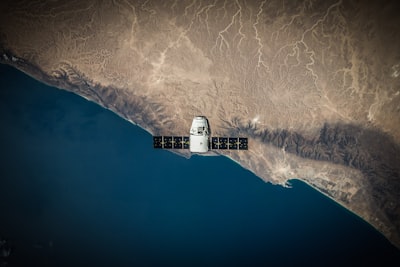
The idea of installing massive processing facilities in low-Earth orbit has moved from science fiction fantasy to headlines in engineering forums and technology investor meetings. The promise is tempting: freeing artificial intelligence from geographical, energy, and regulatory constraints to deploy almost unlimited computing capacity over a network of interconnected satellites. However, when we descend to the realm of hard numbers, network architecture, and real business models, the viability of these orbital platforms as a genuine alternative to terrestrial server farms quickly fades against a series of structural obstacles that few are willing to assume.
From a business perspective, any infrastructure decision must answer a simple equation: total cost of ownership versus value generated. Space deployments break this equation from day one. Transporting each ton of equipment to operational altitude requires fuel, insurance, space permits, and reusable launch vehicles that, despite their advances, remain extraordinarily expensive. Once in orbit, the absence of technical staff to replace a power supply, a faulty disk, or a memory module turns any minor incident into an economically unviable rescue mission. Compared with the elasticity of a cloud infrastructure contract, where capacity expands or contracts within minutes according to demand, the orbital asset resembles an immovable high-risk sculpture more than a dynamic data center.
The heart of a modern processing center lies in its internal network. On the ground, high-density topologies allow thousands of graphics accelerators to exchange data at near-light speeds through fiber optic cables and programmable switches. In space, communication between nodes depends on inter-satellite laser links that, while eliminating atmospheric attenuation, introduce volatility inherent to orbital dynamics. Satellites do not remain static; they rotate, eclipse one another, and traverse interference zones. A satellite constellation, however sophisticated, cannot today guarantee the symmetric network performance across system partitions demanded by the synchronous training of large language models. When training a cutting-edge neural network, each gradient synchronization phase requires predictable performance and low latency among all cluster participants, something that current space topology offers only intermittently at best.
Power generation beyond the atmosphere presents theoretical advantages, such as the absence of clouds or prolonged daylight cycles, but also introduces complex variables. Photovoltaic panels in orbit degrade faster than anticipated under charged particle showers, reducing their efficiency over the mission lifetime. Even more critical is the thermal problem. In a vacuum, there is no air to carry heat away from components. Cooling systems must rely exclusively on passive radiation, heat pipes, and emissive surfaces that occupy considerable volume. A terrestrial server farm can dissipate megawatts through cooling towers or immersion in dielectric fluids; in space, every residual watt must be expelled through radiators whose weight and surface area directly limit the computing density each satellite can host.
Hardware reliability constitutes another decisive hurdle. Ionizing radiation from the Van Allen belts and solar storms generates bit-flip events in memory and latch-ups in integrated circuits. Mitigating these effects requires hardened components by design or triple-redundancy architectures that double or triple cost and power consumption. In terrestrial environments, the physical and logical protection of data centers has reached extraordinary maturity levels. Modern cybersecurity not only defends against remote intruders but also integrates electromagnetic monitoring, biometric access control, and disaster response protocols. Transferring this security posture to the vacuum, where a simple memory error can corrupt an AI model trained for weeks, represents a qualitative leap that the industry has not yet solved.
Before considering the orbital leap, the industry has a range of terrestrial alternatives still to be exploited. Edge computing, the distribution of micro data centers close to data sources, and hybrid multi-cloud architectures allow critical latencies to be reduced without giving up human management capacity. These approaches demonstrate that the problem is not a lack of physical space on Earth, but the need for smarter technical planning. At Q2BSTUDIO we accompany organizations in this digital maturity exercise, identifying when a workload deserves centralized computing, when it benefits from the edge, and how to integrate both without friction.
Faced with this reality, companies seeking competitive advantages through artificial intelligence do not need to look toward the stars, but toward rigorous optimization of their digital assets on the ground. The true revolution is not determined by the physical location of servers, but by the quality of the software that manages data, trains models, and protects information. At Q2BSTUDIO we work from this conviction: differential value is built with well-designed architectures, efficient code, and data strategies that maximize the performance of every infrastructure, whether on-premise, hybrid, or fully cloud.
The development of custom software allows each organization to mold its technology stack to the real needs of its business, eliminating the overhead of generic solutions that consume unnecessary processing cycles. An application designed specifically for an industrial, financial, or logistics workflow can drastically reduce computing requirements, postponing or completely avoiding the need for aggressive scaling. When that custom software relies on cloud AWS/Azure platforms, the organization accesses a global network of regions, availability zones, and managed services that offer millisecond latencies, automatic redundancy, and pay-per-use billing. This combination of personalized software and elastic terrestrial infrastructure far surpasses, in terms of profitability and agility, any current orbital proposal.
Furthermore, the rise of AI agents is redefining how we interact with enterprise systems. These agents not only execute repetitive tasks, but orchestrate complex resources, prioritize critical inferences, and adapt GPU and CPU allocation in real time according to terrestrial network conditions. Implementing this distributed intelligence layer demands a solid cybersecurity foundation, where authentication of each agent, encryption of communications between nodes, and continuous auditing of algorithmic decisions are non-negotiable pillars. A well-secured terrestrial ecosystem allows rapid iteration, patching, and model retraining without depending on space launch windows or the irreversibility of orbital hardware.
The governance of any artificial intelligence platform, whether terrestrial or theoretically spatial, requires total visibility over performance and costs. BI solutions and the implementation of Power BI dashboards allow management teams to translate terabytes of infrastructure logs into clear indicators of energy efficiency, cluster utilization, and network service quality. This observability capability is essential to adjust computing capacity, identify obsolete models, and reassign budget toward initiatives with higher returns. In a hypothetical orbital deployment, obtaining this level of telemetry and its real-time processing would be severely compromised by downlink limits and variable latency, reinforcing the operational superiority of terrestrial platforms.
In conclusion, low-orbit data centers will remain for years an experimental field for space agencies and research consortia, but not a realistic alternative for industry that needs to train and deploy AI models at commercial scale. Network restrictions, insurmountable logistical costs, and the impossibility of corrective maintenance position terrestrial infrastructure, and especially hybrid cloud, as the only mature and profitable option. Companies aspiring to lead their sector must invest in technology partners capable of designing robust software solutions, leveraging hyperscaler elasticity, and applying artificial intelligence where it truly generates value: in process optimization, data-driven decision making, and user experience. Space may be the final frontier for humanity, but the present of AI is written, without doubt, from solid ground.