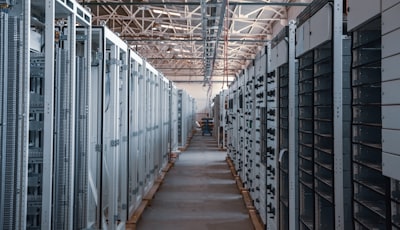
The exponential growth of AI data centers is redefining global technological infrastructure. With projections indicating the need to connect approximately 50 GW of capacity in the United States by 2030, challenges go beyond energy consumption: grid integration, construction timelines, and operational sustainability demand innovative approaches. In this context, a phased development framework emerges as a strategic solution to balance deployment speed with technical and economic viability.
The traditional linear planning model, where the entire data center is designed, built, and connected before going live, proves insufficient given multi-billion-dollar timelines and interconnection constraints that can span years. Therefore, a modular and progressive development approach allows operators to start operations with reduced capacity, using hybrid on-site generation—combining natural gas and battery storage—while completing grid interconnection processes.
From a technical perspective, this approach relies on electromagnetic transient simulations (EMT) that demonstrate how grid-forming storage control can maintain stability during early phases. As the data center expands, infrastructure progressively integrates into the grid, even enabling islanded operation during external disturbances. This resilience is critical for AI workloads that cannot tolerate downtime.
For companies aiming to implement these frameworks, software technology plays an enabling role. Q2BSTUDIO, as a specialized software and technology development firm, offers solutions ranging from custom software applications for managing modular infrastructures to artificial intelligence platforms that optimize energy consumption in real time. Cloud AWS/Azure enables scaling control systems without massive upfront investments, while cybersecurity services ensure data protection and operational continuity against growing threats.
The phased framework also benefits from Business Intelligence (Power BI) to analyze load patterns, generation efficiency, and operational costs. AI agents can make autonomous decisions regarding power source switching, load balancing, and predictive maintenance scheduling. Thus, sustainability becomes not just an environmental goal but also an economic one, reducing waste and maximizing return on investment.
The transition to full interconnection requires reconnection and restoration strategies that minimize downtime. EMT studies show that grid-forming controllers, combined with self-tuning algorithms, enable smooth grid synchronization. Here, custom software developed by Q2BSTUDIO can integrate sensor data, weather forecasts, and market prices to decide when to draw power from the grid or prioritize local generation.
In summary, phased development not only accelerates time-to-market but builds a resilient and adaptable foundation for the next generation of AI data centers. Companies adopting this model will need technology partners with expertise in system integration, automation, and cybersecurity. Q2BSTUDIO, with its portfolio in cloud, artificial intelligence, and BI, is ready to accompany these transformations, offering modular and scalable solutions that meet the demands of a constantly evolving sector.