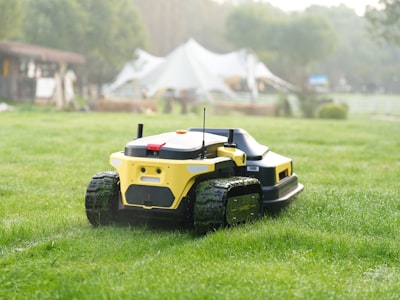
Home automation has taken a decisive step with the arrival of robot lawn mowers that no longer need perimeter wires or RTK antennas. The new Roborock X120H, launched this month, combines a 360-degree LiDAR scanner with binocular vision to navigate independently through complex terrain. Its initial price of $3,199 has dropped to $2,499.99 during the launch period—a $700 discount that makes it an attractive option for owners of lawns up to half an acre. But beyond the immediate savings, this device illustrates how technologies like artificial intelligence, the cloud and cybersecurity converge in an everyday consumer product.
The Roborock X120H features all-wheel drive (AWD) with active front-wheel steering, allowing it to tackle slopes up to 38.7 degrees and obstacles up to 3.1 inches. Its dynamic suspension system and knobby wheels improve grip on wet or uneven grass. The cutting height ranges from 1.57 to 3.54 inches, and it comes with six interchangeable blades that work in a 9.45-inch width. A rain sensor with IPX6 rating stops mowing when it starts to rain and resumes after a delay period. It also includes three years of free 4G connectivity for remote tracking and an anti-theft system based on PIN and GPS.
From a technical perspective, the use of LiDAR in robot mowers remains rare. Most competitors rely on perimeter wires or RTK, which limits their performance in low light, dense trees or irregular layouts. The X120H solves this with a real-time 3D map, adapting to terrain changes without human intervention. This architecture is similar to that used in autonomous vehicles and industrial inspection drones, highlighting the importance of image processing and sensor fusion.
Behind such products lies a software ecosystem that goes far beyond the firmware itself. The Roborock app receives data on lawn condition, routes followed and batteries, sending it to the cloud for analysis. This is where companies like Q2BSTUDIO play a relevant role—a firm that develops custom applications for IoT, integration with AWS or Azure cloud platforms, and artificial intelligence systems that can predict grass growth or schedule optimal cuts based on weather. The data generated by the X120H could feed a Business Intelligence (Power BI) dashboard showing weekly performance, energy consumption or maintenance alerts.
Cybersecurity is also critical for a robot permanently connected to the internet and with access to the garden and potentially the home network. The X120H’s anti-theft system uses PIN and GPS, but any IoT device needs additional layers of protection: encrypted communications, secure updates and vulnerability analysis. Q2BSTUDIO offers cybersecurity services including pentesting and specific audits for these environments, ensuring location data and credentials are not exposed.
Another differentiating aspect of the X120H is its ability to operate without external infrastructure. It requires no RTK or perimeter wire, simplifying installation and reducing setup costs. This independence makes it ideal for rental properties or gardens that change shape frequently. Additionally, the combination of LiDAR and binocular vision allows it to avoid low obstacles and cut edges with centimeter precision.
From a business standpoint, the arrival of robots like the X120H opens opportunities for software developers and technology consultants. Companies wishing to deploy fleets of autonomous mowers—for example, in golf courses, public parks or homeowners’ associations—need process automation solutions and AI agents that coordinate multiple units, optimize routes in real time and manage incidents remotely. Q2BSTUDIO develops automation systems that can connect these devices with ERPs, CRMs or maintenance management platforms.
Environmental impact also deserves attention. Electric mowers like the X120H reduce CO2 emissions and noise compared to gasoline models. Running on a lithium-ion battery and returning to the charging station automatically, its carbon footprint is low. However, manufacturing LiDAR sensors and communication modules has an ecological cost that must be compensated by a long lifespan. Roborock designed the X120H with replaceable parts and an IPX6 casing that allows hose washing, facilitating maintenance.
In terms of user experience, the Roborock app allows scheduling, adjusting cutting height and viewing session history. It also includes a “no-go” zone feature for delicate areas like flower beds or play areas. The built-in 4G connectivity (free for three years) ensures the robot can be controlled from anywhere, without needing home WiFi. This is especially useful for second homes or remote properties.
For tech professionals, the Roborock X120H represents a case study in integrating multiple technologies. LiDAR, which until recently was limited to automotive and industrial robotics, is now available to consumers. This brings concepts like sensor fusion, simultaneous mapping and localization (SLAM) to the general public. Companies that develop custom software, such as Q2BSTUDIO with its experience in cross-platform applications, can offer solutions to interpret LiDAR data and generate 3D garden models, or to train AI agents that improve navigation over time.
The cloud also plays a central role. The X120H communicates with Roborock servers to synchronize maps and updates, but companies managing multiple devices can benefit from an architecture on AWS or Azure that ensures scalability and low latency. Q2BSTUDIO offers cloud services to migrate and optimize infrastructures, including databases to store kilometers traveled, cutting times and usage patterns. With a Power BI dashboard, maintenance managers can visualize whether a robot is underperforming or needs a review.
We cannot forget artificial intelligence. The X120H already incorporates vision algorithms to recognize obstacles like stones or toys, but the next step will be for these robots to learn from experience. AI agents can analyze navigation history to avoid areas where the robot repeatedly got stuck, or to optimize routes based on sun direction and lawn moisture. Q2BSTUDIO is researching precisely in autonomous agents that make decisions based on real-time data, a field known as Agentic AI.
Returning to the product, the $700 discount makes the X120H competitive against models like the Husqvarna EPOS or Worx Landroid, which often require perimeter wire or have lower slope capability. For medium-sized lawns with slopes and trees, the Roborock is a solid choice. Its stated autonomy is enough for half an acre, though in practice it will depend on grass density and mowing frequency.
In conclusion, the launch of the Roborock X120H is not only good news for garden enthusiasts but also a thermometer of where home automation is headed. The combination of LiDAR, 4G connectivity, computer vision and anti-theft systems shows that outdoor robots have reached a technical maturity that makes them reliable for daily use. Software companies like Q2BSTUDIO can accompany this evolution by developing custom applications, cloud integrations, cybersecurity systems and BI dashboards that maximize the potential of these devices. Whether for residential or professional use, the X120H marks a before and after in autonomous lawn care.