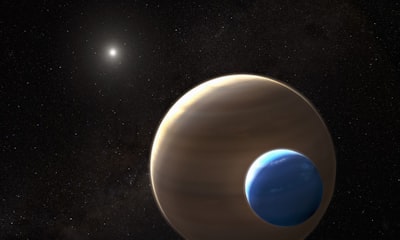
The discovery of a possible extrasolar satellite with a mass comparable to Jupiter has reopened the debate on the conceptual boundaries between planet, moon, and brown dwarf. Published recently in Nature, the study led by Kevin Hoy, a PhD student affiliated with Universidad Diego Portales and the European Southern Observatory, describes an object orbiting a brown dwarf 73 light-years from Earth. This binary system, in turn, orbits a host star, complicating its classification. For the scientific community, this discovery represents a firm step toward the unequivocal detection of exomoons, even though the object itself challenges definitions inherited from the Solar System.
The brown dwarf, with a mass about thirty times that of Jupiter, lies on the border between gas giants and the smallest stars. Unable to fuse hydrogen stably, it only burns deuterium, a heavier isotope. In this context, the exomoon candidate has at least 90% of Jupiter's mass and completes an orbit every 170 days. The researchers applied the radial velocity method, the same one used to discover the first exoplanet orbiting a Sun-like star in 1995. By measuring the gravitational wobble of the brown dwarf, they detected the presence of at least one satellite. Models with two satellites proved unstable, so the most plausible scenario is a single massive companion.
From a technical perspective, this finding illustrates how astronomical nomenclature boundaries blur when moving beyond Solar System parameters. The object is too large to be considered a moon in the traditional sense, but its orbital dependence on a body that is not a star places it in a gray category. Kevin Hoy noted that terms like 'planet' or 'moon' are insufficient to describe such atypical systems. Therefore, the team prefers to use 'exosatellite' until the International Astronomical Union establishes clear criteria. This debate is not trivial, as detecting exomoons opens the door to understanding planetary system formation and the potential habitability of worlds orbiting substellar objects.
In the realm of technology and astronomical observation, this discovery demonstrates the increasing capability of current instruments to detect small, faint bodies in complex environments. Although the candidate is massive, the authors trust that future generations of telescopes and analysis methods will allow the identification of rocky satellites similar to those in our neighborhood. Improvements in spectrograph sensitivity and noise reduction techniques will be key. This progress parallels the development of specialized software for handling large data volumes, a field where companies like Q2BSTUDIO apply their expertise to create custom solutions.
The intersection between astronomy and information technology becomes increasingly relevant. Telescopes generate petabytes of data requiring efficient processing systems, artificial intelligence algorithms to identify patterns, and cloud platforms to ensure scalability. Q2BSTUDIO, as a software development company, understands this need and offers specialized services in custom applications tailored to scientific workflows. The ability to customize tools for analyzing light curves, spectra, and radial velocity data is essential so researchers can focus on science, not technical management.
Artificial intelligence has become an indispensable ally for filtering astronomical background signals, identifying exoplanets and exomoons, and classifying celestial objects. In this study, the team used statistical models to discard the two-satellite hypothesis, optimizing data interpretation. Q2BSTUDIO integrates AI modules into its developments, allowing clients to automate repetitive tasks and extract knowledge from complex datasets. Cybersecurity also plays a crucial role, as sensitive scientific data must be protected against unauthorized access. The company implements robust security practices, including pentesting and encryption, to safeguard information integrity.
The use of the cloud, whether AWS or Azure, offers the elasticity needed to process simulations and store large volumes of observations. Q2BSTUDIO deploys cloud infrastructures that adapt to the changing needs of astronomical projects, ensuring high availability and cost reduction. Additionally, data visualization through Business Intelligence tools like Power BI enables astronomers to explore trends and correlations interactively. The company offers cloud consulting to optimize these environments.
AI agents, in turn, can monitor observations in real time and alert on transient events, such as occultations or eclipses that betray the presence of a moon. Q2BSTUDIO designs intelligent agents that automate the search for candidates, reducing analysis time from weeks to hours. This approach aligns with the trend toward process automation, both in science and industry. The same technology that enables finding exomoons can be applied to quality control in factories, financial fraud detection, or supply chain optimization.
In a business context, the discovery of an exosatellite nearly as massive as Jupiter highlights the importance of technological innovation and interdisciplinary collaboration. Software companies that understand researchers' needs can make a difference. Q2BSTUDIO positions itself as a strategic partner for organizations requiring customized solutions in software development, artificial intelligence, cybersecurity, and cloud computing. Its experience in Business Intelligence transforms raw data into actionable information, a value that transcends the astronomical field.
The future of exomoon detection is promising. The next generation of telescopes, such as the Extremely Large Telescope (ELT) and the James Webb Space Telescope, will offer unprecedented resolution. However, the software that analyzes that data must evolve at the same pace. Q2BSTUDIO invests in research and development to stay at the forefront, offering consulting services in AI and automation that help scientists get the most out of their instrumental investments.
In conclusion, the massive exomoon candidate discovered by Kevin Hoy and his team not only expands our knowledge of planetary system diversity but also highlights the need for advanced technological tools. Collaboration between astronomers and software companies like Q2BSTUDIO is essential to overcome data processing, security, and scalability challenges. While the scientific community debates whether to call it a moon, planet, or exosatellite, it is clear that this finding marks a milestone in the search for worlds beyond our Solar System. And, as with every great discovery, it reminds us that technology, properly applied, can unveil the universe's most hidden secrets.