
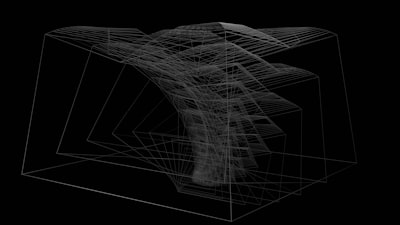
Iterative geometric optimization of separating hyperplanes represents a novel approach in the field of machine learning, particularly for efficiently solving binary classification problems using Support Vector Machines (SVM). Given a labeled and linearly separable dataset, the classic goal is to find the unique maximum-margin separating hyperplane. The key question this technique addresses is: if we already have an initial separating hyperplane, can we leverage it to accelerate convergence to the global optimum? The answer, based on a purely geometric strategy, is affirmative and opens the door to faster, more scalable methods applicable in business environments where computational time is critical.
The proposed algorithm starts from any separating hyperplane and, at each iteration, analyzes the current active set —the data points lying on or near the margin at that iteration— to readjust the hyperplane's orientation. This process maintains separation between classes throughout while monotonically increasing the margin until it reaches the theoretical maximum. Unlike traditional SVM solvers, which solve a large convex quadratic optimization problem, this approach decomposes the global problem into a sequence of smaller local subproblems, each associated with the active set of the current iteration. This not only reduces computational complexity but also allows leveraging local information to guide the search for the optimum.
The method's key lies in its geometric interpretation: instead of optimizing over all points directly, it realigns the hyperplane according to the optimal hyperplane for the active subset. This process repeats until the active set stabilizes, at which point the hyperplane coincides with the maximum-margin one. Theoretical results show that under certain conditions convergence is fast and guaranteed. Moreover, preliminary experimental evaluations indicate that when a reasonable initialization is available —for example, from a previous classifier trained on a subset of data— the method can outperform state-of-the-art techniques, especially on large datasets where global optimization is expensive.
From a business perspective, iterative geometric optimization of separating hyperplanes offers significant advantages for developing custom software applications that integrate artificial intelligence (AI). In sectors such as banking, logistics, or healthcare, where classification models must be frequently updated with new data, the ability to start from an existing hyperplane and refine it quickly drastically reduces training times. Furthermore, the iterative and local nature of the algorithm makes it especially suitable for cloud AWS/Azure environments, where computational resources are elastic and horizontal scaling is required. By splitting the problem into smaller subproblems, iterations can be distributed across multiple nodes, further accelerating the process.
Implementing such algorithms is part of the solutions offered by Q2BSTUDIO as a software and technology development company. Our team integrates advanced optimization techniques into the design of AI systems, ensuring models are not only accurate but also efficient in production. For example, when building AI agents that must learn from continuous data streams, the ability to quickly readjust separating hyperplanes allows maintaining predictive quality without full retraining. This is combined with cybersecurity strategies to protect sensitive data during the process, and Business Intelligence (BI/Power BI) solutions that visualize model performance in real time.
The connection with the cloud ecosystem is natural: AWS and Azure cloud services provide the infrastructure needed to run these algorithms in a distributed manner, while BI/Power BI tools allow monitoring margin evolution and detecting potential deviations. At Q2BSTUDIO, we have developed methodologies to incorporate this geometric optimization into machine learning workflows, offering our clients a differentiating value: models that are faster to train, easier to update, and with lower operational cost.
In summary, iterative geometric optimization of separating hyperplanes is an example of how computational geometry can reinvent classical machine learning methods. Its efficiency when an initial seed is available makes it a powerful tool for business applications that require adaptability and speed. Q2BSTUDIO, as a technology partner, integrates these innovations into AI, automation, cybersecurity, and BI solutions, helping organizations transform their data into intelligent decisions faster.


