
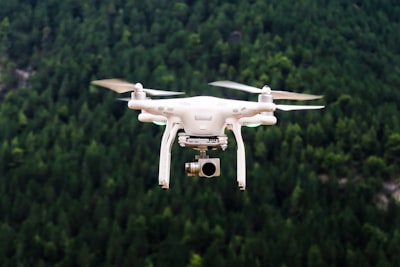
Controlling unmanned aerial vehicles (UAVs) through natural language agents represents an exciting frontier in automation. However, self-hosted agents designed for general desktop computing —known as SHCUAs— present a structural mismatch when directly applied to drone flight. These agents operate under assumptions of tolerable latency and non-critical decisions, while a UAV demands real-time responses, validation of changing physical states, authorization compliance, and forensic traceability. An outdated or tampered command can result in an accident or a security breach. This is where RT-SHCUA emerges: an architecture that restructures the self-hosted agent to operate with explicit contracts of time, state, authority, and evidence. This article explores how this proposal can integrate into business ecosystems and what technological services —such as those offered by Q2BSTUDIO— enable its real-world implementation.
To understand the problem, imagine a delivery drone receiving a verbal instruction: 'drop the package on the roof of building B.' A traditional SHCUA would execute that order as a sequence of high-level commands, but without verifying whether the battery is sufficient, whether wind exceeds operational limits, or whether the airspace is restricted. In a controlled environment, a delay of hundreds of milliseconds might be acceptable; in a drone flying over a city, it is not. RT-SHCUA solves this by transforming the agent's orders into contracted skill invocations: each skill carries an execution deadline, a prior state validation, an authority level, a degradation plan, and an immutable log. The separation between semantic reasoning (slow, in the cloud or edge) and onboard execution (fast, validated, and isolated) is key.
From a business perspective, this architecture opens opportunities for developers of artificial intelligence and cybersecurity. On one hand, semantic reasoning can be processed by large language models (LLMs) hosted on AWS or Azure, leveraging cloud elasticity. On the other hand, the onboard execution layer requires critical software components, often implemented in microcontrollers or trusted execution environments (TEEs). This is where custom application development comes into play: Q2BSTUDIO offers multiplatform software solutions that integrate everything from AI logic to security validation, including cloud orchestration. The company knows how to design contract APIs that ensure each skill is executed only if the drone's state permits, with fallback mechanisms that prevent catastrophic decisions.
Cybersecurity is another fundamental pillar. An inadequately secured UAV can be hijacked, manipulated, or used for espionage. RT-SHCUA proposes protecting enforcement points through TEE or microcontroller isolation, without moving the entire language agent or high-frequency flight control loop into a trusted environment. This reduces the attack surface and enables post-event audits thanks to auditable evidence preservation. Q2BSTUDIO, with its experience in cybersecurity, can help implement these trust layers, from penetration testing to the design of isolated environments. Traceability of every action —who requested which skill, when, with what authorization— is essential for complying with regulations such as GDPR or aviation standards.
The role of business intelligence (BI) is also relevant. Drones generate massive volumes of telemetric and decision data. With tools like Power BI, companies can visualize fleet status in real-time, detect anomalies in agent decisions, or identify risk patterns. Q2BSTUDIO integrates Business Intelligence solutions that connect RT-SHCUA logs with corporate dashboards, allowing managers to make informed decisions. For example, a dashboard can show the number of degraded skills due to communication failures, correlated with weather conditions, and suggest adjustments in agent logic.
Process automation is another area where RT-SHCUA fits. A drone is not an isolated device; it is part of a logistics ecosystem that includes warehouses, charging stations, inventory systems, and delivery platforms. Self-hosted agents must coordinate with these systems via APIs. Q2BSTUDIO offers process automation services that connect the language agent with ERPs, CRMs, and fleet management systems. The contracted skill of RT-SHCUA can include a precondition that checks stock levels in the warehouse (via Power BI or direct API) before authorizing a delivery flight. All this happens in milliseconds, thanks to optimized onboard execution.
From a technical standpoint, implementing RT-SHCUA requires a multidisciplinary approach. Semantic reasoning can be delegated to AI agents hosted on AWS SageMaker or Azure Machine Learning, while the contract logic is coded in languages like Rust or C++ to ensure determinism and low resource consumption. The microcontrollers performing validation can be STM32 or ESP32 with TEE support. Communication between cloud and drone must be encrypted and authenticated, using protocols like MQTT with TLS. Q2BSTUDIO, with its team of engineers specialized in cloud AWS and Azure, can design this hybrid architecture, ensuring that latency between the remote agent and onboard execution stays within the limits agreed in the contracts.
The prototype evaluation mentioned in the research shows that RT-SHCUA maintains bounded task-level responsiveness while supporting degraded handling, trusted admission, and auditable evidence preservation. This is crucial for commercial applications: a drone that loses connection with the cloud agent can fall back to a safe mode, executing only ground-authorized skills and recording all telemetry for later review. Companies adopting this technology will not only improve security but also demonstrate regulatory compliance with ease.
For Q2BSTUDIO, developing UAV control systems based on AI agents represents a growing business opportunity. Sectors such as precision agriculture, infrastructure inspection, urban logistics, and surveillance require drones that understand complex commands without compromising safety. The company already has experience in custom software for IoT, embedded systems, and artificial intelligence, so it can tackle RT-SHCUA projects from consulting to final implementation.
In summary, RT-SHCUA is not just an academic concept; it is an enabler for the next generation of autonomous drones governed by natural language. The combination of semantic reasoning in the cloud and secure onboard execution, with explicit contracts, solves the real-time and security problems that plague traditional SHCUAs. Companies wishing to lead this market need technology partners with a multidisciplinary vision: custom application developers, cloud and AI experts, cybersecurity specialists, and BI analysts. Q2BSTUDIO brings all these capabilities under one roof, offering a complete ecosystem to build, deploy, and maintain UAV control solutions based on intelligent agents. Security and accountability are no longer obstacles; with RT-SHCUA, language-based autonomous flight becomes a viable business reality.

