
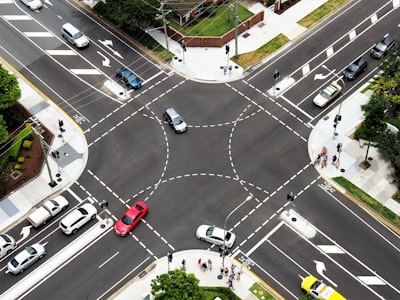
Coordinating autonomous vehicles at unsignalized intersections remains one of the most complex challenges for modern artificial intelligence systems. Unlike signalized intersections with explicit traffic rules, unsignalized environments require vehicles to negotiate right-of-way dynamically and safely in real time. Traditional multi-agent reinforcement learning (MARL) approaches often struggle with combinatorial action spaces, reliance on privileged information, or rigid architectures that limit scalability and practical deployment. In this context, MAPS (Master-Agent Proto-plan System) emerges as a hierarchical deep reinforcement learning architecture that proposes a new coordination paradigm.
MAPS design separates responsibilities: a centralized Master agent generates a compact continuous embedding, called a proto-plan, which encodes a global coordination strategy. This proto-plan serves as a high-level summary of the intersection state and long-term intentions. Decentralized Worker agents then integrate this embedding with their local observations to execute vehicle-specific control. This decomposition between strategic intent and tactical execution allows each module to be optimized independently, reducing learning complexity and improving computational efficiency.
Tests conducted across 72 intersection configurations within the HighwayEnv environment demonstrate that MAPS achieves collision-free navigation while significantly reducing average travel time compared to state-of-the-art baselines. Furthermore, the learned proto-plans exhibit remarkable generalization: a system trained with three agents achieves a 94% success rate when deployed zero-shot to five-agent scenarios. This confirms that proto-plan-based hierarchical learning provides a promising framework for multi-agent coordination in dynamic environments.
From a technical perspective, MAPS addresses the combinatorial explosion problem by compressing the global state into a low-dimensional proto-plan. The Master agent, trained via deep reinforcement learning, learns to generate proto-plans that adapt to different traffic patterns and intersection geometries. This enables decentralized workers to focus on local actions while receiving high-level guidance, enhancing robustness and scalability.
Implementing systems like MAPS requires a multidisciplinary approach combining artificial intelligence, cloud computing, and robust software development. Companies like Q2BSTUDIO, with expertise in custom software development, offer the capabilities needed to translate these research advances into production environments. For instance, deploying AI agents on cloud infrastructures such as AWS or Azure enables scalable training and inference of complex models, optimizing costs and performance. Additionally, cybersecurity is critical to protect vehicle-to-infrastructure communications, ensuring data integrity and confidentiality.
Integrating Business Intelligence tools like Power BI facilitates monitoring and analysis of data generated by coordination systems, allowing identification of bottlenecks and real-time performance optimization. From designing AI agents to process automation, Q2BSTUDIO provides comprehensive solutions covering the entire software lifecycle, including cybersecurity, cloud computing, and business intelligence.
The concept of AI agents is central to MAPS. Each autonomous vehicle acts as an intelligent agent that makes decisions based on its local perception and the received proto-plan. This architecture resembles the multi-agent systems Q2BSTUDIO develops for sectors such as logistics, manufacturing, or urban mobility. The ability to customize these agents according to specific client needs is one of the company's key differentiators.
The generalization observed in MAPS suggests this approach can be extended to more complex scenarios, such as multi-lane intersections, pedestrians, or adverse weather conditions. This requires agile and scalable development platforms, as well as expertise in machine learning and cloud architectures. Q2BSTUDIO combines these capabilities with a results-oriented business vision, helping clients integrate cutting-edge solutions into their daily operations.
In summary, MAPS represents a significant advancement in autonomous vehicle coordination at unsignalized intersections, overcoming limitations of traditional MARL approaches. Its hierarchical architecture and learned proto-plans offer an optimal balance between global vision and local autonomy. To turn these concepts into real-world solutions, collaboration with software development companies like Q2BSTUDIO, specializing in AI, cloud, and custom applications, becomes a critical success factor. The future of autonomous mobility depends on intelligent, secure, and scalable systems, and MAPS is a solid step in that direction.

