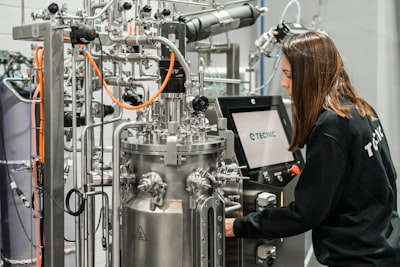
In the biopharmaceutical and biotechnology sectors, developing new manufacturing processes based on microorganisms or cells faces a recurring challenge: scarcity of experimental data. Bioreactors are expensive to operate, experiments can take days or weeks, and data is rarely shared publicly. This reality limits the application of modern artificial intelligence (AI) techniques that require large volumes of information. However, the field of bioprocess engineering possesses valuable prior knowledge: biokinetic ordinary differential equation (ODE) models that have described microbial growth for decades. The key question is how to inject that knowledge into neural networks to overcome data scarcity. A recent systematic study demonstrates that two approaches —pre-training with simulated data and architectural embedding of the ODE— are equally effective and interchangeable, opening a practical path for modeling with scarce data.
For companies developing software and technology solutions in this area, this finding represents a strategic opportunity. It is not necessary to redesign the entire neural architecture; a generic decoder pre-trained on simulated ODE curves suffices. This simplifies implementation and reduces development costs. At Q2BSTUDIO, we understand this need and offer custom software that integrates hybrid models, combining physical foundations with machine learning. Our AI experts design models that leverage these biokinetic priors to optimize fermentation processes, recombinant protein production, or cell cultures, even when datasets are small.
The study compared two methodologies: a data-level approach (pre-training a generic decoder on ODE simulations) and an architecture-level approach (embedding the ODE directly into the neural network). Results across eleven datasets and seven microbial species showed that both consistently outperform no-prior baselines. But most importantly, they are substitutable: a generic decoder trained on simulations matches the performance of a bio-structured model trained on real data. This has huge practical implications: companies can use cheap simulations to pre-train models and then fine-tune them with a few real experiments, saving time and money.
From a software engineering perspective, implementing these priors requires solid technical infrastructure. It involves handling large volumes of simulated data, integrating ODE solvers with deep learning frameworks, and ensuring scalability. This is where cloud services like those we offer in cloud AWS/Azure become essential. Cloud platforms allow parallel simulations, synthetic curve storage, and distributed neural network training without investing in local hardware. Additionally, cybersecurity is critical when handling industrial process data or intellectual property. Our cybersecurity team helps protect these cloud environments and trained models from external threats.
Another key aspect is visualization and analysis of results. Hybrid models generate predictions and also provide insights into process dynamics, facilitating decision-making. Business Intelligence (BI) tools like Power BI allow integrating these outputs into interactive dashboards. At Q2BSTUDIO, we develop BI / Power BI solutions that connect directly with prediction models, offering researchers and managers a clear view of bioprocess performance, early deviation alerts, and data-driven recommendations.
Automation of these workflows is a natural next step. AI agents, like those we implement in automation projects, can orchestrate the entire cycle: from generating ODE simulations to periodic model retraining when new experimental data arrives. This turns a manual process into an autonomous system that learns and adapts, reducing human intervention and accelerating process optimization.
It is important to note that the methodology is not limited to classical biokinetic models. Any domain where differential equations capture underlying dynamics (e.g., enzyme kinetics, substrate transport, or cellular metabolism) can benefit from this approach. Flexibility is high: one can choose between a data-level or architecture-level prior depending on experimental data availability and model complexity. For biotech companies seeking innovation, having a technology partner that understands both process science and software development is key. At Q2BSTUDIO, we combine both capabilities.
Finally, the original article mentions that simulation pre-training offers a simple, data-efficient recipe for deep learning under data scarcity. This simplicity is exactly what companies need to adopt AI without excessive investment. The entry barrier is lowered: no need for a team of physicists to design complex neural architectures; a reasonable ODE model and a synthetic curve generator suffice. From there, developing custom AI agents can drive the next generation of smart bioreactors, capable of real-time self-adjustment with minimal experiments. We are witnessing a paradigm shift that democratizes bioprocess modeling, and at Q2BSTUDIO we are ready to lead its implementation in the business world.