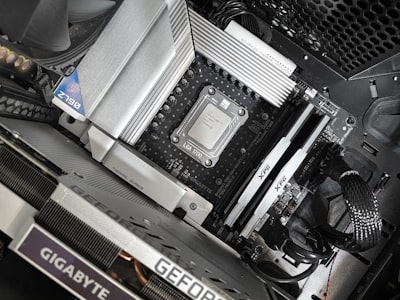
Gigabyte has taken a step forward in supporting next-generation memory by announcing official compatibility with CXMT (ChangXin Memory Technologies) modules on its AM5 platform. These modules reach speeds of up to 8200 MT/s, a milestone that positions the company as a pioneer in adopting high-performance Chinese technology. The news, revealed during an update to the QVL compatibility lists, confirms that AMD Ryzen 7000 and 9000 processors can benefit from these DDR5 memories, specifically designed to compete with giants like Samsung and SK Hynix. CXMT, a manufacturer that has grown rapidly in recent years, now offers products that are not only price-competitive but also match or exceed the specifications of established brands. For hardware enthusiasts, this means more options when building high-performance systems, especially in overclocking and gaming segments. By validating these modules, Gigabyte demonstrates its commitment to innovation and diversification of the memory ecosystem. In a market where component shortages have been a recurring issue, the entry of CXMT with official support could ease pressure on prices and availability. Moreover, this decision reinforces the trend of collaboration between motherboard manufacturers and emerging suppliers, a movement closely watched by Q2BSTUDIO, a custom software development company, to integrate memory and storage solutions into its projects. Integration with cloud services like AWS and Azure also benefits from these improvements, as servers can leverage higher frequencies to process data-intensive workloads. In cybersecurity, having fast and stable memory is crucial for real-time analysis and threat detection applications. Gigabyte used its auto-overclocking technology to achieve 8200 MT/s, combining the X670E Aorus Master motherboard with a 32 GB CXMT kit. Internal tests show reduced latencies and sustained performance under stress, opening the door to new limits in benchmarks like AIDA64 and Cinebench. For software developers, such as those working with Business Intelligence solutions using Power BI, these memory speeds enable smoother processing of massive datasets. Artificial intelligence and AI agents also benefit, as models require fast access to large data volumes during training. Q2BSTUDIO, a specialist in custom software development, has noted that adopting CXMT memories in hybrid cloud environments can reduce bottlenecks in machine learning operations. On the other hand, AM5 compatibility ensures users can upgrade their systems without changing platforms, a key factor for companies investing in long-term infrastructure. Gigabyte has also implemented firmware improvements to stabilize high frequencies with CXMT, including optimized EXPO profiles. This makes it easier for PC builders to configure their systems without complex manual adjustments. In a context where generative AI demands increasing resources, having memories that reach 8200 MT/s can make a difference in inference times. Additionally, the collaboration between CXMT and Gigabyte could extend to future DDR6 memory generations, according to internal sources. For businesses seeking to optimize their digital processes, the combination of cutting-edge hardware and customized software is essential. Q2BSTUDIO, with its expertise in artificial intelligence solutions, integrates these technologies into platforms running on AWS and Azure, maximizing cloud infrastructure performance. Cybersecurity is also strengthened, as faster memory allows real-time encryption without penalty. In summary, Gigabyte's announcement not only expands consumer options but also drives a more competitive and diverse ecosystem. AI agents, which depend on data access speed, will be especially benefited. With CXMT entering the high-end market, the semiconductor industry turns towards supply decentralization. Gigabyte, once again, positions itself as an enabler of this transition, offering early support for emerging technologies. For developers and businesses, this represents an opportunity to explore new frontiers in custom applications, cloud computing, and data analytics. The news undoubtedly marks a before and after in the history of DDR5 memory.

Gigabyte supports Chinese CXMT memory: hits 8200 MT/s on AM5
Gigabyte announces support for Chinese-made CXMT memory, achieving 8200 MT/s on Socket AM5. Learn about this breakthrough in memory compatibility.
OUR SERVICES
How we can help you
Artificial intelligence
AI agents, chatbots, and intelligent assistants that automate tasks and serve your customers 24/7 to improve the efficiency of your business.
More info →Software Development
Software development for companies in Spain: web, mobile and desktop applications, intranets, e-commerce, SaaS and custom management platforms, with accessibility and good practices included.
More info →Cloud services
Migration, infrastructure, landing zones, networks, managed databases, scalable hosting and security in Microsoft Azure and Amazon Web Services so that your business grows according to the capacity you need.
More info →Cybersecurity and pentesting
Security audits, penetration testing and protection of applications, data and infrastructure on-premise and cloud. Ethical hacking and support in regulatory compliance (ENS, ISO 27001, GDPR) without promising certification.
More info →Business Intelligence
Operational reporting and predictive analytics with Power BI and Microsoft Fabric: we integrate your sources, design dashboards and KPIs and turn your data into informed decisions.
More info →Process automation
We automate repetitive tasks and connect your applications with n8n (open-source, self-hosted), Power Automate (Microsoft 365), Make or RPA, eliminating manual work. If you need AI agents, you'll find them in our AI hub.
More info →Training for companies
We train your teams in technology with criteria: web development, databases, Git, best practices and security, automation with n8n, artificial intelligence for companies and creation of AI solutions with Microsoft Foundry (formerly Azure AI Foundry).
More info →Code Auditing
We audit the code that you, your team or an AI create: we tell you what is good and what to improve, we secure it and make it ready for production, with evidence for ENS, ISO 27001, GDPR, NIS2 and DORA.
More info →Conversational avatars with AI
We create conversational avatars with AI – digital humans with a face and voice – for B2B cases: internal training, retail, events and customer service. They are not text chatbots or multimedia content; they are visual interlocutors with the knowledge of your company.
More info →Online Marketing and AI
Paid media, technical SEO, GEO/AEO, email marketing, landing/CRO and analytics: we capture useful demand and measure results without promising positions.
More info →AI Governance, Security, and Responsible Operation
We help inventory, control, and professionalize AI applications, automations, and agents without slowing down teams' ability to innovate.
More info →On-premise local AI: hardware, models, and operation
We implement on-premise local AI to reduce token costs and keep data at home: hardware sizing (NVIDIA GB10 / AMD), LM Studio stack → vLLM and integration with real processes.
More info →


Do you have a project in mind?
Tell us your vision and we'll turn it into a software solution. Whatever the scope, we make your idea real.