
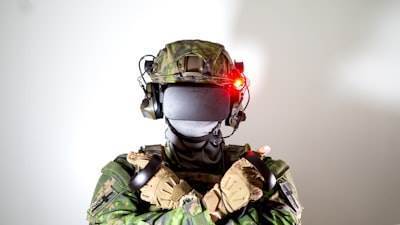
Autonomous risk detection in virtual environments has become a fundamental tool for improving situational awareness in real hazardous situations. When we talk about emergencies such as natural disasters, industrial incidents, or rescues in hostile zones, the ability to quickly and accurately identify threats can mean the difference between an effective response and a catastrophe. Virtual reality (VR) offers a controlled environment where autonomous systems can be trained and evaluated, while artificial intelligence (AI) provides the analytical capability needed to recognize risk patterns. This article explores how the combination of VR, AI agents, and vision language models (VLMs) enables early warning systems that also integrate with cloud platforms like AWS or Azure to process large volumes of data in real time.
Currently, custom custom software applications are transforming how companies approach safety. Instead of relying solely on physical sensors, digital twins of hazardous scenarios are being developed where a virtual exploration robot traverses the environment and, using vision language models, identifies points of interest that could pose a risk to human operators. These systems not only detect gas leaks, collapses, or fire sources, but also communicate information intuitively through immersive interfaces. The key lies in integrating AI with VR: while the machine processes images and data, the user can visualize annotations in real time within the VR headset, improving decision-making without overwhelming the operator with raw data.
From a technical perspective, implementing these systems requires a robust architecture that combines AI agents with cloud infrastructure. For example, a VLM hosted on AWS or Azure can analyze video streams sent from the virtual robot, while a Business Intelligence (BI) dashboard built with Power BI collects performance metrics and historical alerts. Cybersecurity also plays a crucial role: incident data and communications between the robot and the control center must be protected to prevent malicious tampering. Companies that embrace these technologies often turn to customized software developments that adapt to their specific protocols, ensuring every detail of the workflow is optimized for speed and accuracy.
One of the most promising advances in this field is the use of autonomous AI agents that not only detect risks but also prioritize alerts based on severity and proximity. For instance, in a rescue drill in a collapsed building, the system can identify unstable zones by analyzing cracks in virtual walls and mark safe routes for rescuers. All of this is presented in a VR interface that overlays icons, colors, and text descriptions generated by the VLM. Initial studies show that operators prefer this type of annotation over raw visualization because it reduces cognitive load and allows faster reaction. This is especially relevant in environments where every second counts.
The integration of these solutions is not limited to drills. Many companies are already adopting mixed approaches where VR is used for continuous training of safety teams, while the same detection algorithms are deployed on drones or physical robots in real environments. Hybrid cloud (with AWS or Azure) allows trained models from VR to be synchronized with production systems, keeping the knowledge base on new types of risks up to date. Additionally, data analysis through BI tools, such as Power BI, facilitates trend identification and iterative improvement of response protocols. For organizations seeking this level of customization, having a technology partner that offers custom software applications is essential to ensure the architecture precisely fits their operational and safety needs.
Another fundamental aspect is cybersecurity in the data flow. When an autonomous risk detection system communicates with a VR interface, multiple entry points can become vulnerable. Therefore, cybersecurity solutions must be implemented from the design stage, encrypting communications and authenticating both the robot and the operator. Q2BSTUDIO, a company specialized in software development and advanced technologies, offers precisely these integrations: from creating custom VR environments to implementing AI agents and managing cloud infrastructure. Their team combines expertise in fields such as computer vision, machine learning, and information security, enabling them to provide comprehensive solutions that span from prototype to production.
In terms of scalability, cloud computing (AWS or Azure) allows even small organizations to access powerful AI models without investing in expensive hardware. For example, a gas leak detection system in a chemical plant can process virtual camera images in real time using serverless services, while a Power BI dashboard displays the status of each zone. If an anomaly is detected, the system can trigger an immediate alert in the supervisor's VR, who decides whether to activate evacuation protocols. This autonomous response capability, combined with human supervision, is the core of advanced situational awareness.
The current trend suggests that vision language models will become increasingly accurate and faster, allowing virtual robots to identify not only static objects but also dynamic behaviors, such as smoke dispersion or movement of people in danger. Integration with recommendation systems based on AI can even suggest actions to the operator, such as the safest route or use of protective equipment. All these functionalities benefit from custom development, where each module adapts to the specific industry context: mining, oil, disaster response, etc.
In conclusion, autonomous risk detection in VR is not a future technology, but a reality already improving situational awareness in hazardous environments. The combination of automation systems with immersive interfaces, supported by cloud infrastructure and BI tools, provides operators with a decisive advantage. For companies wanting to implement these solutions, collaborating with a provider that masters both custom software development and the integration of AI, cybersecurity, and cloud is the most efficient path. Q2BSTUDIO positions itself as a strategic ally in this transformation, offering from initial consulting to continuous maintenance of critical systems.

