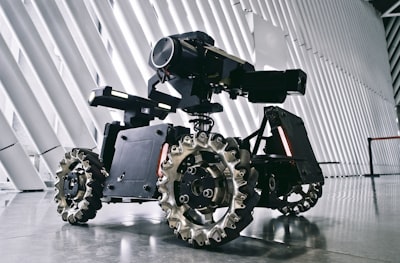
Autonomous navigation of rovers in unstructured environments—such as deserts, steep slopes, or rocky terrain—demands far more robust situational awareness than conventional sensors can provide. Traditional systems relying solely on RGB and depth cameras can fail under adverse lighting, dense shadows, or thermally similar surfaces. To overcome these limitations, multimodal sensor fusion has become a key trend. In this context, the PRISM system (Perception for Rover Integrated Situational Mapping) represents a significant advance by integrating thermal, optical, and depth imagery to generate accurate, real-time traversability maps. This article analyzes PRISM's technological architecture, its real-world applications, and how specialized custom software development companies can replicate and adapt similar solutions for other sectors.
PRISM uses a custom sensor suite that captures aligned RGB imagery, depth maps, and thermal data (RGB-D-T). The core of the system is OmniUnet, a novel vision transformer-based network specifically designed for multimodal semantic terrain segmentation. This architecture enables high-precision classification of categories such as loose rock, sand, vegetation, or water, even under conditions where a single modality would fail. The system was validated using two annotated datasets (BASEPROD and LAENTIEC) and through physical field experiments, demonstrating its ability to run on a resource-constrained embedded computer while generating traversability maps that directly feed the rover's Guidance, Navigation, and Control (GNC) subsystem.
From a technical and business perspective, developing systems like PRISM requires a combination of software engineering, artificial intelligence, and edge computing expertise. Integrating multiple sensors, precisely calibrating data, and optimizing deep learning models for limited hardware are challenges that not all organizations can handle internally. This is where the experience of companies like Q2BSTUDIO comes into play, specializing in custom software development. A team skilled in sensor fusion, image processing, and edge deployment can build robust, scalable robotic solutions tailored to specific client needs, whether for planetary exploration, precision agriculture, or infrastructure inspection.
One of the most critical aspects of such systems is the ability to process large volumes of data in real time without relying on a permanent cloud connection. PRISM achieves this through an efficient segmentation model (OmniUnet) running on a low-power embedded computer. However, training and updating these models requires powerful cloud infrastructure. Cloud solutions from AWS or Azure enable storing labeled datasets, running distributed training, and deploying optimized model versions to devices. A company like Q2BSTUDIO offers cloud services that facilitate the entire model lifecycle, from data ingestion to edge inference, ensuring scalability and high availability.
Cybersecurity is another fundamental pillar when discussing autonomous systems operating in critical or industrial environments. A rover navigating a mine or a solar plant must be protected against attacks that could alter its traversability maps or command dangerous movements. Implementing secure communication protocols, sensor authentication, and encrypted over-the-air updates are essential practices. In this regard, Q2BSTUDIO's cybersecurity services help identify vulnerabilities and design resilient architectures, protecting both data and the robot's operational integrity.
Beyond navigation, the data generated by systems like PRISM holds enormous potential for business analysis. Terrain information (slopes, vegetation cover, soil compaction) can feed Business Intelligence dashboards and Power BI, enabling fleet managers to make informed decisions about optimal routes, predictive maintenance, or resource allocation. Q2BSTUDIO has experts in BI and Power BI who can integrate these heterogeneous data sources and create interactive visualizations that facilitate remote monitoring of autonomous missions.
Finally, the evolution toward AI agents capable of reasoning and planning in real time opens new frontiers. A rover that not only segments terrain but also predicts soil stability or adapts its traction strategy based on continuous learning is moving toward full autonomy. Q2BSTUDIO's AI agents can be integrated into navigation systems to make decisions such as rerouting in unexpected terrain, optimizing energy consumption, or even collaborating with other rovers in cooperative mapping tasks. These capabilities turn PRISM not just into a perception solution, but into a technological enabler for the next generation of autonomous vehicles.
In summary, PRISM demonstrates that combining thermal, depth, and optical vision with advanced deep learning models can overcome the challenges of navigation in complex terrains. For companies seeking to implement similar solutions—whether in agricultural robotics, autonomous mining, or space exploration—having a technology partner that offers custom software, cloud services, cybersecurity, BI, and artificial intelligence is key to accelerating innovation and reducing risks. Q2BSTUDIO, with its multidisciplinary expertise, is ready to accompany its clients at every step, from prototype to mass deployment, ensuring that the robots of tomorrow navigate safely and efficiently even in the harshest environments.