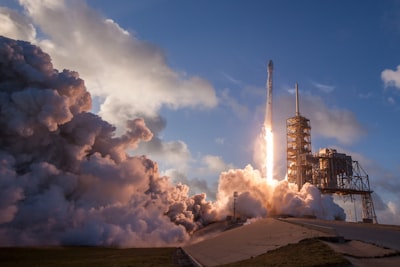
SpaceX has once again made headlines with the launch of a new batch of Starlink V3 satellites, designed to expand its global broadband internet constellation. However, the mission was not without setbacks: the first-stage booster, a reused Falcon 9, experienced another failure in re-lighting its engines during the landing maneuver on the floating platform. This incident, although it did not compromise the orbital insertion of the satellites, highlights the persistent technical challenges in rocket reusability and the need for increasingly precise software engineering.
Elon Musk's company has accumulated unparalleled experience in rapid launches, but each mission reveals areas for improvement. On this occasion, after stage separation, the booster attempted to return to the droneship for a controlled vertical landing. However, telemetry indicates that one of the engines did not reignite correctly, causing an unstable trajectory that forced the landing attempt to be aborted and the rocket to be diverted into the ocean. Fortunately, full flight data was captured, allowing engineering teams to analyze the failure.
This type of problem is not new in the aerospace industry. The Merlin engines that power the Falcon 9 require extremely precise ignition under vacuum conditions and at high speeds. Any deviation in combustion parameters or control systems can lead to failures. The lesson here is that the reliability of a reusable system depends as much on hardware as on the software that governs it. In fact, much of SpaceX's success lies in its ability to rapidly iterate on flight control code, using advanced simulation models and artificial intelligence algorithms to predict behavior.
From a business perspective, these situations underscore the importance of having robust, custom software solutions. Companies that operate critical infrastructure, whether in space or on Earth, need applications that not only work but adapt to extreme conditions. This is where companies like Q2B Studio offer a differential value, developing customized platforms that integrate real-time analytics, cybersecurity, and cloud enablement.
The booster failure also has direct implications for SpaceX's launch strategy. With over 6,000 Starlink satellites already in orbit and plans to deploy thousands more, the company needs to maximize the reuse rate of its boosters to reduce costs. Each failure forces increased inspection intervals and modifications to reignition profiles, slowing the launch cadence. Analysts suggest that the solution may come from control systems based on AI agents, capable of making autonomous decisions in milliseconds to compensate for anomalies.
Precisely, artificial intelligence and autonomous agents are revolutionizing how complex systems are managed. SpaceX already uses neural networks to optimize reentry trajectories, but the recent failure indicates there is still room for improvement. In sectors such as logistics, manufacturing, or telecommunications, incorporating AI agents allows anticipating failures, automating responses, and reducing downtime. Q2B Studio, with its experience in custom application development, helps companies integrate these capabilities without reinventing the wheel.
Another relevant aspect is cybersecurity. A rocket like the Falcon 9 is essentially a flying computer, vulnerable to attacks if its communication and control systems are not properly protected. The reignition failure, though likely mechanical in origin, reminds us that any software vulnerability can be exploited. Therefore, companies handling sensitive data or critical infrastructure should invest in cybersecurity from the design phase, including penetration testing and continuous monitoring.
The cloud also plays a central role. SpaceX stores and processes petabytes of telemetry on platforms like AWS, where it runs big data analytics to identify failure patterns. The combination of hybrid cloud with Azure or AWS allows scaling resources on demand, essential for launch operations. Companies looking to modernize their infrastructure can benefit from managed cloud services offered by experts like Q2B Studio, providing secure migrations and cost optimization.
In the field of business intelligence, space mission telemetry data is a perfect example of how to turn complex information into strategic decisions. Tools like Power BI enable real-time visualization of engine performance, turbopump temperatures, or structural vibrations. Q2B Studio helps organizations implement Business Intelligence solutions that transform raw data into intuitive dashboards, facilitating early anomaly detection.
Returning to the SpaceX incident, the company has already announced it will temporarily pause launches with that specific booster while investigating the root cause. Transparency in communicating failures is a hallmark of the company's engineering culture, and also a lesson for any organization wanting to improve its processes. Instead of hiding errors, SpaceX uses them as fuel for innovation, iterating on design and software.
For tech companies not operating in space, the moral is clear: software reliability is not a luxury, it is a necessity. From mobile apps to industrial control systems, skipping thorough testing or lacking a specialized development team can result in costly failures. Q2B Studio, with its focus on process automation and cross-platform development, offers companies the ability to create robust solutions tailored to their specific needs, whether in cloud, on-premise, or hybrid environments.
In conclusion, the launch of the new Starlink V3 satellites once again demonstrates SpaceX's ambition to democratize Internet access, but also highlights the technical challenges that still persist. The booster failure is a reminder that innovation comes with risks, and that excellence in software and hardware engineering is key to overcoming them. Companies like Q2B Studio are at the forefront of this transformation, helping organizations of all sizes implement custom applications, artificial intelligence, cybersecurity, and cloud solutions that make a difference in an increasingly competitive market.