
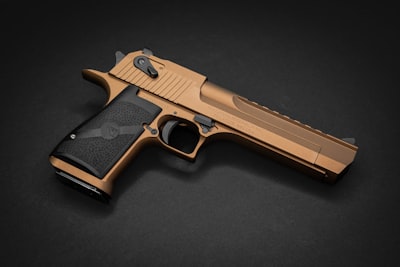
In the fast-paced world of tech accessories, creations sometimes emerge that defy not only functional logic but also legal and social frameworks. The recent launch of designer Luke Blackford’s “Gundle”—a case for the Xteink X4 e-reader shaped like a pistol—has ignited a debate that goes far beyond aesthetics. The question is clear: can a 3D-printed plastic case that mimics a real gun but lacks any firing mechanism be considered a weapon? The answer is not so simple, and to understand it, we need to explore the technical, business, and cybersecurity angles surrounding this peculiar object.
From a purely physical perspective, the Gundle is harmless: its trigger doesn’t activate any striker, it can’t hold ammunition, and it’s designed solely to hold an e-reader vertically. However, appearance matters. In a context where gun violence is a global concern, carrying an object that resembles a Glock 19 can trigger legitimate alarms. Law enforcement, trained to assess threats in milliseconds, could mistake it for a real weapon, with potentially serious consequences. This is where technology comes in: how can we, through software development, help mitigate these risks?
Companies like Q2BSTUDIO, specialized in custom applications, are already exploring artificial intelligence solutions for real-time object recognition. Imagine a surveillance system equipped with AI agents that, through models trained on thousands of images, can distinguish between a functional gun and an inert accessory like the Gundle. This capability would not only improve the effectiveness of security protocols but also reduce false positives that could endanger innocent citizens. Implementing such systems requires robust cloud processing, which is why platforms like cloud AWS and Azure become indispensable allies for handling high data volumes and critical latency.
But the debate doesn’t stop at instant perception. Cybersecurity also plays a key role. If a pistol-shaped case can be considered an ambiguous object, what about the IoT devices around it? Many modern e-readers connect to Wi-Fi networks and store personal information. A 3D-printed accessory might seem harmless, but in the wrong hands, it could serve as a container to hide malicious hardware, like a camouflaged Raspberry Pi or a card reader. That’s why at Q2BSTUDIO we offer cybersecurity and pentesting services to assess vulnerabilities in environments where the line between physical and digital blurs. Our team analyzes not only software but also peripheral hardware that could be an attack vector.
Another angle worth attention is the business perspective. Companies that manufacture tech accessories must anticipate market reactions and regulatory responses. The Gundle, though a small-scale artisan creation, could inspire others to design similar cases. In that scenario, businesses need business intelligence (BI) tools to model risk scenarios and make informed decisions. With Power BI and customized BI solutions, it’s possible to cross-reference sales data, user reviews, local regulations, and security trends to predict potential legal or reputational issues. Predictive analytics, powered by AI agents, allows companies to stay ahead of conflicts before they materialize.
The question of whether an e-reader case shaped like a pistol is a weapon transcends the legal realm. From a technical standpoint, the answer is no. But the reality is that public perception and law enforcement response may treat it as one. In countries with strict laws on replica firearms—like Australia or the UK—the Gundle could be illegal even if it can’t fire. In the US, where gun ownership is a constitutional right, the debate revolves more around potential confusion. This is where custom software solutions can make a difference: from biometric authentication systems that verify the carrier’s identity to mobile apps that alert about the proximity of suspicious objects.
We cannot forget the role of automation in this ecosystem. 3D printing, the technology that enables the Gundle, is also a gateway to decentralized manufacturing. Q2BSTUDIO has developed process automation platforms that integrate 3D printers, robots, and quality control systems. These solutions allow companies to scale production safely but also demand rigorous control over what is printed. Traceability of designs through blockchain or AI verification systems can prevent the manufacture of dangerous objects disguised as harmless accessories.
Ultimately, the Gundle represents much more than a maker curiosity. It’s a perfect case study for understanding how technology can be a double-edged sword: on one hand, it democratizes creativity; on the other, it poses risks that must be managed intelligently. At Q2BSTUDIO, we believe the key lies in the balance between innovation and responsibility. Our team of developers, experts in AI, cybersecurity, and cloud computing, is ready to help companies and governments navigate these complex waters. Whether creating an object recognition system for airports or a compliance platform for accessory manufacturers, we are committed to a future where technology serves to protect, not deceive.
The final answer to the initial question is that, although the Gundle is not a functional weapon, its mere existence forces us to rethink how we define, regulate, and perceive objects in the digital age. And in that task, custom software, artificial intelligence, and cybersecurity are indispensable tools. The next time we see a suspicious case, perhaps we won’t need to ask if it’s a weapon, but rather what technology we have to identify it without margin for error.

