
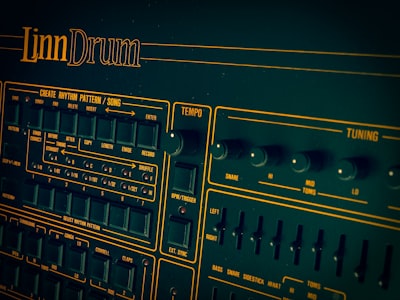
The world of electronic music is full of innovations that defined genres, but few tools have been as transformative as drum machines. From the early beats of Detroit techno to today's mainstream pop, these devices have set the pulse of contemporary culture. Now, journalist and musician Oli Freke presents Beat Gems, a visual work that promises to become the new classic reference for collectors, producers, and enthusiasts alike. Published by Bjooks, the book follows the publisher's line: a high-quality edition packed with stunning photographs, historical anecdotes, and practical advice to get the most out of the gear. But behind this seemingly simple collection of images lies a deep analysis of how analog and digital technology have shaped the music we listen to.
Freke, known for his collaborations with Sound on Sound, The Quietus, and Mixmag, is no newcomer to the study of sound. His previous work includes mathematical explorations of the Western 12-tone scale and detailed breakdowns of effects plug-ins. He has even written a book tracing the evolution of the synthesizer from 1963 to 1995, charting the fascinating journey from analog to digital and back again. With Beat Gems, Freke applies that same rigorous eye to drum machines, offering more than a retro catalog: it is a lesson in engineering, design, and pop culture.
The book does not merely showcase the most iconic machines — such as the Roland TR-808, the Linn LM-1, or the Oberheim DMX — but contextualizes each model within the technological ecosystem of its time. For example, the transition from analog circuits to digital processing not only changed the sound but opened the door to complex rhythm programming, quantization, and later integration with MIDI sequencers. This evolution has a direct parallel with the development of custom software in the world of software: just as hardware engineers had to optimize every component to achieve a unique sound, today's developers build personalized platforms that adapt to the specific needs of each business.
This is precisely where the technical and business perspective worth highlighting comes in. At a time when artificial intelligence is beginning to generate rhythmic patterns and melodies autonomously, understanding the fundamentals of classic drum machines becomes essential. It is not about replacing human creativity, but about enhancing it with tools that mimic the sound design processes Freke documents. Companies that bet on innovation, such as Q2BSTUDIO, understand that value lies not only in the latest technology but in how it is integrated into real workflows. For instance, the development of AI agents capable of assisting in music composition or automated mixing is revolutionizing production, but it requires a solid foundation of knowledge accumulated over decades.
Another fascinating aspect of Beat Gems is how it reflects the intersection of art and science. Drum machines are not just musical instruments; they are electronic engineering artifacts that have required meticulous calibration, circuit design, and often cybersecurity to protect proprietary designs. Today, that same need for security moves to the digital realm: recording studios and streaming platforms depend on robust cloud infrastructures, such as cloud AWS/Azure, to store and process terabytes of audio without compromising data integrity. The cloud not only offers scalability but enables real-time collaboration among producers from different parts of the world, something unthinkable in the age of analog machines.
Furthermore, the ability to analyze music trends through data is a growing field. BI/Power BI is used to understand which sounds perform best in each market, which grooves succeed most in playlists, or how styles evolve over time. In this sense, Freke's work is not only a celebration of the past but a tool to understand the present: by studying the technical specifications of each drum machine, one can draw conclusions about why certain timbres have become iconic and how to replicate them with modern software. Companies like Q2BSTUDIO help record labels and studios develop custom dashboards that visualize this data, facilitating strategic decision-making.
The publication of Beat Gems arrives at a time when interest in music production has grown exponentially thanks to the democratization of digital tools. Anyone with a laptop can create quality tracks, but true mastery still lies in understanding the fundamentals. Freke devotes entire pages to explaining how to adjust drum machine parameters to achieve a characteristic sound, something applicable to both a vintage TR-909 and an emulator plugin. This practical knowledge is invaluable for developers of custom software seeking to create more intuitive and powerful production environments.
From a business perspective, the book is also a reminder that innovation is not linear. The back-and-forth journey between analog and digital that Freke describes for synthesizers is repeated in drum machines: after years of digital dominance, many producers have returned to seeking the warmth of analog circuits, and manufacturers have responded with hybrid recreations. This dynamic is similar to that experienced by technology companies when deciding whether to adopt cloud solutions, maintain on-premise systems, or combine both approaches. Q2BSTUDIO's consulting services for migration to cloud AWS/Azure offer precisely that flexibility, adapting to each organization's changing needs.
We cannot forget the role of artificial intelligence in contemporary music. AI agents are already capable of generating drum patterns that mimic the styles of great drummers or classic drum machines, but their training depends on precisely labeled datasets. Books like Beat Gems provide a source of structured knowledge about how these patterns work, which could feed future, more sophisticated AI models. Collaboration between human experts and intelligent systems is the next step, and companies like Q2BSTUDIO are at the forefront of developing these synergies.
Ultimately, Beat Gems is not just a book for nostalgics; it is a testament to human ingenuity and a guide for those who want to understand how technology shapes culture. Oli Freke has achieved something many attempt and few accomplish: uniting technical rigor with artistic passion, offering a work that will be consulted by engineers and musicians alike. And in a world where the speed of digital change can be overwhelming, remembering the foundations — whether analog circuits or lines of code — is the first step to innovating with meaning.
For those interested in bringing this philosophy to the business realm, custom software development offers the same creative freedom Freke finds in drum machines: personalization, adaptability, and technical excellence. And if what is sought is integrating artificial intelligence into production processes, Q2BSTUDIO's AI solutions allow automating complex tasks while maintaining human control. Just like a well-programmed drum machine, the right technology can make the difference between an ordinary beat and a hit that endures.

