
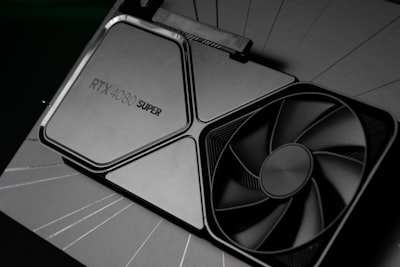
The world of modding has taken a step further with a modification that blends engineering, creativity, and a touch of eccentricity: an enthusiast has installed a 2.5-kilogram aluminum heatsink on an NVIDIA GeForce RTX 4060 graphics card. The result, far from being merely aesthetic, demonstrates how natural convection can effectively cool a modern GPU without active fans. This experiment not only challenges the conventions of thermal design but also opens up debates on efficiency, customization, and the role of software in maximizing the performance of alternative hardware.
The RTX 4060, known for its energy efficiency and low thermal profile, becomes the perfect candidate to test extreme passive cooling. The modder selected a solid 2.5 kg aluminum block with dense fins, optimized for heat dissipation through convection. Initial tests show that under sustained load, the temperature remains within acceptable ranges (around 75-80°C) without fans, proving that passive design can be viable if sufficient thermal mass and adequate exchange surface are present.
Behind this feat lie basic thermodynamic principles: convection allows hot air to rise naturally while cool air takes its place, creating a continuous flow. The heatsink acts as a large heat sink that absorbs energy from the chip and dissipates it into the environment. However, in enclosed spaces or without controlled airflow, this method may not suffice, so the modder also optimized the card's orientation and case ventilation.
Such experiments have implications beyond hobbies. For companies developing custom software or integrating high-performance systems, thermal management is a critical factor. For instance, in data centers with silent servers or in industrial equipment where fans are failure points, well-designed passive cooling solutions can reduce maintenance costs and improve reliability. In this context, the ability to simulate and control temperature through intelligent software becomes essential. A company like Q2BSTUDIO offers custom applications that enable monitoring and dynamically adjusting workload based on thermal conditions, thus optimizing performance and hardware lifespan.
Moreover, integration with cloud AWS/Azure allows these thermal and performance data to be collected and analyzed remotely, facilitating decision-making based on artificial intelligence. AI agents can predict temperature spikes and automatically adjust computing processes, a key functionality in enterprise environments handling large volumes of data or critical applications.
Returning to the modding, this 2.5 kg heatsink is not only a physical achievement but also a conceptual one. It forces a rethink of the relationship between hardware and software: without fine-grained control of GPU performance (via drivers, overclocking, or undervolting), the passive heatsink could not maintain adequate temperatures. Here comes the role of custom software tools, like those developed by Q2BSTUDIO, which allow users and companies to adjust hardware parameters granularly, whether for gaming, rendering, or servers.
In the realm of cybersecurity, a passive cooling system reduces the attack surface because there are no mechanical components that can be intercepted or tampered with for malicious purposes. Additionally, eliminating fans minimizes electromagnetic noise, improving signal integrity. Q2BSTUDIO offers comprehensive cybersecurity to protect both physical systems and the data they process.
On the other hand, performance analytics are fundamental. With BI/Power BI solutions, companies can visualize metrics such as temperature, power consumption, and computational load, identifying bottlenecks and savings opportunities. Extreme modding reminds us that innovation often arises from the need to push limits, and the same applies to the world of enterprise software.
Finally, the trend toward automation and AI agents is transforming how hardware resources are managed. A system that can self-regulate its cooling based on machine learning algorithms would be a logical step after experiments like this. Q2BSTUDIO positions itself as a technology partner capable of implementing everything from simple monitors to complex predictive control systems, all integrated into a scalable cloud architecture.
In conclusion, the 2.5 kg heatsink on the RTX 4060 is not just an overclocker curiosity; it is a demonstration that with intelligent engineering and appropriate software support, limits can be redefined. For businesses seeking robust, scalable, and efficient solutions, combining custom hardware with Q2BSTUDIO and its services in custom software development, cloud, cybersecurity, BI, and artificial intelligence is the path to next-generation technological infrastructure.

