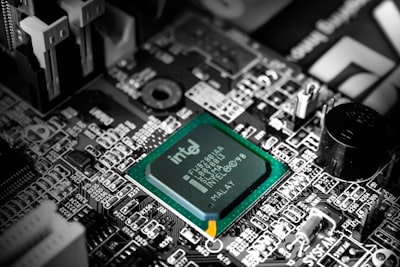
In a move that redefines enterprise network security, Intel and Fortinet have announced a strategic collaboration to co-develop and manufacture an ASIC (Application-Specific Integrated Circuit) for Fortinet's next-generation firewalls, using the advanced Intel 4 process node. This alliance not only underscores the importance of hardware customization for cybersecurity but also marks a milestone in how companies can optimize performance and energy efficiency for critical devices. In a landscape where threats evolve at lightning speed, having tailored security solutions becomes a fundamental competitive advantage. For companies like Q2BSTUDIO, specialized in custom software applications, this trend reinforces the need to integrate hardware and software cohesively, offering clients robust systems adapted to their specific needs.
Fortinet's ASIC, manufactured on Intel 4, represents a qualitative leap in packet processing capacity and deep traffic inspection. By offloading intensive tasks from the main CPU, the chip allows firewalls to handle massive data volumes without compromising latency, a critical requirement in hybrid and multi-cloud environments. The choice of Intel 4 is no coincidence: this node offers significant improvements in transistor density and energy consumption, resulting in more compact and sustainable devices. From an industry perspective, this collaboration demonstrates that innovation in semiconductors remains the driving force of digital transformation. Companies like Q2BSTUDIO, which work with cloud AWS/Azure, understand that perimeter security must evolve at the same pace as infrastructure, and this ASIC is a clear example of how hardware specialization can address the most demanding performance challenges.
Intel's decision to co-develop and manufacture for Fortinet responds to a broader strategy of becoming a trusted partner for cybersecurity solutions. Historically, firewalls relied on general-purpose processors, but the explosion of encrypted traffic and the complexity of current attacks demand a more granular response. With this ASIC, Fortinet can inspect every packet without degrading performance, allowing organizations to apply security policies uniformly across their networks, even in high-data-volume environments. This custom-hardware approach is especially relevant for sectors like finance, healthcare, and telecommunications, where data integrity is critical. It also reflects a growing trend toward integrated cybersecurity solutions, where artificial intelligence plays an increasingly important role. Q2BSTUDIO, for its part, offers consulting services in AI agents and automation, complementing these infrastructures with intelligent protection layers.
From a business perspective, the Intel-Fortinet alliance is a reminder that innovation does not happen in a vacuum. It requires close collaboration between chip manufacturers, software providers, and technology services companies. For Q2BSTUDIO, which develops AI and Business Intelligence solutions such as BI/Power BI, this type of advancement underscores the importance of having flexible and scalable platforms. The ability of ASIC-based firewalls to process complex rules in real time opens the door to new applications in anomaly detection and automated response, two areas where AI agents can make a difference. Moreover, integration with cloud services like AWS and Azure allows security policies to be synchronized across the organization, reducing the attack surface and improving visibility. In this context, companies seeking to maintain a proactive security posture should consider adopting specialized hardware technologies, along with custom software development that leverages all their capabilities.
The impact of this ASIC goes beyond individual firewalls: it affects the entire cybersecurity supply chain. Managed service providers (MSPs) can offer more powerful and cost-effective firewall solutions, while system integrators have the opportunity to design network architectures that maximize the new chip's performance. For end-user companies, the promise of faster and more efficient security reduces the risk of breaches and improves regulatory compliance. However, adopting these technologies also poses challenges: the need to upgrade existing infrastructures, train personnel, and ensure interoperability with already deployed security tools. This is where the role of a company like Q2BSTUDIO becomes essential, offering consulting services and custom application development that facilitate the transition to more secure and optimized environments.
On the horizon, a greater convergence between hardware and security software is envisioned. Artificial intelligence, and particularly AI agents, are starting to play a key role in automating responses and managing security events. ASICs like Fortinet's, designed with inference acceleration capabilities, could integrate machine learning models directly into the packet processing flow, enabling detection of unknown threats in real time. This evolution opens a range of possibilities for companies betting on innovation. Q2BSTUDIO, with its experience in artificial intelligence and process automation, is positioned to help its clients leverage these synergies, creating solutions that combine the best of custom hardware with the most advanced software.
Finally, it is worth noting that manufacturing this ASIC on Intel 4 also has geopolitical and technological sovereignty implications. At a time when semiconductor production has become a matter of national security, having a reliable supply chain with manufacturing capacity in the United States is a strategic advantage. Fortinet and Intel thus reinforce their commitment to local innovation and reducing external dependencies. For companies operating in regulated markets, having solutions manufactured on advanced nodes with guaranteed traceability is a differentiating factor. In this sense, the co-development of a firewall ASIC is not only a technical milestone but also an example of how collaboration between tech giants can drive security and global competitiveness. Q2BSTUDIO, as a technology partner, supports its clients in adopting these solutions, offering integration services, custom software development, and consulting in cloud, AI, and cybersecurity, always with the goal of transforming technology into real business value.