
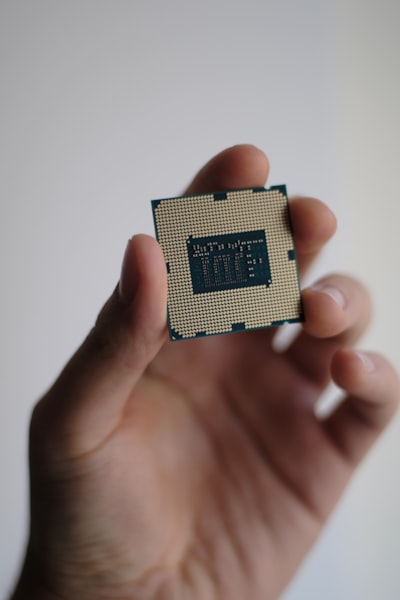
The cybersecurity hardware industry has found a key competitive advantage in custom processors, and Fortinet knows it well. The company recently announced that it will turn to Intel Foundry to manufacture its sixth-generation Security Processor (SP6), a move that reinforces Intel's bet on its foundry business and opens new possibilities in chip design for high-performance firewalls. This agreement is no coincidence: Fortinet has always favored custom ASICs over commodity hardware based on x86 or ARM, and with the SP6 it aims to take network security to the next level.
The SP6 is designed with dedicated accelerators for cryptographic and security operations, intended for modern hardware firewalls. Although specific specifications and production dates have not yet been revealed, it is expected to significantly outperform its predecessor, the SP5, launched in 2023 with support for layer 7 firewalling and IPsec VPN connectivity at speeds exceeding 30 Gbps. When advanced threat protection or SSL inspection was enabled, the SP5 maintained a respectable performance of 4.3 Gbps and 3.3 Gbps respectively. The SP6, manufactured on the Intel 4 node (a mature but not leading-edge process), promises significant optimizations in efficiency and scalability.
Intel has indicated that the chip could employ chiplet architecture and advanced packaging techniques, suggesting a disaggregated design that allows scaling performance without drastically increasing power consumption. This approach resembles modern data center processors, where separating functions across different chiplets improves flexibility. Moreover, the fact that the SP6 will be manufactured in a US plant strengthens supply chain security, a critical factor in a geopolitical context where dependence on Asian foundries like TSMC or Samsung can be a risk.
For Fortinet, this alliance with Intel Foundry not only guarantees stable supply but also gives it access to Intel's expertise in disaggregated semiconductor design. The SP6 will focus primarily on smaller devices, such as SD-WAN gateways, rather than large data center systems that use the NP and CP series. This aligns with Fortinet's strategy to offer optimized perimeter security solutions for distributed environments, increasingly demanded by companies migrating to the cloud or adopting hybrid models.
From a business perspective, this collaboration demonstrates how custom chip manufacturing can be a differentiator in the cybersecurity market. At Q2BSTUDIO, as a software and technology development company, we understand that hardware innovation must be accompanied by robust and adaptable software. Our custom software services help companies integrate security solutions into their infrastructures, whether through cloud applications, artificial intelligence, or process automation. The convergence between specialized hardware and intelligent software is key to protecting digital assets in a hyperconnected world.
Cybersecurity is no longer a luxury but a strategic necessity. Companies adopting ASIC-based firewalls like Fortinet's gain advantages in performance and latency, but they also need management and analysis tools to fully leverage those capabilities. This is where artificial intelligence and Business Intelligence come into play. For example, with BI/Power BI solutions, we can transform network traffic data into actionable insights, detecting attack patterns or bottlenecks. Similarly, deploying AI agents in the security layer can automate incident responses, reducing reaction time.
The announcement from Intel and Fortinet also highlights the importance of technological sovereignty. At a time when the semiconductor supply chain is subject to geopolitical tensions, having a domestic foundry like Intel Foundry provides peace of mind. The US government's $3 billion investment to establish a secure manufacturing enclave underscores this commitment. However, there is still a long way to go: the Intel 4 node is not the most advanced (18A surpasses it), but for network security applications, where reliability and long-term support are more important than the latest nanometer, it may be the right choice.
At Q2BSTUDIO, we work with companies looking to integrate cloud technologies such as AWS or Azure into their security environments. The cloud offers scalability but also new attack vectors. Our cloud AWS/Azure services allow deploying secure architectures that complement Fortinet hardware, ensuring protection spans from the perimeter to the application. Additionally, process automation through AI agents can manage security patches, firewall rule updates, or incident responses autonomously.
The collaboration between Intel Foundry and Fortinet is an example of how hardware specialization can make a difference in cybersecurity. However, for that advantage to translate into real protection, companies need a software ecosystem that includes artificial intelligence, data analytics, and automation. That is why at Q2BSTUDIO we offer comprehensive solutions: from custom software development to implementing AI agents that learn from traffic patterns and anticipate threats. The security of the future is not only built with silicon but with intelligent code.
In conclusion, Fortinet's SP6, manufactured by Intel Foundry, represents a milestone in the evolution of hardware firewalls. Although details are still to come, this alliance strengthens both companies' positions in an increasingly competitive market. For businesses looking to protect their data and applications, the combination of specialized hardware, secure cloud, and artificial intelligence is the winning formula. And at Q2BSTUDIO, we are ready to help build that multi-layered defense, with technologies ranging from custom software to AI agent-based automation.

