
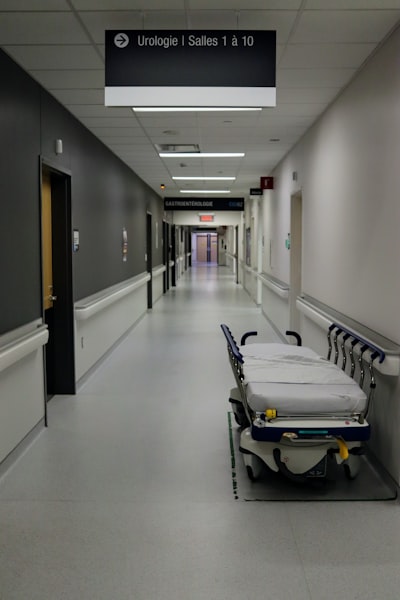
Emergency department (ED) overcrowding is a global issue that directly impacts the quality of care. One critical factor is boarding, where admitted patients remain in the ED while waiting for an inpatient bed. Traditionally, bed requests are made only after the formal admission decision, causing avoidable delays. This article proposes an innovative approach: proactive bed requests based on real-time predictions, supported by artificial intelligence and data analytics, as developed by Q2BSTUDIO in its custom software solutions.
The underlying problem is complex. Patients arrive at the ED with varying severity levels and flow patterns. When a patient needs hospitalization, the usual process involves the physician confirming admission, generating the order, and then contacting the inpatient unit to assign a bed. This gap can last hours, crowding the ED, delaying care for new patients, and worsening clinical outcomes. Medical literature has shown that prolonged boarding is associated with higher mortality, longer lengths of stay, and lower patient satisfaction.
However, the key to reducing these times is not just speeding up administrative processes but anticipating. What if the system could predict, before the physician confirms admission, that a patient has a high probability of being admitted and consequently request the bed in advance? This is precisely what recent research in ED management proposes, using machine learning models to estimate admission probability and time to disposition (discharge, transfer, or death).
Implementing a proactive bed request system requires a robust technological architecture. First, data from multiple sources must be integrated: electronic health records, triage systems, severity scores, inpatient bed occupancy, and historical patterns. On this data, predictive models are trained to generate two essential variables: the probability that a patient will be admitted (e.g., ≥80%) and the estimated time until the final decision. With that information, the system triggers a bed request at the optimal time, balancing the risk of requesting a bed that may not be used (bed idle time) against the benefit of reducing boarding.
This approach, known as 'proactive aggregate request policy,' has shown in simulations based on real data reductions of 30% to 70% in boarding time for admitted patients and 6% to 15% in total ED length of stay. Moreover, it generates only a modest increase in idle time for prepared beds, making it an efficient strategy for hospital managers.
From a business and technological perspective, deploying such solutions requires advanced capabilities in software development, artificial intelligence, and cloud computing. Q2BSTUDIO offers AI and machine learning services to build custom predictive models for healthcare environments. Additionally, its expertise in AWS and Azure cloud ensures the scalability and security needed to handle sensitive patient data, complying with regulations such as GDPR or HIPAA where applicable.
Cybersecurity is another fundamental pillar. A system that automatically requests beds must protect clinical data confidentiality and prevent unauthorized access. Q2BSTUDIO integrates security audits, end-to-end encryption, and role-based access controls, as detailed in its cybersecurity service.
Data analysis and visualization are equally important. Hospital managers need dashboards that show in real time predictions, active requests, waiting times, and bed occupancy. Q2BSTUDIO's Business Intelligence solutions, such as those based on Power BI, enable interactive dashboards that facilitate strategic decision-making. Likewise, AI agents can automate communication between the ED and inpatient units, freeing up clinical staff time.
A key aspect of this strategy is the choice of decision algorithm. Research shows that both simple heuristics (like the newsvendor approach) and advanced reinforcement learning methods can be effective, but with different performance profiles. The newsvendor heuristic offers an attractive trade-off between boarding reduction and bed idle time, while reinforcement learning produces smoother request patterns, useful when downstream process stability is a priority. The final choice depends on the hospital's objectives: maximum ED efficiency versus a more predictable flow for inpatient wards.
Implementing a proactive bed request system is not trivial. It requires a cultural shift among clinical teams, who must trust algorithmic predictions and accept that a bed can be reserved before medical confirmation. This demands collaboration among physicians, nurses, managers, and software developers. Q2BSTUDIO, with its focus on custom applications, can tailor algorithms to each center's specifics, integrate legacy systems, and ensure an intuitive user experience for clinical staff.
Another major challenge is managing bed idle time. If beds are requested too early, resources may be blocked that could be used for other patients. The model must be calibrated to minimize this effect, for instance by adjusting the admission probability threshold or the lead time. Simulations show that with proper calibration, the increase in idle time is minimal compared to the benefits obtained.
In terms of return on investment, the benefits are multiple. Reducing boarding improves care quality indicators, decreases patient and family complaints, and may even reduce mortality. Additionally, decongesting the ED allows faster care for new patients, increasing potential revenue (in fee-for-service systems) or reducing penalties for long wait times. Optimizing bed flow also avoids the need to hire additional staff or expand facilities, generating significant long-term savings.
From a technological perspective, Q2BSTUDIO's solution is built on a cloud-native architecture, using AWS services (such as SageMaker for ML models, Lambda for serverless functions, and DynamoDB for real-time storage) or Azure equivalents. This allows automatic scaling according to demand without hardware investments. Integration with hospital information systems (HIS) is done via secure RESTful APIs, facilitating interoperability.
Artificial intelligence is not only used for admission predictions but also for dynamic optimization of requests. For example, an AI agent can learn from past decisions and automatically adjust thresholds, adapting to seasonal changes or unforeseen events (like a flu epidemic). These agents, combined with BI dashboards, provide a comprehensive view of the hospital's status and recommend proactive actions.
In summary, proactive bed requests represent a real opportunity to transform ED management. With the support of technologies such as artificial intelligence, cloud computing, and data analytics, hospitals can anticipate demand and reduce delays that affect patients and professionals alike. Companies like Q2BSTUDIO offer the necessary know-how to design, implement, and maintain these systems, from consulting to production deployment. The combination of simple heuristics and machine learning also allows choosing the strategy that best fits each center's priorities, whether efficiency, stability, or a balance between both.
For hospital managers looking to improve operational indicators without large physical infrastructure investments, this data-driven, custom software approach is a promising path. The key is to take the first step: collect the right data, develop predictive models, and, above all, have a technology partner capable of integrating all pieces securely and scalably.
