
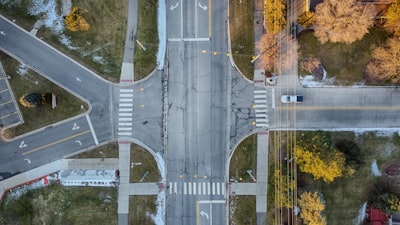
The increasing complexity of urban traffic demands smarter and more proactive monitoring systems. In this context, PRISA (Proactive LiDAR-based Intersection Safety Architecture) emerges as an innovative framework that combines infrastructure LiDAR sensors with edge processing to anticipate conflicts at intersections, protecting vehicles and vulnerable road users such as pedestrians and cyclists. Unlike traditional camera-based solutions, which depend on lighting conditions and may compromise privacy, PRISA uses LiDAR sensors that operate robustly in low light and do not capture biometric data, offering continuous and privacy-respecting observation.
The framework consists of a sensing and perception layer and a plug-and-play risk assessment module. This module can curate site-specific training data from accumulated perception outputs without manual annotation to train a trajectory prediction model. Once trained, it deploys the model for continuous motion forecasting and dual surrogate safety evaluation, using Time-to-Collision (TTC) for longitudinal conflicts and Predicted Post-Encroachment Time (PPET) for crossing and VRU-involved interactions. This dual metric allows detecting risk situations before they become accidents.
Evaluated on the public R-LiViT dataset and deployed on an NVIDIA Jetson AGX Thor at a live signalized intersection in Chattanooga, Tennessee, PRISA demonstrates an end-to-end latency of only 194 ms in PPET-based assessment over a 2.4-second predictive horizon, while keeping TTC-based detection and perception within real-time constraints. These results confirm its practical feasibility for proactive multi-agent intersection safety monitoring.
From a business and technology perspective, PRISA is a clear example of how integrating advanced sensors, artificial intelligence, and edge computing can transform road safety. At Q2BSTUDIO, a company specialized in software and technology development, we see this approach as a replicable model to create customized solutions addressing similar challenges. Our experience in custom software allows us to adapt architectures like PRISA to specific environments, whether optimizing the prediction model or integrating data with existing traffic management systems.
Artificial intelligence is the heart of this system: trajectory prediction models and risk evaluation algorithms require careful training and efficient deployment. At Q2BSTUDIO we offer advanced AI services that can help cities build similar systems, from data collection to deployment on edge hardware like NVIDIA Jetson. Additionally, cybersecurity is a fundamental pillar in these distributed environments, as sensors and processing modules must be protected against unauthorized access and manipulation. Our team can integrate security measures into every layer of the system.
Another critical aspect is cloud data management. Although PRISA processes at the edge, historical perception data and trained models can be stored and managed on AWS or Azure cloud platforms, enabling scalability and post-analysis. With our expertise in Business Intelligence (Power BI), we can build dashboards that visualize real-time safety metrics like TTC and PPET, facilitating decision-making for traffic managers. Likewise, AI agents can automate alerts and responses, such as reducing recommended speed or changing traffic light cycles in the face of imminent risk.
Process automation is another area where Q2BSTUDIO adds value. The data curation and model training pipeline in PRISA can be optimized with automation tools, reducing manual intervention and accelerating adaptation to new intersections. Our automation services allow creating pipelines from LiDAR data ingestion to safety report generation.
In conclusion, PRISA is not just an academic breakthrough but a practical and replicable model for improving urban road safety. At Q2BSTUDIO we have the technical knowledge and development capacity to implement similar solutions, adapting them to each client's needs. Whether through custom software, cloud integration, artificial intelligence, or cybersecurity, we can help cities make the leap toward safer and more efficient intersections. The future of mobility lies in proactive systems like PRISA, and we are ready to build it.
