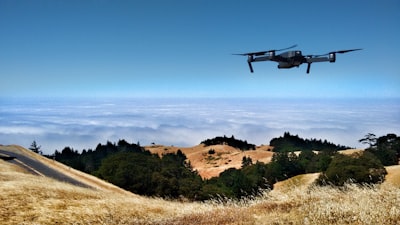
Early and accurate drone detection has become a priority for critical infrastructure, airports, and mass events. While radar and radio frequency systems are effective, they have limitations in urban environments or with interference. This is where acoustic imaging emerges: a technology that uses microphone arrays to capture the sound field and generate energy maps revealing the position of a sound source, such as a drone. An innovative approach inspired by semantic segmentation with U-Net is redefining how we process these maps to achieve precise and robust localization.
The traditional acoustic source localization (SSL) method relies on regressing discrete direction-of-arrival (DoA) angles. However, the reference article introduces a paradigm shift: turning the problem into spherical semantic segmentation. Instead of predicting a point, the U-Net model segments beamformed energy maps (azimuth and elevation) into regions of active sound presence. The process starts with delay-and-sum beamforming on signals from a custom 24-microphone array, synchronized with the drone's GPS telemetry. This generates 2D maps representing acoustic energy in each direction. On these maps, a modified U-Net, trained with frequency-domain representations and optimized with the Tversky loss function to handle class imbalance, learns to identify spatially distributed source regions.
One major advantage is its independence from the microphone array. Since the network operates on beamformed energy maps, it can adapt to different configurations with minimal changes. This is crucial for commercial applications where clients already own specific hardware. Additionally, post-processing computes centroids over activated regions, providing robust DoA estimates even in noisy environments. Experiments with a DJI Air 3 in open fields, synchronizing 360° video and flight logs, show that the U-Net generalizes well across different dates and locations, improving angular precision over classical methods.
From a business perspective, this technology opens the door to advanced security solutions. At Q2BSTUDIO, as a software and technology development company, we see enormous potential in integrating artificial intelligence models into drone detection systems. Combining acoustic segmentation with cloud platforms like AWS or Azure enables real-time processing of large data volumes, while cybersecurity ensures critical data is not intercepted. Furthermore, creating custom software applications for alert visualization and management, integrated with Power BI dashboards, facilitates data-driven decision-making. AI agents can even automate responses, such as activating countermeasures or notifying security.
The approach is not limited to drones: validated also on benchmarks like DCASE 2019 TAU for multi-class sound event localization and detection (SELD), it demonstrates versatility that can be applied to industrial surveillance, wildlife monitoring, or smart city systems. The combination of beamforming and U-Net segmentation represents a new paradigm for spatial audio understanding, overcoming the limitations of traditional methods.
For organizations looking to implement acoustic detection solutions, the key is having a technology partner that understands both hardware and software. Q2BSTUDIO offers consulting and development services in AI, cloud, cybersecurity, and Business Intelligence, helping companies of all sizes build robust and scalable systems. Drone detection with acoustic imaging is not science fiction: it is a technical reality that, with the right architecture, can protect us from unauthorized aerial threats.