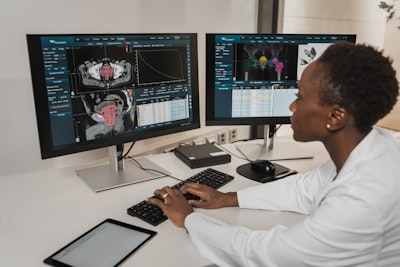
At the intersection of artificial intelligence and resource optimization, the GraphDx framework represents a qualitative leap in sequential diagnosis. This system, based on collaborative agents and knowledge graphs, solves a common paradox in large language models (LLMs): they possess immense medical knowledge but lack the ability to reason systematically under cost constraints, often leading to excessive testing. GraphDx addresses this with two core innovations: automated construction of Medical Diagnosis Knowledge Graphs (MDKGs) that quantify typicality, action-centric topology, and dual-objective attributes (diagnostic relevance and cost sensitivity), and a three-agent system — Perception, Reasoning, and Decision — where the Reasoning Agent performs deterministic scoring and cost-aware planning over the graph. Results on MedQA and MIMIC-IV benchmarks, using backbones like DeepSeek-V3, Kimi-k2, and Llama-3.3, show an improvement in diagnostic success rates from 50–68% to 79–93%, alongside a 20–54% reduction in test costs. This approach is not only more accurate but also interpretable and economical.
For technology companies like Q2BSTUDIO, specializing in custom software and AI solutions, GraphDx illustrates how to translate advanced medical diagnostic principles into business environments. In cybersecurity, a multi-agent system could analyze threat patterns, prioritize alerts based on mitigation cost, and decide which penetration tests to run, minimizing expenditure without sacrificing detection. Similarly, in Business Intelligence (BI), a reasoning agent over a graph of indicators can recommend which analyses to launch in Power BI for maximum informational return with minimal computational cost. The key lies in modeling domain knowledge (threats, KPIs, industrial failures) in a graph with cost and relevance attributes, and then letting a specialized agent plan the most efficient sequence of actions.
Cloud infrastructure, whether AWS or Azure, is the ideal support for deploying these frameworks. Q2BSTUDIO offers cloud services that allow scaling agents, managing knowledge graphs, and ensuring data security. Additionally, the company develops tailored cybersecurity systems, integrating AI agents that monitor and respond to incidents with a cost-aware approach. For example, an intrusion detection system can prioritize high-risk alerts while postponing low-risk ones, saving hours of security team work. This 'cost versus benefit' logic is exactly what GraphDx applies to medical diagnosis, but it is transferable to any domain where sequential decisions must be made with limited resources.
Another direct application field is industrial process automation. Imagine a manufacturing plant with multiple sensors monitoring temperature, vibration, and pressure. Instead of continuously analyzing all data, a reasoning agent over a known failure graph can decide which sensor to activate first based on test cost and anomaly detection probability. This reduces sensor wear and energy consumption while maintaining diagnostic quality. Q2BSTUDIO, with its experience in cloud AWS/Azure, can implement these multi-agent systems in production environments, ensuring low latency and high availability.
The success of GraphDx also highlights the importance of interpretability. Unlike black-box models, knowledge graphs allow doctors (or engineers) to understand why the system recommends certain tests. In the business world, this transparency is crucial for adopting AI-based decisions with confidence. BI/Power BI tools benefit from this clarity: by showing not only the result of an analysis but the decision tree that led to it, business leaders can validate the logic and adjust parameters according to their cost priorities. Q2BSTUDIO integrates these capabilities into its developments, offering solutions that combine knowledge graphs with interactive dashboards.
Adapting the GraphDx framework to other sectors requires customization work that only a company with extensive experience in custom software can handle. Q2BSTUDIO not only understands the underlying technology but also masters agile methodologies and integration with legacy systems. From building the knowledge graph to deploying agents in production, the entire lifecycle can be managed by a multidisciplinary team that includes experts in AI, cloud, and cybersecurity. Results speak for themselves: success rates above 90% in complex diagnoses and significant resource savings.
In conclusion, GraphDx is not just an academic advance; it is a roadmap for building intelligent, cost-aware, and highly effective multi-agent systems. Companies that want to lead the next wave of automation and artificial intelligence should consider this approach, and count on a partner like Q2BSTUDIO that offers AI agents, robust cloud infrastructure, and integrated cybersecurity. The future of diagnosis — medical, industrial, or business — is sequential, collaborative, and optimized. And with the right tools, that future is already here.