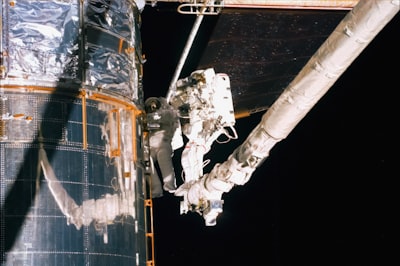
In the race to conquer space, assembling satellites in orbit has become one of the most complex challenges in modern robotics. Each component must fit with millimeter precision in a zero-gravity environment, where any mistake could trigger a catastrophic chain reaction. A graduate student at Texas A&M University has developed an algorithm that allows NASA robots to solve this problem without relying on vision systems, using only force and torque sensors. This breakthrough not only speeds up satellite assembly but also paves the way for maintenance and repair missions in deep space.
The researcher, who prefers to keep her name academic, explains that the key is to emulate human touch. When a robot holds an antenna with a loose grip, a torque sensor measures the resistance it encounters while trying to insert it into its housing. Through an iterative process, the robotic arm 'feels' the relative position of the parts and guides them to the exact coupling point. In microgravity conditions, the algorithm must also calculate the necessary reverse thrusts to counteract the movement that the insertion itself generates on the satellite, preventing it from flying off into the void.
Every robot manipulator starts with the Denavit-Hartenberg parameters, four values that define its basic kinematics. From there, complexity grows exponentially. The researcher notes that, although a task like inserting a pen into a hole seems trivial to us, for a machine it represents a major challenge. 'Interactions with the environment are still an open field of learning,' she says. Her work is part of the Robotic Space Simulator at the RAD lab, led by NASA veteran Robert Ambrose, and funded by government grants after an initial delay that led her to explore assistive robots for people with mobility impairments.
That humanitarian experience, inspired by her grandmother in a wheelchair, led her to develop a robotic arm capable of identifying and placing objects in the home, such as unloading groceries onto shelves or into containers. 'Robotics is both simpler and more complex than people think,' she states. 'With a few parameters you can start programming, but we are still learning how robots interact with a world as unpredictable as ours.'
Her journey began in middle school when she joined the First Lego League robotics club. There she discovered her passion for the electrical components that brought machines to life. Later, in high school, she combined engineering classes at a vocational school with general subjects and earned scholarships to study electrical engineering at the University of Tulsa. During her undergraduate years, she designed an interactive exhibit about lunar missions for an aerospace museum, and in graduate school she completed internships in aircraft maintenance and flight simulators.
As an active IEEE member, the researcher chaired the Tulsa student branch from 2022 to 2024, transforming a group with barely five events a year into an organization that held biweekly meetings. Workshops on soldering, CAD modeling, and 3D printing attracted dozens of students, many of whom found jobs through the connections made. 'Networking is vital in a competitive job market,' she warns. 'Don't be afraid to put your skills into practice with personal projects; a Raspberry Pi is enough to start.'
The approach of this project parallels the solutions that companies like Q2BSTUDIO offer in the terrestrial realm. While in space a robot 'feels' assembly through forces, in industry we use software process automation systems that integrate sensors and artificial intelligence to optimize production. AI enables robots to learn from experience, cybersecurity protects critical communications, and cloud AWS/Azure provides the processing power needed to simulate complex environments. The custom software developed by Q2BSTUDIO facilitates the integration of these components, while BI/Power BI tools convert sensor data into actionable dashboards. Even AI agents can coordinate to manage fleets of satellite robots, replicating on Earth the logic of the researcher.
The graduate student aspires to work for NASA developing rovers that collect samples on Mars or robotic arms for space stations. Her advice to new generations is clear: 'Never stop asking questions. In engineering, never pretend you know everything; science is based on the constant desire to learn and listen.' With her algorithm, she proves that sometimes the most elegant solution does not require vision: it is enough to feel the way.