
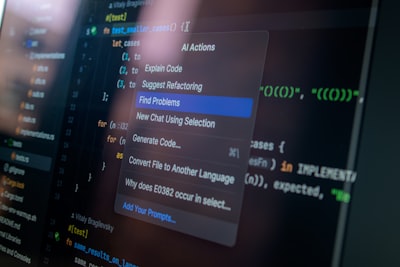
In recent years, artificial intelligence has moved from a futuristic promise to a practical tool for software development. A recent experiment demonstrates how far collaboration between a human developer and a frontier language model like DeepSeek can go: the creation of two fully functional desktop search applications, completely offline and with a radical focus on privacy. The project not only validated the ability of AI to generate complex code but also revealed valuable lessons on how to structure work when integrating intelligent assistants into the software lifecycle.
Imagine a real scenario: a lawyer needs to locate a contract signed years ago among hundreds of thousands of local documents; a video designer searches for transcript fragments in interviews without uploading anything to the cloud. To cover both profiles, two applications were developed: Desktop Search Light, aimed at office professionals requiring fast search and deep metadata in formats like PDF, DOCX, or XLSX; and Desktop Search Pro, a more advanced version incorporating natural language processing, audio and video transcription, and semantic search, all running 100% locally. The result is portable executables that require no admin rights and can run from a USB drive.
The key to success was not the amount of code generated—over 30,000 lines organized in 52 files—but the collaboration methodology. Instead of asking DeepSeek to write entire blocks without control, a custom software approach was applied with highly specific prompts. For example, when a dependency error arose, the model was fed dependency diagrams and structure reports so it could identify exactly which scripts needed changes, without touching unrelated functions. This discipline avoided typical generative model hallucinations and maintained a clean architecture with no circular dependencies.
A highlight is the creation of internal support tools designed together with the AI. An AST-based code aggregator scans the project separating the GUI layer from the indexer, extracts classes and methods with signatures, generates call graphs, and produces detailed structure reports. A SQLite database documentor examines the schema, calculates quality metrics, and generates HTML and Markdown documentation. An automated test harness traverses every menu in the interface, opens dialogs, persists settings, and reports errors. All this is orchestrated by a script that cleans previous artifacts, resets the database, indexes test files, generates documentation, and executes multiple test suites, dumping results into logs that feed back into DeepSeek for later analysis.
The separation between the PySide6 frontend and the indexer backend follows an extractor factory pattern, handling dozens of formats with robust metadata. Automated tests achieved 100% success in indexing samples in Light mode, with clear performance metrics. This level of quality would not have been achieved without constant human supervision and DeepSeek's ability to act as architect, reviewer, and technical writer simultaneously.
From a business perspective, the experiment shows that AI does not replace the developer but empowers them. Companies like Q2BSTUDIO apply similar principles in their projects for AI, cloud AWS/Azure, cybersecurity, and BI/Power BI, integrating intelligent agents into automation and data analysis processes. The ability to create custom software accelerates when combining human expertise with well-orchestrated AI tools.
One of the most valuable lessons was that the greatest return came not from generating application code directly, but from building meta-tools: the aggregator, the documentor, and the tester. These allowed the model itself to analyze its own work and suggest improvements iteratively. In a context where software process automation is increasingly critical, this approach lays the foundation for a new development paradigm.
Challenges were not minor. Model hallucinations, though reduced with strict prompts, required constant validation. Generated patterns sometimes followed suboptimal paths, forcing refactoring in certain sections. However, the combination of automated tests, analysis tools, and DeepSeek's ability to process large logs enabled quick detection and correction of these issues.
In conclusion, this six-month project demonstrates that a frontier LLM like DeepSeek can act as a genuine development partner when provided with structured context and accompanied by traditional software engineering. The result is not magic code generated by AI, but a complete, tested, documented, and packaged product delivered at an accelerated pace. In 2025, mastering the orchestration of AI tools along with classic practices is what will set the most productive teams apart. And companies like Q2BSTUDIO are already applying these lessons to offer AI agent solutions, intelligent automation, and cloud-native applications that transform how organizations manage their information.

