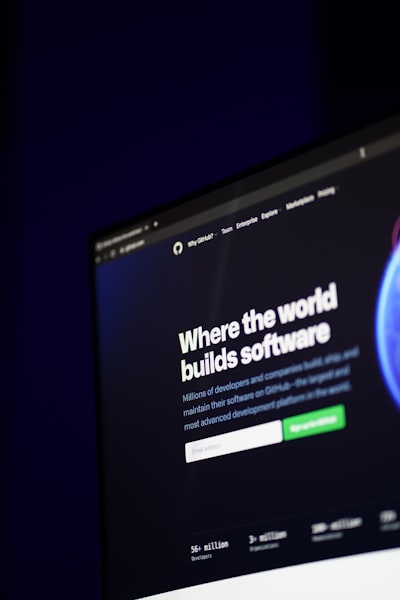
GitHub is undoubtedly the code social network par excellence. Millions of developers use it daily to host repositories, collaborate on open source projects, and showcase their technical activity. However, when a recruiter, a potential client, or a tech partner reviews your profile, they find a list of commits, forks, and stars. Context is missing. The story behind each line of code is absent: why did you choose that architecture? How did you solve a scalability problem? What impact did your work have on the business? The truth is that GitHub alone is not enough to show everything you are capable of as a developer.
A GitHub profile tells what you have programmed, but not how you have thought. Experienced recruiters look for soft skills, technical leadership, product vision, and expertise in areas beyond programming languages. For instance, knowing how to design and implement custom software applications that solve real business problems demonstrates that you understand requirements, deadlines, and teamwork. That is not reflected in a simple repository.
Moreover, today's technology ecosystem demands mastery of multiple platforms. Working with cloud AWS/Azure is no longer optional—it is a standard. Showing that you can deploy scalable infrastructure, manage instances, configure load balancers, or integrate serverless services adds a layer of professionalism that no repository alone can convey. A portfolio that includes cloud use cases proves you are ready for real production environments.
Artificial intelligence (AI) is redefining software development. AI agents, machine learning models, and intelligent automation solutions are increasingly in demand. If you have participated in projects that integrate AI—for example, a recommendation system, a chatbot with natural language processing, or a predictive analytics model—that positions you far above the average. And you don't need to be a data scientist: understanding how to consume and deploy AI models is a differentiating skill. Q2BSTUDIO, for instance, incorporates AI into its solutions to optimize processes and deliver added value to clients.
We cannot forget cybersecurity. More and more companies seek developers who can write secure code, perform penetration testing, and apply data protection best practices. Having experience in cybersecurity, whether in pentesting or implementing access controls, is a huge plus. A developer who understands risks and knows how to mitigate them is an invaluable asset. Even small projects can benefit from security awareness, and showing it in your portfolio demonstrates technical maturity.
Business intelligence (BI) and tools like Power BI are another important front. The ability to transform data into visual and actionable information is increasingly cross-functional. A developer who can connect data sources, create dashboards, and extract insights is better prepared for data-driven decision-making roles. Adding a BI project to your portfolio—for example, a performance metrics dashboard for an application—connects your technical work with business impact.
So, how do you build a complete portfolio that complements your GitHub? The answer lies in getting involved in real projects, with real clients, where you can show the full lifecycle: from requirements gathering to deployment and monitoring. Collaborating with a software development and technology company like Q2BSTUDIO gives you that opportunity. There you will work on custom solutions, cloud integration, AI implementation, cybersecurity, and BI, all documented with measurable results. That experience becomes your best calling card.
Also, do not underestimate the power of a well-structured narrative. Instead of scattered links, organize your portfolio by project: each with a summary, technologies used, your specific role, challenges faced, and achievements. Include architecture diagrams, dashboard screenshots, or demo links. Such a portfolio speaks for itself and makes recruiters call you without needing any explanation.
Finally, remember that community also matters. Participating in events, writing technical articles, or contributing to open source projects complements your profile. But the core must be tangible evidence that you can take an idea to production with quality, security, and scalability. GitHub is the showcase of your code; your portfolio must be the showcase of your career.
In summary, GitHub remains a fundamental tool, but it is not enough. To stand out in a competitive market you need to demonstrate real impact, mastery of modern technologies (cloud, AI, cybersecurity, BI), and teamwork ability. Investing in building a solid portfolio, supported by companies like Q2BSTUDIO that offer real projects in these areas, will make the difference between being just another developer and being the developer everyone wants to hire.