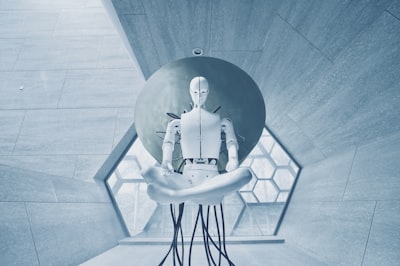
Embodied artificial intelligence, also known as embodied AI, represents a qualitative leap compared to traditional AI models that operate exclusively in digital environments. While a chatbot or text generator can process information and deliver sophisticated responses, it lacks the ability to physically interact with the real world. Embodied AI closes that gap by integrating advanced algorithms with a physical body — whether a robotic arm, a drone, an autonomous vehicle, or a humanoid — enabling the machine to perceive, reason, and act in its surroundings.
To understand what embodied AI is, it helps to break down its operation into the classic sense-think-act loop. First, the sensory unit captures data from the environment using cameras, LiDAR sensors, microphones, and other devices. Then an AI model processes that information — recognizing objects, understanding verbal instructions, or assessing risks — and generates a decision. Finally, the system executes physical actions through actuators: moving an arm, turning a wheel, adjusting a gripper. This cycle repeats continuously, allowing dynamic adaptation to unexpected changes.
Recent advances in vision-language-action (VLA) models have been key to the rise of embodied AI. These models directly integrate visual perception and natural language understanding with the generation of motor commands, eliminating the need for multiple separate modules. As a result, robots developed by companies like NVIDIA, Google DeepMind, Figure, or Tesla can learn new tasks with a flexibility that was previously impossible. In fact, we are already hearing about the 'ChatGPT moment' for physical AI — an inflection point that is accelerating investments in the sector.
One of the keys to this progress is large-scale simulation training. Platforms such as NVIDIA Isaac allow systems to practice millions of iterations in virtual environments before being deployed on real hardware. This reduces costs, speeds up development, and minimizes risks. Simulation is also essential for testing extreme scenarios that would be difficult or dangerous to replicate in the physical world.
Embodied AI has a wide range of applications. In logistics and warehouses, robots equipped with this technology can autonomously sort packages, transport goods, or perform inventory checks. In manufacturing, robotic arms with advanced perception can assemble parts with millimeter precision while adapting to variations. In healthcare, robotic assistants help in surgeries or patient mobilization. And in the home environment, although still in early stages, we envision smart vacuum cleaners, companion robots, or assistants for the elderly.
From a business perspective, adopting embodied AI represents a profound strategic shift. Companies that integrate these solutions will be able to automate complex physical processes, improve workplace safety by delegating dangerous tasks to machines, and increase operational efficiency. However, implementation is not trivial: it requires a combination of advanced artificial intelligence, robust control systems, cybersecurity to protect data and communications, and a reliable cloud infrastructure like AWS or Azure for processing and storage.
This is where companies like Q2BSTUDIO bring value. With a solid track record in developing software process automation and custom applications, Q2BSTUDIO offers specialized consulting and development in AI, cloud integration, cybersecurity, and business intelligence. For any company looking to make the leap into intelligent robotics, having a partner that masters both the digital and physical layers is essential. For example, designing an embodied AI system for a warehouse involves not only training VLA models but also managing connectivity with sensors, ensuring data security through cybersecurity protocols, and analyzing performance indicators in real time using tools like Power BI.
The trend is clear: embodied AI will transform the way we interact with the physical environment, much like chatbots changed digital interaction. Companies already exploring this territory — from startups to tech giants — are laying the groundwork for the next industrial revolution. For those wishing to ride this wave, the recommendation is to start with well-defined pilot projects, leverage simulation to minimize risks, and surround themselves with experts in software development, cloud, and AI.
In summary, embodied AI is not just an extension of existing artificial intelligence; it is a new paradigm where knowledge translates into physical action. Its evolution will depend on the convergence of more capable hardware, smarter algorithms, and a software ecosystem that integrates all pieces. And in that ecosystem, expertise in custom software development and cloud platforms will be as decisive as the AI models themselves.