
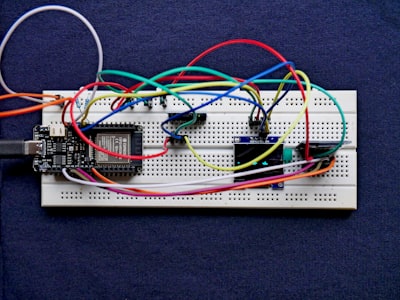
These are fascinating times for artificial intelligence development on low-cost devices. Recently, the technical community has been amazed by the feat of running a language model with 28.9 million parameters on an ESP32-S3 microcontroller that costs around $10. This achievement not only demonstrates the growing efficiency of lightweight models but also opens the door to countless edge computing applications previously unthinkable due to memory and processing limitations. To understand the real impact, it is worth analyzing how this capability transforms sectors such as industrial automation, home automation, wearables, and, of course, custom software development.
The ESP32-S3 is an Espressif SoC that combines two Xtensa LX7 cores, WiFi and BLE connectivity, and a neural network acceleration unit (Tensor Processing Unit). With only 512 KB of internal SRAM and support for external PSRAM, getting a model of almost 30 million parameters to run in real time is a major technical challenge. The engineers behind this project employed quantization (INT8), pruning, and knowledge distillation techniques, reducing the original model to a size that fits in available memory without sacrificing acceptable accuracy. The result is a basic conversational assistant capable of answering questions, generating short text, and executing local commands, all without relying on the cloud.
This breakthrough has direct implications for companies seeking local, fast, and affordable AI solutions. For example, in environments where network latency or data privacy are critical — such as medical devices, surveillance systems, or embedded voice assistants — having an offline model avoids cybersecurity risks and reduces bandwidth costs. This is where Q2BSTUDIO's expertise in artificial intelligence becomes invaluable: the company helps integrate these lightweight models into custom applications, optimizing them for specific hardware and ensuring efficient and secure inference.
However, running such a model on a microcontroller is not just a lab trick. It poses a paradigm shift in how we understand AI deployment. Traditionally, large models are hosted on cloud servers (AWS, Azure) and end devices act as simple clients. With this approach, the device itself processes intelligence, reducing cloud dependency and enabling millisecond responses. For companies handling sensitive data, this is a competitive advantage. Furthermore, by combining this capability with cloud AWS/Azure services, a hybrid architecture can be created: the local model handles fast, recurring tasks while the cloud handles updates, training, and complex queries. Q2BSTUDIO advises on designing these solutions, balancing cost, performance, and security.
From a business perspective, democratizing AI at the $10 hardware level has profound consequences. Small startups and IoT device manufacturers can now incorporate natural language processing, image classification, or anomaly detection without investing in expensive servers. This drives the creation of custom applications that were previously only within reach of large companies. For example, a smart thermostat could understand complex voice commands without sending recordings to the internet, preserving user privacy. Or an industrial sensor could analyze vibrations and predict failures in real time using a lightweight regression model. The limit is imagination and the ability to integrate the software correctly.
Now, for these systems to work robustly, cybersecurity cannot be an afterthought. Every device running local AI is a potential attack point. Models can be extracted, poisoned, or manipulated if not properly protected. It is crucial to apply obfuscation, firmware encryption, and secure updates. Q2BSTUDIO offers cybersecurity and pentesting services to assess vulnerabilities in embedded systems, ensuring that edge intelligence does not become a risk. Additionally, when integrating these devices with cloud platforms, end-to-end security is essential, and the company addresses it holistically.
Another key aspect is managing the data generated by these models. Although inference is local, the results often feed Business Intelligence (BI) systems for strategic decisions. For example, a sensor park with AI models can send aggregated metrics to a Power BI dashboard, allowing visualization of energy consumption trends or predictive maintenance. Q2BSTUDIO specializes in BI solutions with Power BI, connecting embedded data sources with business indicators so executives have actionable information without needing to be AI experts.
Finally, the potential of autonomous AI agents running on low-cost hardware cannot be ignored. An AI agent could be a personal assistant embedded in a bracelet that remembers appointments, filters emails, or controls home devices. These agents need lightweight models capable of reasoning and planning. The ESP32-S3 with 28.9 million parameters is a perfect candidate for prototyping, then scaling to more powerful chips. Companies like Q2BSTUDIO help design the architecture of these agents, from base model selection to implementing feedback loops and over-the-air updates.
In summary, running a 28.9 million parameter model on a $10 ESP32-S3 is not just a technical curiosity; it is a milestone announcing a new era of ubiquitous intelligence. For businesses, it represents an opportunity to innovate with custom applications that are more secure and efficient. The key is having technology partners like Q2BSTUDIO, who bring expertise in AI, cloud, cybersecurity, BI, and agent development, ensuring every solution not only works but generates real value. The future is no longer in the cloud: it is at the edge, and it costs less than we imagined.


