
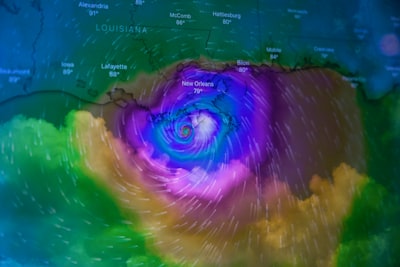
Predicting spatial events, such as tropical cyclone genesis or earthquake locations, represents one of the most complex challenges in data science and applied artificial intelligence. These phenomena not only have a devastating economic impact —with losses that can reach billions of dollars per event— but also require precise uncertainty quantification so that evacuation, insurance, or infrastructure decisions are effective. In this context, conformal prediction has emerged as a powerful statistical tool, capable of generating calibrated prediction sets that guarantee predefined coverage levels. However, its direct application to spatial data presents limitations, especially when events are represented as point clouds on a geographic plane. This is where a recent innovation comes in: manifold-constrained conformal prediction, an approach that combines empirical measure theory with Wasserstein distance (or its sliced version) to build prediction regions that respect the underlying geometry of the data.
The method starts from a simple idea: instead of predicting a single point or a one-dimensional interval, it works with empirical measures that represent spatial distributions. For example, for a forming cyclone, we care not only about its most likely location but about the entire distribution of possible trajectories and genesis points. Sliced Wasserstein distance allows comparing these distributions efficiently, even in high dimensions, and offers a metric with geometric properties that facilitate coverage control. From there, a prediction set is built based on the distribution of the distance between the prediction and training observations. But there is a problem: those sets can become excessively large or even unrepresentative if they are not restricted to the actual space where the data lives. To solve this, a manifold constraint is introduced, which limits the support of the prediction set to the neighborhood of the training data. This yields a lower coverage bound and, through an adaptive selection criterion, the gap can be made practically negligible.
From a computational standpoint, the resulting set has no closed-form analytic expression. To handle it in practice, a flow-based sampling procedure is used, allowing the set to be represented as an ensemble of predictions. In this way, the end user —a meteorologist, a seismic engineer, or an emergency manager— obtains not a single output but a set of plausible scenarios with statistical guarantees. Numerical experiments on synthetic data, tropical cyclone genesis, and earthquake occurrences show that the method achieves near-nominal coverage, with significantly lower energy distance and manifold distance than those obtained via highest predictive density regions (HDR) or standard generative models. This makes it a robust alternative for early warning systems and risk analysis.
Now, how can a software development company like Q2BSTUDIO leverage these techniques to offer high-value solutions? The answer lies in the vertical integration of artificial intelligence with cloud infrastructures and data methodologies. Building a system that implements manifold-constrained conformal prediction requires, first, custom software that manages georeferenced data streams, training of base models (such as neural networks or Gaussian processes), and execution of the sampling algorithm. Q2BSTUDIO has experience in developing personalized applications that scale on cloud environments like AWS or Azure, ensuring high availability and real-time processing. Furthermore, the inclusion of AI agents —for example, assistants that continuously monitor new observations and update prediction sets— allows automating much of the alert cycle. In a typical scenario, a client from the insurance or civil protection sector could have a dashboard based on Power BI showing dynamic risk maps, where each region is associated with a conformal confidence interval. The combination of these capabilities —cloud AWS/Azure, AI agents, BI/Power BI, and cybersecurity— is exactly the kind of comprehensive solution that Q2BSTUDIO can design and implement.
From a business perspective, the adoption of manifold-constrained conformal prediction opens new opportunities in sectors such as energy (solar storm prediction), logistics (transport routes under adverse weather conditions), or finance (branch location planning after disasters). The current limitations of existing methods —such as lack of calibration or overly large sets— are overcome with this approach, allowing organizations to make more informed decisions. However, technical implementation requires a multidisciplinary team that understands both advanced statistics and software engineering. This is where Q2BSTUDIO adds value, offering not only custom software development but also consulting in cloud architecture, AI model integration, and cybersecurity strategies to protect sensitive geographic risk data.
In conclusion, manifold-constrained conformal prediction represents a significant advance in uncertainty quantification for spatial events, with direct applications in natural disaster management. Its practical implementation, however, goes beyond theory: it demands robust, scalable, and secure software solutions. Companies like Q2BSTUDIO are in an ideal position to turn these innovations into operational tools, combining artificial intelligence, cloud computing, and business intelligence. The future of catastrophe prediction lies in calibrated prediction sets, and the technology is already ready to build them.

