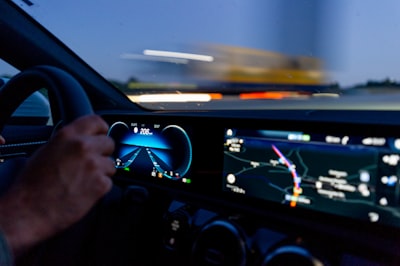
Autonomous driving represents one of the most complex challenges in artificial intelligence and robotics. For a self-driving vehicle to navigate safely and efficiently, it must accurately predict the movements of pedestrians, cyclists, and other vehicles. This task, known as trajectory prediction, goes far beyond estimating a simple route; it involves understanding intentions, social dynamics, and the implicit rules of traffic. Purely data-driven approaches often fail when confronted with unseen situations during training. Therefore, incorporating structural biases—such as those offered by small-world networks—is emerging as a promising solution. This article explores the SWIFT (Small-World Interaction Framework for Trajectory prediction) framework and analyzes how principles like this can be integrated into real-world technology solutions, with the help of companies like Q2BSTUDIO, which develops custom software applications for the automotive sector and beyond.
Imagine a busy intersection. An autonomous vehicle must predict whether the car on the left will yield, if a pedestrian will cross unexpectedly, or if a cyclist will turn without signaling. The interactions are complex, not only local but also global, because a change in one lane can affect traffic hundreds of meters ahead. This is where small-world networks make a difference. This concept, taken from network theory, describes systems where most nodes are not direct neighbors but can be reached via few hops, generating a mix of local connections and global shortcuts. Applied to traffic, it allows modeling both close interactions (such as following the vehicle ahead) and distant dependencies (like a traffic light affecting an entire artery). SWIFT integrates this structure into a flow regime encoder that adapts the interaction to the traffic state across the scene, improving predictive accuracy.
SWIFT's strength lies in its ability to generalize under distribution shifts. For example, a model trained in a European city with narrow streets should work on a U.S. highway without massive retraining. This is made possible by the multi-relational graph module, which explicitly encodes direct and higher-order relationships between agents. It does not just know that two cars are close, but understands whether one is following another, if there is a potential crossing, or if a pedestrian is on a collision course. This semantic richness, combined with the efficiency of small-world networks, allows SWIFT to outperform purely attention-based or pooling-based models, as demonstrated on public datasets such as nuScenes, MoCAD, and NGSIM.
But beyond academic results, how can a technology company apply these concepts? At Q2BSTUDIO, we understand that innovation in autonomous driving requires a robust and scalable software ecosystem. Trajectory prediction is not an isolated module; it needs to integrate with perception, planning, and control systems. That is why we offer AI services ranging from implementing graph neural networks to optimizing models for real-time inference. Our teams work with cloud technologies like AWS and Azure to manage the massive volume of data generated by sensors, as well as cybersecurity practices to protect vehicle-to-everything communications. Additionally, big data analysis using BI and Power BI tools allows manufacturers to understand traffic patterns and validate models before deploying them in real fleets.
The key to making a framework like SWIFT production-ready is custom software engineering. Having a good algorithm is not enough; it must be implemented with computational efficiency, low latency, and updatability. This is where the development of custom applications comes into play, adapting to each client's specific architecture, whether an embedded system in a vehicle or a cloud simulation platform. From integrating LiDAR and camera sensors to generating digital twins, every component must work synchronously. SWIFT, by relying on small-world network principles, offers a sparse attention scheme that reduces computational load, which is essential for meeting real-time requirements.
Another crucial aspect is cybersecurity. An autonomous vehicle is essentially a computer system on wheels, and any vulnerability can have serious consequences. By encoding multi-relational relationships, SWIFT can also help detect anomalies: for example, an agent behaving unexpectedly could signal a cyberattack or sensor failure. Our experience in cybersecurity allows us to audit both the model and the supporting cloud infrastructure, ensuring predictions are reliable and data is protected. Furthermore, process automation, another key service of Q2BSTUDIO, streamlines the training and continuous deployment pipeline, using AI agents to monitor model performance in production and retrain when necessary.
Cloud plays a central role in the large-scale viability of SWIFT. Autonomous driving datasets can reach petabytes, and training complex models requires GPU clusters. Cloud solutions from AWS and Azure provide the necessary elasticity, but also pose cost and latency challenges. At Q2BSTUDIO, we design hybrid architectures that optimize data flow: heavy training is done in the cloud using spot instances, while inference runs on the vehicle edge or nearby servers. Our cloud AWS/Azure services include virtual network configurations, load balancing, and optimized storage for unstructured data like LiDAR point clouds.
The implications of SWIFT are not limited to autonomous driving. Any system that requires motion prediction in dynamic environments—such as collaborative robots, delivery drones, or surveillance systems—can benefit from this interaction structure. In fact, the small-world concept is transversal across many disciplines. At Q2BSTUDIO, we have applied similar principles in process automation projects where multiple agents (robots, sensors, ERP systems) need to coordinate their actions with a global view. The ability to model local and global dependencies with few parameters is a huge competitive advantage.
Finally, it is worth reflecting on the future of artificial intelligence in the transportation sector. Models like SWIFT demonstrate that combining structural knowledge with deep learning not only improves accuracy but also makes systems more robust, interpretable, and efficient. In this context, collaboration between academic research and software development companies like Q2BSTUDIO is essential. We provide the engineering needed to turn a promising framework into a functional product: from API integration, through implementing AI agents that manage the model lifecycle, to deployment on scalable and secure cloud infrastructures. The road to fully autonomous driving is long, but with structurally sound tools and the right technology ecosystem, we are increasingly closer to making it a reality.