
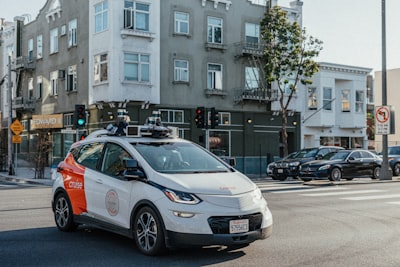
Autonomous driving and advanced driver-assistance systems (ADAS) face a critical challenge: anticipating lane-change maneuvers of surrounding vehicles. It is not merely about predicting a future position, but understanding the underlying intention and how it translates into a safe trajectory. Traditional approaches often focus on a single target vehicle or generate positional predictions without explicitly linking them to a maneuver. In this context, the DSiGAT (Dynamic Scene Graph Attention Framework) emerges as an innovative solution that integrates intention and trajectory prediction for all relevant vehicles in a local traffic scene, modeling dynamic interactions through a spatio-temporal graph.
DSiGAT represents the scene as a time-varying interaction graph, where each vehicle is a node and spatial and kinematic relationships are encoded as explicit edges. Through temporal attention-based message passing, the model captures inter-vehicle dependencies and pre-maneuver cues. An intention-guided decoder associates each predicted maneuver with its corresponding future motion, while a scene-level consistency objective enforces compatibility among multi-vehicle predictions. Results on the NGSIM and highD datasets show significant improvements, with intention accuracies above 90% and trajectory RMSE reductions of up to 52.94% compared to the strongest baselines. These numbers reflect not only higher individual precision but also global scene coherence, reducing inter-agent collision rates and joint displacement errors.
From a business and technical perspective, models like DSiGAT open the door to concrete applications in the automotive and smart mobility sectors. At Q2BSTUDIO, a company specialized in software and technology development, we see in this type of architecture an opportunity to build robust prediction systems that can be integrated into commercial fleets, autonomous vehicles, or traffic management platforms. Implementing a dynamic graph attention model requires a solid foundation of custom software applications that connect the model to real sensors, control systems, and real-time databases. This is where custom software development plays a key role, from data orchestration to displaying predictions in operational dashboards.
To scale these solutions, cloud computing (AWS, Azure) provides the necessary infrastructure to train complex models, deploy low-latency inference services, and store large volumes of traffic data. For example, a cloud architecture can host multiple DSiGAT instances that process traffic scenes from a city in parallel, feeding early warning systems or Business Intelligence (Power BI) dashboards that analyze lane-change patterns and risky behaviors. Additionally, cybersecurity becomes critical when these models are part of driving decisions; both sensor data and the models themselves must be protected against adversarial attacks. Q2BSTUDIO offers pentesting and auditing services to ensure system integrity.
Another emerging concept is that of AI agents. DSiGAT can be considered a component within a broader autonomous agent that makes planning decisions. These agents need to interact with other modules (perception, localization, control) and must be able to learn and adapt. Integrating graph attention models with intelligent agent architectures allows, for instance, an autonomous vehicle not only to predict another vehicle’s lane change but also to plan its own maneuver accordingly, improving road safety.
At Q2BSTUDIO, we have worked on projects that combine AI with custom applications for the transportation sector, using cloud platforms and generating BI dashboards that monitor fleet efficiency in real time. The ability to predict intentions and trajectories as DSiGAT does fits perfectly into this ecosystem. To learn more about how we implement artificial intelligence solutions in business environments, you can visit our intelligence art page. Also, if your company needs to develop a custom traffic prediction system or any other software solution, our capabilities in cross-platform software application development are at your disposal.
DSiGAT’s results demonstrate that it is possible to achieve over 90% accuracy in intention prediction with improved scene coherence. However, bringing this model to production involves additional challenges: optimizing performance on embedded hardware, adapting to different driving styles, and ensuring robustness under adverse weather conditions. At Q2BSTUDIO, we address these challenges through a multidisciplinary approach that combines AI research with high-quality software engineering. Our team can design and implement complete solutions ranging from data collection to cloud deployment, including integration with cybersecurity systems and creation of Power BI dashboards.
In conclusion, lane-change intention and trajectory prediction is a rapidly evolving field where frameworks like DSiGAT mark a turning point. But technology alone is not enough: it needs to be packaged into custom applications, scaled with cloud AWS/Azure, protected with cybersecurity, analyzed with BI, and orchestrated by AI agents. At Q2BSTUDIO, we are prepared to face this transformation and help mobility, logistics, and automotive companies implement these advances safely and efficiently.

