
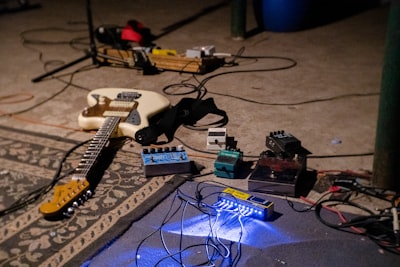
Artificial intelligence has opened new frontiers in music production, and one of the most fascinating examples is the transformation of clean guitar to effects using generative models. Clean2FX, a recent study and demo, tackles precisely this challenge: given a raw guitar audio and a desired effect label, the system must synthesize the processed signal while preserving the original musical content. Although the initial focus is on electric guitar, the technical and commercial implications extend to any domain requiring conditioned audio transformation.
The work uses training pairs built from real recordings from the EGFxSet set, combining clean and processed chords, melodies, and timelines to enable controlled comparisons between effects. Four neural approaches are evaluated under a common spectrogram-based transformation framework: two variational autoencoders (VAE) and two U-Net models, differing in whether they operate on linear or log-magnitude representations. Metrics include linear-magnitude spectrogram MSE and Fréchet Audio Distance (FAD). Results show that U-Nets significantly outperform VAEs, with distortion effects showing the most improvement, while delay and reverb effects exhibit weaker FAD gains despite substantial spectral-error reductions. A conditioning sensitivity diagnostic confirms that the best model responds to effect labels and does not collapse into a single transformation.
From a technical perspective, this breakthrough represents a milestone in AI application development for audio. However, beyond the lab, the key question is how to bring this technology to real products. This is where expertise in software engineering, cloud integration, and cybersecurity becomes critical. Implementing a system like Clean2FX in a recording studio or streaming platform requires not only accurate models but also scalable infrastructure, protection of sensitive data (such as original tracks), and a smooth user experience. Companies with experience in custom software development and cloud solutions can transform these prototypes into robust commercial tools.
The current ecosystem demands that any AI solution integrate with cloud services like AWS or Azure to handle real-time or batch processing. Model orchestration, dataset storage, and low-latency inference are challenges that only a well-designed cloud architecture can solve. Cybersecurity also plays a fundamental role: copyright and intellectual property of original recordings must be protected, especially when training models on protected content. Security audits, data encryption in transit and at rest, and access controls are essential in any professional deployment.
Another relevant aspect is data analytics. A tool like Clean2FX generates huge amounts of metadata: which effects are applied, with what parameters, which users use them, etc. This is where Business Intelligence (BI) comes in to extract usage patterns, optimize models, and provide personalized recommendations. With Power BI or similar solutions, studios can visualize trends, compare effect performance, and make data-driven decisions to improve the musician's experience.
Finally, the natural evolution of these systems is toward autonomous AI agents. Imagine an assistant that, upon listening to a clean recording, automatically suggests a chain of effects, adjusts parameters in real time, and learns from user preferences. That is the next step, and it requires combining audio processing, reinforcement learning, and conversational interface design. Companies already investing in AI agents for business processes can apply that same know-how to the musical domain.
At Q2BSTUDIO, we understand that technological innovation only has an impact when it materializes into reliable and secure products. Our team combines expertise in artificial intelligence, cross-platform application development, cloud computing (AWS and Azure), cybersecurity, BI with Power BI, and intelligent agent creation. If your company aims to bring an idea like Clean2FX to market, from model conception to production deployment, we can support you at every stage. Clean guitar-to-effects transformation is just one example of what AI can do; the possibilities are endless when you have the right technology partner.

