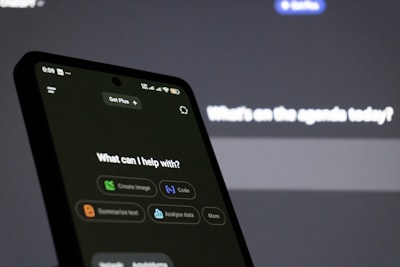
A few days ago, I had the opportunity to thoroughly test ChatGPT's new live voice feature—the one that promises a conversation almost indistinguishable from a human being. After several hours of use, the experience left me with mixed feelings: on one hand, the fluency and naturalness are impressive; on the other, small mechanical glitches still creep in, betraying the machine. But what is truly interesting is not just whether it feels human, but what this means for businesses and software development today.
ChatGPT's live voice is not limited to reading text aloud. It is a multimodal system that listens, processes, researches in real time, and responds with intonation, pauses, and even interjections. To achieve this naturalness, the model combines low-latency speech recognition, a language engine capable of maintaining conversational context, and neural speech synthesis that modulates emotion and rhythm—all running in near real-time. Behind it lies a massive cloud infrastructure, likely supported by services like AWS or Azure, that allow scaling these processes without sacrificing speed.
From a technical perspective, the main challenge is simultaneity. While the user speaks, the system is already anticipating responses, performing internet searches, and updating context. This requires an architecture of asynchronous AI agents and optimized processing queues. It is not a simple chatbot with TTS; it is an ecosystem of orchestrated components. And this is where companies like Q2BSTUDIO bring real value: not just integrating the OpenAI API, but designing custom software applications that manage security, privacy, personalization, and regulatory compliance for these conversational flows.
I tested the system in several scenarios: asking for restaurant recommendations while walking, simulating a job interview, and even debating philosophy. In the first case, the live voice was almost magical: the assistant listened to my request, searched for options in real time, asked clarifying questions ('Do you prefer Italian or Asian?'), and adjusted the response naturally. Only a couple of times did I notice a slight lag when changing topics or when background noise affected capture. In the philosophical debate, coherence held up, but the intonation sometimes felt too flat, as if reading an essay. That’s where you see the model optimizes for informative responses, not emotional persuasion.
The question that arises is: how can businesses leverage this technology without falling into the trap of superficiality? The answer lies in understanding that ChatGPT's live voice is not a final product, but a component. Integrating it into a corporate system involves solving cybersecurity issues (voice data protection, biometric authentication, stream encryption), cloud scalability, and connectivity with legacy systems. At Q2BSTUDIO we work precisely on those layers: from deploying AI agents in conversational interfaces to creating Business Intelligence dashboards with Power BI that monitor the quality of those interactions.
Another key aspect is personalization. ChatGPT's live voice does not yet allow cloning specific voices or fine-tuning tone to a brand, but evolution points in that direction. Companies that want to stand out will need to build custom applications on top of these models, incorporating their own knowledge base, compliance rules, and approval workflows. Here, the cloud plays a fundamental role: cloud services like AWS and Azure provide the necessary components (Lambda, S3, Cognitive Services) to build robust and secure architectures.
We cannot forget cybersecurity. Every voice conversation may contain sensitive data. Without proper design, an exposed API or poor log management could lead to data leaks. That’s why, when developing live voice solutions, it is essential to perform security audits and pentesting. At Q2BSTUDIO we integrate these practices into the development cycle, ensuring innovation does not compromise protection.
In short, testing ChatGPT's live voice has confirmed that we are facing a qualitative leap. The technology is no longer a promise; it is raw material for building new products. But the difference between an impressive demo and a reliable production system lies in the engineering that supports it. That is why, if a company wants to explore these capabilities, it is advisable to work with a technology partner who understands both AI and custom software development, cloud, security, and analytics. Only then can we move from a 'almost human' conversation to a truly transformative experience.